

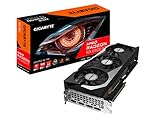
- Top Pick: GIGABYTE PowerColor Red Devil AMD Radeon™ RX 6900 XT Gaming Graphics Card with 16GB GDDR6 Memory, Powered by AMD RDNA™ 2, Raytracing, PCI Express 4.0, HDMI 2.1, AMD Infinity Cache
- Best Value: GIGABYTE Radeon RX 6900 XT Gaming OC 16G Graphics Card, WINDFORCE 3X Cooling System, 16GB 256-bit GDDR6, GV-R69XTGAMING OC-16GD Video Card
- Premium Choice: GIGABYTE GeForce RTX 4070 Super WINDFORCE OC 12G Graphics Card, 3X WINDFORCE Fans, 12GB 192-bit GDDR6X, GV-N407SWF3OC-12GD Video Card
The RTX 4070 Super is the better choice for most gamers, because it roughly matches the RX 6900 XT in rasterized games while winning big in ray tracing, supporting DLSS Frame Generation and using about 80 W less power, whereas the RX 6900 XT only makes sense as a used bargain for raster-focused players who value its 16 GB of VRAM. If a used RX 6900 XT costs well under a used RTX 4070 Super and you rarely enable ray tracing, it still delivers excellent 1440p frame rates per dollar.
As an Amazon Associate we earn from qualifying purchases at no extra cost to you.



How These Two Ended Up in the Same Bracket
The RX 6900 XT was AMD’s RDNA 2 flagship at launch in October 2020, priced at $999 with 5,120 stream processors, 16 GB of GDDR6 on a 256-bit bus and a 128 MB Infinity Cache. Three years later, NVIDIA’s RTX 4070 Super landed at $599 in January 2024 with 7,168 Ada Lovelace CUDA cores, 12 GB of GDDR6X and a large 48 MB L2 cache. Thanks to architectural gains and higher clocks, the mid-range Ada refresh caught the old flagship in raster and passed it in everything else. Both cards are previous-generation in 2026, succeeded by the RX 9070 series and RTX 50 cards.
Specification Comparison
| Spec | RX 6900 XT | RTX 4070 Super |
|---|---|---|
| Architecture | RDNA 2.0 | Ada Lovelace |
| Release date | 28 October 2020 | 8 January 2024 |
| Launch MSRP | $999 | $599 |
| Shaders | 5,120 | 7,168 |
| Boost clock | 2,250 MHz | 2,475 MHz |
| Process | 7 nm | 5 nm |
| TDP | 300 W | 220 W |
| Memory | 16 GB GDDR6 | 12 GB GDDR6X |
| Bus / bandwidth | 256-bit / 512.0 GB/s | 192-bit / 504.2 GB/s |
| Cache | 4 MB L2 + 128 MB L3 | 48 MB L2 |
| Interface | PCIe 4.0 x16 | PCIe 4.0 x16 |
| Power connectors | 2x 8-pin | 1x 16-pin |
| Length / width | 267 mm / 3-slot | 267 mm / 2-slot |
| Outputs | 1x HDMI 2.1, 2x DisplayPort 1.4a, 1x USB Type-C | 1x HDMI 2.1, 3x DisplayPort 1.4a |
Rasterization: Essentially a Tie
Benchmark compilations generally place these two cards within about 5% of each other in rasterized games at 1440p, with the result depending on the game list. Some datasets show the RX 6900 XT marginally ahead at 1440p in AMD-friendly titles, while others give the RTX 4070 Super a small lead, particularly at 1080p where Ada’s cache and clocks help. TechPowerUp’s RTX 4070 Super review frames the card as a maxed-out 1440p performer, and the RX 6900 XT sits in that same performance class.
- 1080p: both are often CPU-limited; high-refresh 1080p is easy for either.
- 1440p: typically an approximate 80-140 FPS range at high or ultra in modern AAA games for both cards.
- 4K: both handle 4K at high settings in many games, often in roughly a 45-80 FPS band natively, and upscaling helps in heavier titles.
Expect these ranges to shift with settings, CPU, driver version and game patches.
Ray Tracing: The 4070 Super Pulls Away
Ray tracing is where the comparison stops being close. RDNA 2’s ray accelerators are first-generation hardware, and despite the RX 6900 XT having more of them on paper, Ada’s RT cores do far more work per unit. Published game tests, such as Tech4Gamers’ results for the plain RTX 4070 against the 6900 XT, show the NVIDIA card leading by around 30-50% in ray-traced titles like Cyberpunk 2077 and Spider-Man: Miles Morales, and the 4070 Super is faster still. In path-traced games the RX 6900 XT is generally not a practical option.
Upscaling and Frame Generation
The RTX 4070 Super supports DLSS 4 Super Resolution and Ray Reconstruction with the transformer model, plus DLSS Frame Generation. Multi Frame Generation stays exclusive to RTX 50 cards. The RX 6900 XT runs FSR 2, FSR 3 with frame generation in supported games, and AMD Fluid Motion Frames in the driver; AMD’s ML-based FSR 4 is officially reserved for RDNA 4 GPUs. DLSS at Quality settings generally looks cleaner than FSR 3, so in games supporting both, the 4070 Super can often run a lower internal resolution for similar image quality. That effectively turns a raster tie into a practical NVIDIA lead whenever upscaling is used.
VRAM: 16 GB Versus 12 GB
The RX 6900 XT’s 16 GB is its main long-term advantage. In 2026, 12 GB is adequate for 1440p in nearly every game, but 4K with maximum textures and ray tracing can approach the limit in a handful of titles. For texture mods, high-resolution packs or light local AI experiments, the extra 4 GB gives more breathing room.
| Workload | RX 6900 XT | RTX 4070 Super |
|---|---|---|
| 1440p ultra raster | No VRAM concerns | No VRAM concerns |
| 4K ultra textures | Comfortable | Occasionally tight |
| 1440p with heavy RT | Memory fine, RT speed weak | Strong |
| Modded games | Better headroom | Adequate |
Power Draw, PSU and Case Fit
Size the power supply as GPU TDP plus CPU plus about 150 W:
- RX 6900 XT: 300 W + 125 W + 150 W = 575 W, so a quality 650-750 W unit is appropriate. RDNA 2 high-end cards can spike briefly above their rating.
- RTX 4070 Super: 220 W + 125 W + 150 W = 495 W, so a quality 600-650 W unit is plenty.
The 80 W gap shows up as noticeably less heat in the case. Gaming three hours a day for a year, that is roughly 88 kWh, or about $13 per year at $0.15 per kWh, so efficiency matters more for noise and thermals than for the power bill.
Both reference cards are 267 mm long, but the RX 6900 XT reference cooler is a three-slot design, and partner cards are often longer and thicker. The 4070 Super Founders Edition is a two-slot card with a 16-pin connector; many partner models use a single 8-pin. The RX 6900 XT needs two 8-pin plugs.
Value per Frame
At launch MSRP and treating raster performance as equal (100 each), the RX 6900 XT cost $9.99 per performance point and the RTX 4070 Super $5.99. On the used market in 2026, the RX 6900 XT usually trades around $300-$380, while a used RTX 4070 Super is typically about $450-$520. That makes the 6900 XT roughly $3.00-$3.80 per point against $4.50-$5.20 for the 4070 Super in pure raster terms. The NVIDIA card’s extra cost buys ray tracing performance, better upscaling, frame generation, lower power and a longer full-driver-support runway, since AMD moved RDNA 2 into a maintenance driver track in 2025.
Buying a Used RX 6900 XT
Many RX 6900 XT cards spent time in mining rigs. Ask about usage history, check hotspot temperatures under load (a large gap between edge and hotspot temperatures can indicate dried thermal paste), and test for fan noise. Partner models vary widely in length and thickness compared with the 267 mm reference card, so confirm dimensions before purchase.
Decision Guide
| Scenario | Pick |
|---|---|
| 1440p raster gaming, lowest cost | RX 6900 XT (used) |
| Ray tracing, path tracing, DLSS | RTX 4070 Super |
| 4K with upscaling | RTX 4070 Super |
| Heavy texture mods | RX 6900 XT |
| Compact case or 650 W PSU | RTX 4070 Super |
| Buying new with warranty in 2026 | Consider RX 9070 or RTX 5070 instead |
Frequently Asked Questions
Is the RX 6900 XT faster than the RTX 4070 Super?
In rasterized games they are roughly equal, usually within about 5% depending on the game list and resolution. With ray tracing enabled, the RTX 4070 Super is much faster, often by 30% or more.
Does the RX 6900 XT support FSR 4?
No, not officially. FSR 4 requires an RDNA 4 Radeon RX 9000 card. The RX 6900 XT supports FSR 3 frame generation in compatible games and AMD Fluid Motion Frames.
What power supply is needed for an RX 6900 XT?
A quality 650-750 W unit with two 8-pin PCIe connectors is recommended. Factory-overclocked partner cards can draw more than the 300 W reference rating.
Is 12 GB on the RTX 4070 Super a problem?
Not for 1440p gaming in 2026. At 4K with maximum textures and ray tracing, a few games approach the limit, and dropping texture quality one notch usually resolves it.
Should an RX 6900 XT owner switch to an RTX 4070 Super?
Only for ray tracing, DLSS or lower power draw. The raster gain is negligible, so owners wanting a real upgrade should look at an RX 9070 XT, RTX 5070 Ti or faster.
Which card handles 4K better?
In pure raster at 4K they are close, and the RX 6900 XT’s 16 GB helps in texture-heavy games. With upscaling enabled, the RTX 4070 Super usually pulls ahead because DLSS holds image quality better at lower internal resolutions. For 4K with ray tracing, the NVIDIA card is the clear choice.
Ready to decide? Our #1 pick for 2026 is the Architecture.
Live price & availability on Amazon.












