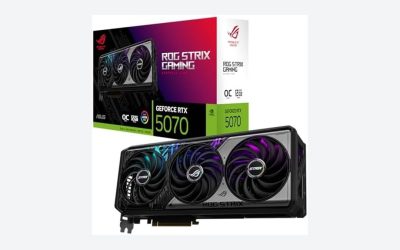
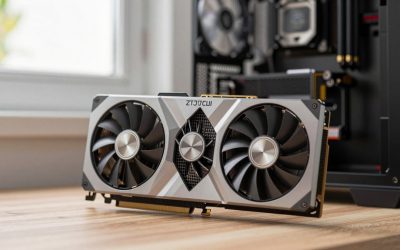
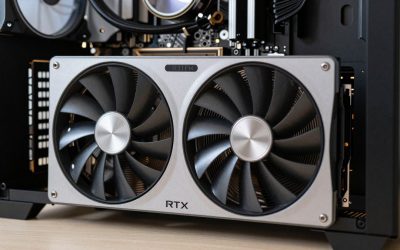
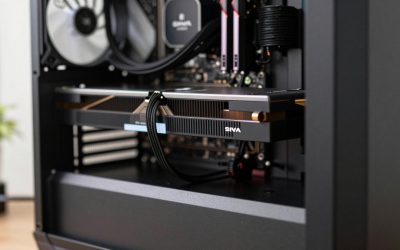
- Top Pick: Gigabyte Radeon RX 7800 XT Gaming OC 16G Graphics Card, 3X WINDFORCE Fans 16GB 256-bit GDDR6, GV-R78XTGAMING OC-16GD Video Card
- Best Value: PowerColor Fighter AMD Radeon RX 7800 XT 16GB GDDR6 Graphics Card
- Premium Choice: GIGABYTE Radeon RX 7600 XT Gaming OC 16G Graphics Card, 3X WINDFORCE Fans 16GB 128-bit GDDR6, GV-R76XTGAMING OC-16GD Video Card (Renewed)
The RX 7800 XT is far faster, roughly 55 to 75 percent ahead of the RX 7600 XT at 1440p, and is the right buy for 1440p gaming; the newer RX 7600 XT is a lower-tier 1080p card, not an upgrade, and only makes sense for buyers on a tighter budget or with a smaller power supply who still want 16 GB of VRAM. Both cards carry 16 GB, but that is where the similarity ends.
The confusion comes from the release order. The RX 7600 XT launched in January 2024, five months after the RX 7800 XT, so it looks like the newer product. In reality it is an RX 7600 with doubled memory and higher clocks, built on a smaller 6 nm RDNA 3 chip, while the 7800 XT uses AMD’s larger chiplet-based Navi 32 design with nearly twice the shaders and more than twice the memory bandwidth.
As an Amazon Associate we earn from qualifying purchases at no extra cost to you.


Where the Hardware Differs
| Specification | RX 7800 XT | RX 7600 XT |
|---|---|---|
| Architecture | RDNA 3.0 | RDNA 3.0 |
| Release date | 25 August 2023 | 8 January 2024 |
| Launch MSRP | $499 | $329 |
| Stream processors | 3840 | 2048 |
| Boost clock | 2430 MHz | 2755 MHz |
| Process | 5 nm | 6 nm |
| TDP | 263 W | 190 W |
| Memory | 16 GB GDDR6 | 16 GB GDDR6 |
| Memory bus | 256-bit | 128-bit |
| Bandwidth | 624.1 GB/s | 288.0 GB/s |
| L2 / L3 cache | 4 MB / 64 MB | 2 MB / 32 MB |
| Interface | PCIe 4.0 x16 | PCIe 4.0 x8 |
| Power connectors | 2x 8-pin | 1x 8-pin |
| Length / width | 267 mm / 2-slot | 204 mm / 2-slot |
| Outputs | 1x HDMI 2.1a, 3x DP 2.1 | 1x HDMI 2.1a, 3x DP 2.1 |
Matching VRAM capacity is the only headline spec the two share. The 7800 XT has 88 percent more stream processors, double the bus width, double the Infinity Cache and over twice the bandwidth.
Performance Gap in Real Games
Review data and benchmark aggregates show a wide gap. Per-game 1440p results commonly put the RX 7800 XT around 60 to 75 percent ahead, and broad aggregates land as low as about 45 percent, so a realistic overall range is roughly 55 to 75 percent at 1440p. Reviews of the 7600 XT, including TechPowerUp’s and Hardware Unboxed’s, found it only around 5 to 10 percent faster than the plain 8 GB RX 7600 on average, with larger gains only in games that overflow 8 GB. That places it a full performance class below the 7800 XT.
Approximate expectations, which vary with settings, CPU and game patch:
- 1080p high: the 7600 XT usually runs current AAA games around 60 to 90 fps; the 7800 XT is often well past 100 fps and limited by the CPU in lighter titles.
- 1440p high/ultra: the 7800 XT typically sits in the 70 to 110 fps range; the 7600 XT often falls to 40 to 65 fps and benefits from FSR.
- 4K: the 7800 XT can handle many games with upscaling; the 7600 XT is not suited to 4K in modern AAA releases.
Ray tracing
Both use the same RDNA 3 ray accelerators, so the 7800 XT’s lead in ray tracing is proportional to its larger GPU and typically similar to or greater than its raster lead. The 7600 XT is not a practical ray tracing card beyond light effects at 1080p with upscaling; the 7800 XT can manage moderate RT at 1440p with FSR.
Upscaling and frame generation
Feature support is identical: FSR 3.1 upscaling and frame generation, plus driver-level AMD Fluid Motion Frames. FSR 4 launched for RDNA 4 cards only. Because the 7600 XT has a lower base frame rate, it leans on upscaling more heavily, and FSR 3.1’s image quality weakens at lower internal resolutions.
Same 16 GB, Different Usefulness
The 7600 XT’s 16 GB is its main selling point, and it genuinely helps in games that exceed 8 GB at 1080p high textures. A rough VRAM guide:
- 1080p high: 8 to 10 GB covers most games; 16 GB removes any concern.
- 1440p ultra: 12 to 16 GB is ideal, but the GPU needs enough horsepower to use those settings.
- 4K: 16 GB is comfortable for texture budgets.
The catch is that the 7600 XT often lacks the GPU power to run settings that actually need 16 GB at playable frame rates, and its 128-bit bus limits how quickly that memory can be fed. The 7800 XT pairs the same capacity with enough compute and bandwidth to use it at 1440p ultra.
Price-to-Performance Breakdown
Using launch MSRPs with the 7600 XT at 100 points and the 7800 XT at about 165 (middle of the 1440p range):
- RX 7600 XT: $329 / 100 = $3.29 per point.
- RX 7800 XT: $499 / 165 = about $3.02 per point.
Despite costing $170 more at launch, the 7800 XT delivered better performance per dollar at 1440p. At 1080p, where CPU limits narrow the gap, the 7600 XT’s value improves, but the 7800 XT still offers the far better experience. On the used market, the 7600 XT usually sells around $200 to $250 and the 7800 XT around $350 to $430.
Stepping up later
Buyers sometimes choose the 7600 XT planning to upgrade in a year or two. That path tends to cost more overall than buying the 7800 XT up front, because resale value on entry-level cards drops quickly and the second purchase needs to be a full tier higher to feel worthwhile. If 1440p is the end goal, buying the stronger card once is usually the cheaper route. If the monitor will stay at 1080p for the life of the card, the 7600 XT’s lower price and power draw become much easier to justify, and its 16 GB of memory protects against texture-related stutter in future releases.
PSU, Connectors and Case Fit
The 7600 XT’s lower power draw and smaller size are its practical advantages. PSU sizing with GPU TDP plus CPU plus about 150 W headroom:
- RX 7800 XT + 105 W CPU: 263 + 105 + 150 = 518 W, so a quality 600 to 650 W unit is recommended.
- RX 7600 XT + 105 W CPU: 190 + 105 + 150 = 445 W, so a good 500 to 550 W unit is enough.
The 7800 XT needs two 8-pin cables, the 7600 XT one. At a 204 mm reference length, the 7600 XT is noticeably shorter than the 7800 XT’s 267 mm, and partner 7800 XT cards often grow to around 300 mm and 2.5 slots. The 7600 XT’s PCIe 4.0 x8 link matters little on PCIe 4.0 boards, and its 16 GB buffer reduces the risk of hitting the bus on PCIe 3.0 systems.
Who Each Card Is For
| Budget and resolution | Pick |
|---|---|
| 1080p, around $300, 500 W PSU | RX 7600 XT |
| 1080p high refresh in AAA games | RX 7800 XT |
| 1440p at high/ultra settings | RX 7800 XT |
| Entry 4K with upscaling | RX 7800 XT |
| Compact mini-ITX build | RX 7600 XT |
| Already own an RX 7800 XT | Keep it; the 7600 XT is a downgrade |
Budget buyers looking at the 7600 XT today should also compare the RX 9060 XT 16GB, which offers RDNA 4 ray tracing and FSR 4 in the same price class. For 1440p, the 7800 XT remains a strong card, while the RX 9070 is the current-generation step up.
Frequently Asked Questions
Is the RX 7600 XT better than the RX 7800 XT because it is newer?
No. The RX 7600 XT launched later but is a lower-tier card, and the RX 7800 XT is roughly 55 to 75 percent faster at 1440p according to review data and benchmark aggregates. Moving from a 7800 XT to a 7600 XT would be a significant downgrade.
Why does the RX 7600 XT have 16 GB of VRAM?
AMD doubled the memory of the RX 7600 to address games that exceed 8 GB at higher texture settings. The extra memory improves frame pacing in those titles. However, the GPU itself is the same class as the RX 7600, so overall performance gains are modest.
Can the RX 7600 XT run 1440p?
Yes, at medium to high settings or with FSR upscaling it handles many games at 1440p. Demanding new releases often drop below 60 fps at high settings. It is best suited to 1080p.
What power supply does each card need?
A quality 600 to 650 W power supply is recommended for the RX 7800 XT, which uses two 8-pin connectors. The RX 7600 XT runs comfortably on a good 500 to 550 W unit with one 8-pin connector. Exact needs depend on the CPU.
Is the RX 7800 XT worth the extra cost over the RX 7600 XT?
For 1440p gaming, yes, because its performance lead outweighs its price premium and it offered better performance per dollar at launch MSRPs. For strictly 1080p gaming on a budget, the 7600 XT is adequate. The decision depends mainly on target resolution.