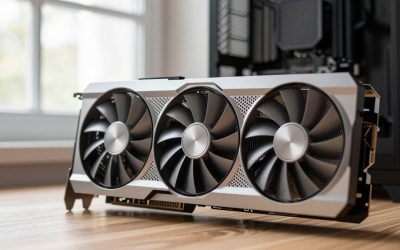
Yes, upgrading from an RX 6600 XT to an RX 9060 XT is worth it, as long as you buy the 16 GB version: you get roughly 40–60% more performance, double the VRAM, FSR 4 and much better ray tracing at about the same power draw and on the same power supply. The 8 GB RX 9060 XT is still much faster than a 6600 XT, but it keeps the same 8 GB limit that is already holding your current card back. Unless you only play esports titles at 1080p, the extra $50 for the 16 GB model is the most important part of this upgrade.
Quick answer: Our top pick in 2026 is the Architecture — our #1 rated choice. See the full ranked comparison, alternatives and buying advice below.
What You Are Upgrading From
The RX 6600 XT launched in July 2021 at $379 as AMD’s 1080p RDNA 2 card. It has 2048 stream processors, 8 GB of GDDR6 on a 128-bit bus and a 32 MB Infinity Cache. It was quick at 1080p in its day, but three things have aged it: 8 GB of VRAM, weak ray tracing, and no access to the machine-learning upscaling that newer Radeon cards use.
The RX 9060 XT, released in June 2025, keeps the same shader count, bus width and Infinity Cache size on paper. Everything else changes: RDNA 4 architecture, a 4 nm process, boost clocks up to 3130 MHz, double the L2 cache and upgraded AI hardware that powers FSR 4. Matching shader counts can make the upgrade look smaller than it is. It is not.
Old Card vs Both New Versions
| Spec | RX 6600 XT | RX 9060 XT 8GB | RX 9060 XT 16GB |
|---|---|---|---|
| Architecture | RDNA 2.0 | RDNA 4.0 | RDNA 4.0 |
| Release date | 30 July 2021 | 4 June 2025 | 4 June 2025 |
| Launch MSRP | $379 | $299 | $349 |
| Stream processors | 2048 | 2048 | 2048 |
| Boost clock | 2589 MHz | 3130 MHz | 3130 MHz |
| Process | 7 nm | 4 nm | 4 nm |
| VRAM | 8 GB GDDR6 | 8 GB GDDR6 | 16 GB GDDR6 |
| Bus / bandwidth | 128-bit / 256.0 GB/s | 128-bit / 322.3 GB/s | 128-bit / 322.3 GB/s |
| L2 / L3 cache | 2 MB / 32 MB | 4 MB / 32 MB | 4 MB / 32 MB |
| Interface | PCIe 4.0 x8 | PCIe 5.0 x16 | PCIe 5.0 x16 |
| TDP | 160 W | 150 W | 160 W |
| Power connector | 1x 8-pin | 1x 8-pin | 1x 8-pin |
| Length / width | 190 mm, 2-slot | 267 mm, 2-slot | 267 mm, 2-slot |
| Outputs | 1x HDMI, 2x DisplayPort | 1x HDMI 2.1b, 2x DP 2.1a | 1x HDMI 2.1b, 2x DP 2.1a |
How Big the Performance Jump Is
Reviewers rarely included the 6600 XT in RX 9060 XT launch charts, but the data that exists lines up well. In Gamers Nexus’ RX 9060 XT 16GB review, the new card’s lead over the RX 6600 XT ranged from about 36% to about 66% depending on the game, with the largest gaps in heavy titles such as Black Myth: Wukong. Hardware Unboxed’s generational test on TechSpot, which used the plain RX 6600, showed the RX 7600 about 30% ahead of the 6600, and the 9060 XT 8GB another 31% ahead of the RX 7600 at 1080p and 49% ahead at 1440p.
Allowing for the 6600 XT being somewhat quicker than the 6600, the realistic expectation is roughly 40–60% higher frame rates. In TechSpot’s 16 GB review, the 9060 XT averaged about 70 FPS at native 1440p across 18 games, putting it near RX 7700 XT level and just behind the RTX 5060 Ti. That is a resolution class above where a 6600 XT is comfortable.
A concrete way to picture it: a game that runs at roughly 45–55 FPS on your 6600 XT at 1080p high is likely to move into roughly the 70–85 FPS range on a 9060 XT 16GB. Exact numbers depend on settings, CPU and game patches.
Why the 8 GB version is a weaker upgrade
TechSpot’s RX 9060 XT 8GB review was blunt about it. With the same settings, the 16 GB card was 22% faster on average and 37% faster in 1% lows in The Last of Us Part II at 1440p, while Oblivion Remastered at 1440p Ultra pushed the 8 GB model down to about 19 FPS. Monster Hunter Wilds used up to 14 GB at 1440p Ultra. When the 8 GB card has enough memory, the two versions perform almost the same. When it runs out, the 8 GB model can fall behind badly, and that will happen more often as new games arrive.
Features You Gain
- FSR 4: AMD’s ML-based upscaler runs natively on RDNA 4 and looks clearly better than FSR 3.1, especially in Performance and Balanced modes. AMD has also announced FSR 4.1 upscaling for RX 6000 cards, so a 6600 XT may get some of this too, but RDNA 4 is the hardware it was designed for.
- Ray tracing: RDNA 4 substantially reworked AMD’s RT hardware. The 6600 XT can technically run RT, but it is rarely playable. On the 9060 XT, light-to-moderate RT at 1080p becomes realistic.
- PCIe 5.0 x16: The 6600 XT uses only eight PCIe lanes, which costs it performance on older PCIe 3.0 boards. The 9060 XT uses all sixteen, so it holds up much better in older systems.
- Modern display outputs: HDMI 2.1b and DisplayPort 2.1a make high-refresh 1440p and 4K displays easier to drive.
Will It Fit Your Current PC?
Power is the easy part. The 9060 XT 16GB is rated at 160 W, the same as your 6600 XT, and both use one 8-pin connector. Using the GPU TDP + CPU + ~150 W headroom rule with a typical 65–105 W CPU: 160 + 105 + 150 = 415 W, so a quality 500–550 W PSU that already runs your 6600 XT is fine. No new cables or adapters are needed.
Length is the thing to check. The 6600 XT figure in the table is 190 mm, while the 9060 XT figure is 267 mm, and some partner models are longer. In a compact mini-ITX or micro-ATX case, measure the space between the PCIe slot bracket and the front fans or radiator before ordering. Shorter dual-fan 9060 XT models exist, but they are not the default.
Upgrade Value, Worked Out
Using launch prices and the middle of the performance range (6600 XT = 100, 9060 XT ≈ 150):
| Card | Launch MSRP | Relative performance | Cost per point |
|---|---|---|---|
| RX 6600 XT | $379 | 100 | $3.79 |
| RX 9060 XT 8GB | $299 | ~150 (when VRAM is not exceeded) | ~$1.99 |
| RX 9060 XT 16GB | $349 | ~150 (holds up in VRAM-heavy games) | ~$2.33 |
Selling your 6600 XT lowers the real cost further. Used RX 6600 XT cards usually sell for roughly $130–$180, so the net cost of moving to a 16 GB 9060 XT is often around $170–$220 at launch pricing.
Who Should Upgrade, and Who Can Wait
| Your use | Recommendation |
|---|---|
| 1080p AAA games, VRAM warnings on the 6600 XT | Upgrade to 9060 XT 16GB |
| Moving to a 1440p monitor | Upgrade to 9060 XT 16GB |
| Esports titles only (Valorant, CS2, Fortnite competitive) | Keep the 6600 XT or consider the 8GB model |
| PCIe 3.0 motherboard | Upgrade, the x16 link helps |
| Very old quad-core CPU | Upgrade the CPU first, or plan both |
One CPU caution: a much faster GPU exposes a weak processor. If you are still on a 4-core chip from the Ryzen 1000/2000 or Intel 7th–9th generation era, part of the 9060 XT’s advantage will be lost in CPU-heavy games.
Frequently Asked Questions
How much faster is the RX 9060 XT than the RX 6600 XT?
Roughly 40–60% on average, based on Gamers Nexus game results and Hardware Unboxed’s generational data on TechSpot. The gap is larger at 1440p and in ray-traced games, and smaller in light esports titles.
Should I get the 8GB or 16GB RX 9060 XT?
Get the 16 GB model unless your budget is fixed and you only play lighter games. Reviews showed the 8 GB version falling far behind in several new games at 1440p and high texture settings. The $50 difference at launch pricing buys years of extra usefulness.
Do I need a new power supply to upgrade?
Usually not. The 9060 XT 16GB is rated at 160 W, the same as the 6600 XT, and uses the same single 8-pin connector. A quality 500–550 W unit is enough with mainstream CPUs.
Will the RX 9060 XT work on a PCIe 3.0 motherboard?
Yes. It is backward compatible, and because it uses a full x16 link it loses less on PCIe 3.0 than the x8 RX 6600 XT does. Enable Resizable BAR (Smart Access Memory) if your board supports it.
Can the RX 6600 XT use FSR 4?
FSR 4 originally launched only for RX 9000 cards. AMD announced FSR 4.1 upscaling support for RX 6000 and RX 7000 GPUs in mid-2026. Support depends on drivers and each game, so it does not replace the native FSR 4 experience on RDNA 4.
Ready to decide? Our #1 pick for 2026 is the Architecture.
Live price & availability on Amazon.