

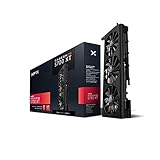
- Top Pick: XFX Rx 5700 XT Raw II 8GB GDDR6 1905MHz 3xDP HDMI PCI Express 4.0 Graphics Card Rx-57XT8OFF6 (Renewed)
- Best Value: XFX RX 5700 XT Triple Dissipation 8GB GDDR6 3xDP HDMI Graphics Card RX-57XT83LD8
- Premium Choice: Gigabyte Radeon RX 6650 XT Gaming OC 8G Graphics Card, WINDFORCE 3X Cooling System, 8GB 128-bit GDDR6, GV-R665XTGAMING OC-8GD Video Card (Renewed)
For most RX 5700 XT owners, moving to an RX 6650 XT is not worth it for speed alone. The newer card is only around 5-12% faster depending on resolution, keeps the same 8 GB of VRAM, and costs real money for a small gain. The RX 6650 XT does make sense in one situation: you need hardware ray tracing and DirectX 12 Ultimate support because games you want to play now require them. If you are buying a card from scratch, the RX 6650 XT is the more future-proof of the two. If you already own a 5700 XT, a current RX 9060 XT 16 GB or RTX 5060 Ti 16 GB is a much bigger step up.
- What Actually Changes When You Swap Cards
- Spec Sheet Side by Side
- Gaming Performance: How Big Is the Jump?
- Ray Tracing and DirectX 12 Ultimate: The Real Reason to Upgrade
- Upscaling and Frame Generation on Each Card
- Power, PSU and Case Fit
- Cost per Frame at Launch Pricing
- Used-Market Reality
- Who Should Upgrade and Who Should Wait
- Frequently Asked Questions
As an Amazon Associate we earn from qualifying purchases at no extra cost to you.



What Actually Changes When You Swap Cards
The RX 5700 XT (RDNA 1, July 2019) and the RX 6650 XT (RDNA 2, May 2022) both launched at $399 and both carry 8 GB of GDDR6. The two cards get there in very different ways, though. The 5700 XT relies on brute memory bandwidth: a 256-bit bus delivering 448 GB/s. The 6650 XT uses a much narrower 128-bit bus (280.3 GB/s) but adds 32 MB of Infinity Cache and runs far higher clocks, 2635 MHz boost against 1905 MHz.
That design difference explains almost everything about how the upgrade feels. At 1080p, the cache hit rate is high and the 6650 XT pulls ahead. At 1440p and above, more data spills past the cache, and the older card’s wider bus closes the gap.
Spec Sheet Side by Side
| Spec | RX 5700 XT | RX 6650 XT |
|---|---|---|
| Architecture | RDNA 1.0 | RDNA 2.0 |
| Release date | 7 July 2019 | 10 May 2022 |
| Launch MSRP | $399 | $399 |
| Stream processors | 2560 | 2048 |
| Boost clock | 1905 MHz | 2635 MHz |
| Process | 7 nm | 7 nm |
| TDP | 225 W | 176 W |
| VRAM | 8 GB GDDR6 | 8 GB GDDR6 |
| Memory bus | 256-bit | 128-bit |
| Bandwidth | 448.0 GB/s | 280.3 GB/s |
| Cache | 4 MB L2 | 2 MB L2 + 32 MB L3 (Infinity Cache) |
| Interface | PCIe 4.0 x16 | PCIe 4.0 x8 |
| Power connectors | 1x 6-pin + 1x 8-pin | 1x 8-pin |
| Length (reference) | 272 mm | Varies by partner model |
| Width | 2-slot | 2-slot |
| Display outputs | 1x HDMI 2.0b, 3x DP 1.4a | 1x HDMI 2.1, 3x DP 1.4a |
Gaming Performance: How Big Is the Jump?
Published reviews agree the gap is small. In TechPowerUp’s RX 6600 XT testing, the RX 5700 XT landed about 8% behind a factory-overclocked 6600 XT across 22 games, and TechPowerUp’s RX 6650 XT review measured the 6650 XT about 5% ahead of the 6600 XT at 1080p. Put together, that puts the 6650 XT around 8-12% ahead of the 5700 XT at 1080p. TechSpot’s 2024 revisit of the RX 5700 XT is a more direct data point: across its 12-game suite at 1440p, the 5700 XT came out about 6% slower than the 6650 XT, roughly level with an RTX 3060.
- 1080p: RX 6650 XT ahead by roughly 8-12%. Where a 5700 XT averages around 70-80 fps at high settings in a modern title, expect the 6650 XT to land a few frames higher. These are approximate figures that vary with settings, CPU and game patches.
- 1440p: The lead shrinks to roughly 5-6%, which most people will not notice without an FPS counter.
- 4K: Neither card is a 4K card. The 5700 XT’s bandwidth advantage can let it match or edge the RDNA 2 card in heavy scenes.
Frame-time consistency is similar, because both cards run out of VRAM at the same point. Games that blow through 8 GB at high textures will stutter on either card.
Ray Tracing and DirectX 12 Ultimate: The Real Reason to Upgrade
The RX 5700 XT has no hardware ray-tracing units and does not support the DirectX 12 Ultimate feature set (mesh shaders, sampler feedback, variable-rate shading). For years that barely mattered. It now matters more, because a growing number of releases assume these features exist. Games built around mandatory ray tracing, such as Indiana Jones and the Great Circle and Doom: The Dark Ages, list RT-capable GPUs as a minimum requirement. That leaves the RX 5700 XT locked out entirely, while an RX 6650 XT can at least launch and run them at reduced settings.
The 6650 XT’s ray-tracing performance is weak in absolute terms. Optional RT effects in most games cost too much frame rate to be worth enabling at 1080p. The value here is compatibility, not RT eye candy.
Upscaling and Frame Generation on Each Card
- FSR 2 / FSR 3.1 upscaling: Works on both cards. It is shader-based, so both benefit about equally.
- FSR 3 frame generation: Supported in-game on both, though AMD positions RX 6000 and newer as the better experience.
- AFMF (driver-level frame generation): Available on RX 6000 and newer through the Adrenalin driver, not on RX 5000 cards. This gives the 6650 XT a way to raise perceived smoothness in games without built-in frame generation.
- FSR 4: AMD’s machine-learning upscaler is officially aimed at RX 9000 (RDNA 4) cards. Do not count on either of these GPUs for it.
- XeSS: Intel’s upscaler runs on both via its fallback path.
DLSS is NVIDIA-only and is not relevant to either card.
Power, PSU and Case Fit
This is the one area where the 6650 XT is clearly better day to day. Its 176 W TDP is about 50 W lower than the 5700 XT’s 225 W, and it needs only a single 8-pin connector instead of 6-pin plus 8-pin.
PSU Sizing, Worked Out
A simple rule of thumb: GPU TDP + CPU power + about 150 W of headroom for the motherboard, drives, fans and transient spikes.
- RX 5700 XT + a 125 W CPU: 225 + 125 + 150 = 500 W, so a quality 550 W unit is the sensible floor.
- RX 6650 XT + a 125 W CPU: 176 + 125 + 150 = 451 W, so a good 500-550 W unit is comfortable.
If your current PSU runs a 5700 XT, it will run a 6650 XT. The upgrade never forces a PSU change. Both cards are 2-slot designs. The reference 5700 XT is 272 mm long, and most RX 6650 XT partner cards are similar or shorter, so case clearance is rarely an issue. On older PCIe 3.0 boards, the 6650 XT’s x8 link can cost a few percent in some games, which erodes its already small lead further.
Cost per Frame at Launch Pricing
Both cards launched at $399. Using the 5700 XT as a baseline of 100 and the 6650 XT at roughly 106-110 (1440p to 1080p average), launch cost per performance point works out to:
- RX 5700 XT: $399 / 100 = about $3.99 per point
- RX 6650 XT: $399 / ~108 = about $3.69 per point
Nearly three years separated these launches, and the improvement was only around 8% in value per dollar. That small step is the core reason reviewers were lukewarm on the 6650 XT as an upgrade path.
Used-Market Reality
Both cards are previous-generation parts that now live mostly on the used market. A used RX 5700 XT usually sells for roughly $100-$150 depending on condition and cooler. A used RX 6650 XT usually sits around $170-$220. Selling a 5700 XT and buying a used 6650 XT typically costs $50-$100 net for a single-digit to low double-digit performance gain plus RT/DX12U compatibility. Check any used 5700 XT for fan wear and high hotspot temperatures, since many ran hot for years.
Who Should Upgrade and Who Should Wait
| Your situation | Better move |
|---|---|
| Own a 5700 XT, play esports and older titles at 1080p | Keep the 5700 XT |
| Own a 5700 XT, a must-play game needs RT hardware | Upgrade, but consider skipping to RX 9060 XT 16 GB or Arc B580 |
| Own a 5700 XT, gaming at 1440p | Skip the 6650 XT; the gain is ~5-6% |
| Building a budget 1080p PC and both are offered used at similar prices | RX 6650 XT for features and lower power |
| Small case or weak PSU | RX 6650 XT (176 W, single 8-pin) |
The broader point is that a meaningful upgrade from a 5700 XT means a card that is at least 50% faster and has more than 8 GB of VRAM. Current-generation options such as the RX 9060 XT 16 GB or RTX 5060 Ti 16 GB address both weaknesses at once (an Arc B580 12 GB is a cheaper middle step with a smaller speed gain), where the 6650 XT addresses neither.
Frequently Asked Questions
Is the RX 6650 XT faster than the RX 5700 XT?
Yes, but only slightly. Published review data places the RX 6650 XT roughly 8-12% ahead at 1080p and about 5-6% ahead at 1440p. At 4K the older card’s wider memory bus can let it catch up in some games.
Can the RX 5700 XT run games that require ray tracing?
No. The RX 5700 XT has no hardware ray-tracing units, so titles that list an RT-capable GPU as a minimum requirement will not launch or run properly. The RX 6650 XT supports hardware RT and DirectX 12 Ultimate, so it can run those games at modest settings.
Do I need a new power supply to go from a 5700 XT to a 6650 XT?
No. The RX 6650 XT has a lower 176 W TDP and uses a single 8-pin connector, so any PSU that handled a 225 W RX 5700 XT will cope. A quality 500-550 W unit is enough for the 6650 XT paired with a mainstream CPU.
Is 8 GB of VRAM still enough on these cards?
It is enough for 1080p at medium-to-high settings in most games, but several recent releases need texture settings lowered to avoid stutter. Both cards have the same 8 GB, so the upgrade does nothing for VRAM limits. If VRAM is your bottleneck, look at 12 GB or 16 GB cards instead.
Does the PCIe 4.0 x8 link hurt the RX 6650 XT on older motherboards?
On a PCIe 3.0 board the x8 link halves available bus bandwidth, which can cost a few percent in some games, especially when VRAM overflows. On PCIe 4.0 boards the effect is negligible. The RX 5700 XT uses a full x16 link, so it is less sensitive to older platforms.
What is a better upgrade from an RX 5700 XT?
A card that is at least 50% faster with more VRAM makes far more sense. TechSpot’s revisit found the RX 7700 XT about 60% faster than the 5700 XT, and current cards like the RX 9060 XT 16 GB or RTX 5060 Ti 16 GB also add VRAM and modern upscaling support. These options turn the upgrade into a clear, noticeable improvement.
Ready to decide? Our #1 pick for 2026 is the Architecture.
Live price & availability on Amazon.













