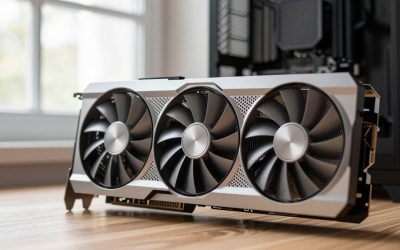
Buy the RTX 5050 if you are purchasing new, because it matches or slightly beats the RX 6600 XT in rasterized 1080p gaming while adding much better ray tracing, DLSS 4 with Multi Frame Generation, lower power draw and a full warranty at a lower launch price; a used RX 6600 XT only makes sense if it costs clearly less. These two cards land in almost the same raster performance tier, so features, efficiency and price decide this matchup rather than raw frame rates.
The RX 6600 XT launched in July 2021 at $379 on AMD’s RDNA 2 architecture, during a period of inflated GPU pricing. The RTX 5050 arrived in July 2025 at $249 as the entry point to NVIDIA’s Blackwell-based RTX 50 series. Four years separate them, and it shows in their features more than in their benchmarks.
Quick answer: Our top pick in 2026 is the Architecture — our #1 rated choice. See the full ranked comparison, alternatives and buying advice below.
Spec Table
| Specification | RX 6600 XT | RTX 5050 |
|---|---|---|
| Architecture | RDNA 2.0 | Blackwell 2.0 |
| Release date | 30 July 2021 | 1 July 2025 |
| Launch MSRP | $379 | $249 |
| Shaders | 2048 stream processors | 2560 CUDA cores |
| Boost clock | 2589 MHz | 2572 MHz |
| Process | 7 nm | 5 nm |
| TDP | 160 W | 130 W |
| VRAM | 8 GB GDDR6 | 8 GB GDDR6 |
| Memory bus | 128-bit | 128-bit |
| Bandwidth | 256.0 GB/s | 320.0 GB/s |
| Cache | 2 MB L2 + 32 MB L3 | 24 MB L2 |
| Interface | PCIe 4.0 x8 | PCIe 5.0 x8 |
| Power connector | 1x 8-pin | 1x 8-pin |
| Size | 190 mm, 2-slot | 2-slot |
| Outputs | 1x HDMI, 2x DisplayPort | 1x HDMI 2.1b, 3x DP 2.1b |
Both cards use 8 GB of GDDR6 on a 128-bit bus with an x8 PCIe link, so their memory limitations are essentially the same. The RTX 5050 gets 25 percent more bandwidth from faster memory, a 30 W lower power rating, and one extra display output. The RX 6600 XT’s 190 mm reference length makes it one of the more compact cards in this class, though partner designs vary for both GPUs.
Raster Performance at 1080p
The two cards are close in traditional rendering. Professional reviews pairing these exact two cards are scarce, but aggregated benchmark data points the same way: Technical City places the RTX 5050 about 2 percent ahead overall, DropReference measured roughly a 4 percent lead at 1440p across its game set, and HowManyFPS shows near-identical results in titles like Dirt 5. A few individual games show much larger gaps; PCBench’s God of War Ragnarok data, for example, favored the RTX 5050 by a wide margin. A fair summary is that the RTX 5050 is roughly equal to slightly faster, around 0 to 10 percent depending on the game.
At 1080p with high settings, both cards typically deliver around 60 to 100 FPS in demanding modern games and far more in esports titles, with exact results varying by game, settings, CPU and driver version. Neither card is designed for 1440p in new AAA releases without lowering settings or using upscaling.
Ray tracing
Ray tracing is where the generational gap appears. RDNA 2 was AMD’s first architecture with ray tracing hardware, and its performance was limited even when new. The RTX 5050 uses NVIDIA’s latest RT cores and generally holds a clear lead in ray-traced games. That said, neither card is really built for heavy ray tracing at native resolution; on the RTX 5050, light RT effects combined with DLSS are realistic, while on the RX 6600 XT, ray tracing is usually best left off.
Upscaling and Frame Generation
This is the RTX 5050’s strongest argument. It supports the full DLSS 4 suite, including the transformer-based Super Resolution model, Ray Reconstruction, and Multi Frame Generation, which can generate up to three additional frames for each rendered frame in supported games. For a budget card, upscaling and frame generation are what make demanding new games playable at good settings.
The RX 6600 XT supports FSR 3.1 upscaling and frame generation in games that include it, plus AMD Fluid Motion Frames at the driver level. It does not support FSR 4, which is limited to RDNA 4 cards. FSR 3.1 works but shows more visual artifacts in aggressive modes, which is especially noticeable at 1080p, where the internal render resolution is already low.
One caution: frame generation uses extra VRAM, and both cards have only 8 GB. In the newest games, enabling frame generation alongside high textures can push either card over its memory limit, so lower texture settings may be needed to get the full benefit.
Living With 8 GB of VRAM
Neither card has a memory advantage, so set expectations for both. Eight gigabytes is workable for 1080p in most current games with high textures, and is fine for esports and older titles. Some recent AAA releases need medium textures to avoid stutter. At 1440p, 8 GB requires regular compromises in new games. If you want more headroom in this price range, consider a 12 GB card such as the Intel Arc B580.
Power, PSU and Platform Notes
Using the sizing rule of GPU power plus CPU power plus about 150 W of headroom with a 65 W CPU typical of budget builds:
- RX 6600 XT: 160 + 65 + 150 = 375 W, so a quality 450 W to 500 W unit is suitable.
- RTX 5050: 130 + 65 + 150 = 345 W, so a quality 400 W to 450 W unit is enough.
Both cards use a single 8-pin connector, so almost any PSU works. Both also use an x8 PCIe link. On an older PCIe 3.0 motherboard, the RX 6600 XT runs at PCIe 3.0 x8, which can cost a few percent in some games, and the same applies to the RTX 5050. The penalty grows when VRAM overflows, since the card then relies on the PCIe bus to fetch data.
Value Calculation
Using the RX 6600 XT as 100 and the RTX 5050 at 104, near the middle of the available data:
- RX 6600 XT at launch: $379 / 100 = $3.79 per point
- RTX 5050 at launch: $249 / 104 = $2.39 per point
Launch pricing heavily favors the RTX 5050, but the RX 6600 XT is no longer sold at its original price. On the used market it usually sells in the broad $140 to $190 range. At $160, it would work out to about $1.60 per point, which beats a new RTX 5050 on raw raster value, but you give up DLSS 4, better ray tracing, lower power draw and a warranty.
Decision Table by Budget and Use
| Situation | Pick |
|---|---|
| Buying new, 1080p AAA gaming | RTX 5050 |
| Tightest possible budget, esports at 1080p | Used RX 6600 XT |
| Want ray tracing or frame generation | RTX 5050 |
| Small PSU or prebuilt office PC upgrade | RTX 5050, lower power rating |
| Very compact case, need a short card | RX 6600 XT, 190 mm reference length |
| Streaming or video encoding | RTX 5050, newer NVENC encoder |
Used RX 6600 XT Buying Tips
The RX 6600 XT was popular during the cryptocurrency mining era, so check its history when buying used. Ask about prior use, look for clean fans and heatsinks, test for artifacts under a sustained load, and confirm temperatures are reasonable. A well-kept card still makes an excellent budget 1080p GPU, but price it with the lack of warranty and newer features in mind.
Frequently Asked Questions
Is the RTX 5050 faster than the RX 6600 XT?
Slightly, on average. Benchmark aggregators place the RTX 5050 a few percent ahead in rasterized games, with some titles showing larger gaps. In ray-traced games and with DLSS enabled, the RTX 5050’s advantage is much clearer.
Can the RX 6600 XT use FSR 4?
Officially, no. FSR 4 is limited to RDNA 4 cards. The RX 6600 XT supports FSR 3.1 upscaling and frame generation along with driver-level Fluid Motion Frames.
Is 8 GB enough for 1080p gaming?
For most games, yes, especially at high rather than ultra textures. A handful of recent AAA titles may require medium textures to avoid stutter. Both of these cards share the same 8 GB limitation.
What power supply do I need for the RTX 5050?
A quality 400 W to 450 W unit is enough with a typical budget CPU. It uses a single 8-pin PCIe connector and is rated at 130 W.
Should I consider other cards in this price range?
Yes. The Intel Arc B580 offers 12 GB of VRAM, and the RTX 5060 is a faster step up from the RTX 5050. If your budget stretches slightly, either can provide more headroom than both cards compared here.
Ready to decide? Our #1 pick for 2026 is the Architecture.
Live price & availability on Amazon.