

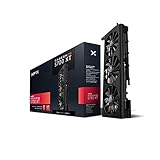
- Top Pick: XFX Rx 5700 XT Raw II 8GB GDDR6 1905MHz 3xDP HDMI PCI Express 4.0 Graphics Card Rx-57XT8OFF6 (Renewed)
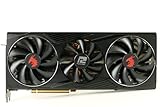
- Best Value: XFX RX 5700 XT Triple Dissipation 8GB GDDR6 3xDP HDMI Graphics Card RX-57XT83LD8
- Premium Choice: GIGABYTE AORUS Radeon RX 6800 Master 16G Graphics Card, MAX-Covered Cooling, 16GB 256-bit GDDR6, GV-R68AORUS M-16GD Video Card
Yes, going from an RX 5700 XT to an RX 6800 is a worthwhile upgrade: review data puts the RX 6800 roughly 50-75% faster depending on resolution, it doubles VRAM from 8 GB to 16 GB, and it adds hardware ray tracing and DirectX 12 Ultimate support, all for only about 25 W more board power; it pays off most for 1440p players and anyone running into the 5700 XT’s memory or feature limits.
As an Amazon Associate we earn from qualifying purchases at no extra cost to you.


What the Jump From RDNA 1 to RDNA 2 Brings
The RX 5700 XT (July 2019, $399) was AMD’s first RDNA card and a strong 1440p value at the time. The RX 6800 (October 2020, $579) arrived just over a year later on RDNA 2, the architecture also used in the PS5 and Xbox Series consoles. That shared console lineage matters: many current games are designed around RDNA 2 feature sets, which the 5700 XT only partially supports.
The upgrade touches four areas:
- Performance class: 60 compute units (3840 stream processors) versus 40 (2560), plus 128 MB of Infinity Cache.
- VRAM: 16 GB instead of 8 GB.
- Features: hardware ray tracing, mesh shaders, variable rate shading and full DirectX 12 Ultimate support, none of which the 5700 XT has.
- Efficiency: far more performance for nearly the same power.
Spec Sheet Comparison
| Specification | RX 5700 XT | RX 6800 |
|---|---|---|
| Architecture | RDNA 1.0 | RDNA 2.0 |
| Release date | 7 July 2019 | 28 October 2020 |
| Launch MSRP | $399 | $579 |
| Stream processors | 2560 | 3840 |
| Boost clock | 1905 MHz | 2105 MHz |
| Process | 7 nm | 7 nm |
| Memory | 8 GB GDDR6 | 16 GB GDDR6 |
| Bus / bandwidth | 256-bit / 448.0 GB/s | 256-bit / 512.0 GB/s |
| Cache | 4 MB L2 | 4 MB L2 + 128 MB L3 |
| Interface | PCIe 4.0 x16 | PCIe 4.0 x16 |
| Board power | 225 W | 250 W |
| Power connectors | 1x 6-pin + 1x 8-pin | 2x 8-pin |
| Length / width (reference) | 272 mm / 2-slot | 267 mm / 2-slot |
| Outputs | 1x HDMI 2.0b, 3x DP 1.4a | 1x HDMI, 2x DisplayPort, 1x USB-C |
How Much Faster Is the RX 6800?
Raster performance by resolution
TechPowerUp’s RX 6800 XT review described that card as almost twice as fast as the RX 5700 XT, and Hardware Unboxed/TechSpot’s RX 6800 review placed the non-XT RX 6800 about 9% behind the 6800 XT at 1440p. Combining those findings, the RX 6800 lands roughly 60-75% ahead of the 5700 XT at 1440p and higher at 4K, while at 1080p the lead is typically smaller, closer to 45-60%, because the CPU becomes a limit more often. Exact figures vary by game selection, CPU and driver version.
In practical terms, a title running around 55 fps on a 5700 XT at 1440p high settings would commonly land somewhere around 90-95 fps on the RX 6800. That moves 1440p from “60 fps target” to genuine high-refresh territory. These are approximate and depend on settings, CPU and game version.
Ray tracing
The 5700 XT has no ray-tracing hardware. The RX 6800’s first-generation ray accelerators deliver moderate RT performance, roughly in RTX 3060 to RTX 3070 territory depending on the game, so light-to-medium RT effects at 1440p with FSR are realistic. More importantly, games that require hardware RT or mesh shaders, a growing category, run on the RX 6800 and either fail to launch or perform badly on the 5700 XT.
Upscaling and frame generation
Both cards can use FSR up to 3.1, including FSR 3 frame generation in supported games, and XeSS through its DP4a path. The RX 6800 additionally supports AMD Fluid Motion Frames, AMD’s driver-level frame generation, which is not available on RX 5000 cards. FSR 4 officially targets RX 9000 hardware, so neither card receives it.
VRAM: The Quiet Reason to Upgrade
Eight gigabytes was generous in 2019. In 2026, numerous large releases exceed 8 GB at 1440p with high textures, leading to stutter, missing textures or forced quality drops. A general guide for current AAA games:
- 1080p high: about 6-8 GB
- 1440p high/ultra: about 8-12 GB
- 4K high: 10-14 GB or more
The RX 6800’s 16 GB covers all three comfortably, which is a major reason it has aged better than many of its contemporaries.
Power Supply, Connectors and Fit
The power increase is small: 250 W for the RX 6800 versus 225 W for the 5700 XT. The connector requirement changes, though, from one 6-pin plus one 8-pin to two 8-pin plugs, so check that your PSU has two 8-pin PCIe leads (or one lead with two connectors, though separate cables are preferable).
PSU sizing with a 125 W gaming CPU:
- RX 5700 XT: 225 + 125 + 150 headroom = 500 W.
- RX 6800: 250 + 125 + 150 headroom = 525 W, so a quality 600-650 W unit is comfortable.
Most systems that ran a 5700 XT on a 600 W or larger PSU will handle the RX 6800 without changes. In terms of efficiency, the RX 6800 delivers roughly 50-60% more performance per watt; TechPowerUp noted its gaming power draw was similar to the 5700 XT’s at much higher performance.
The reference RX 6800 is 267 mm, slightly shorter than the reference 5700 XT’s 272 mm, so fit is rarely an issue. Partner cards can be larger.
Cost of the Upgrade
At launch, the jump from $399 to $579 bought around 60-75% more performance at 1440p, a fair trade even at MSRP. Today both are used-market cards. An RX 5700 XT usually sells in the $100-$140 range and an RX 6800 in the $250-$320 range. Selling the old card brings the net upgrade cost to roughly $130-$200, which is reasonable for the performance, VRAM and feature gains.
Before buying, compare against current cards. An RX 9060 XT 16 GB or RTX 5060 Ti 16 GB offers similar memory, newer features such as FSR 4 or DLSS 4, warranty coverage and lower power draw, though at a higher price than a used RX 6800.
Used RX 6800 checklist
- Check fan health and hotspot temperatures under load; a large gap between edge and hotspot temperatures can indicate dried thermal paste.
- Confirm both 8-pin connectors are undamaged.
- Avoid listings that are near the price of a new current-generation 16 GB card.
Does the Upgrade Pay Off for You?
| Your setup | Upgrade value |
|---|---|
| 1440p, 144 Hz monitor | High: large frame-rate gain and VRAM headroom |
| Games that require ray tracing or mesh shaders | High: the 5700 XT cannot run them properly |
| 1080p, esports titles | Moderate: may be CPU limited |
| 4K gaming | High, with FSR |
| Older 4-core CPU | Lower: upgrade CPU first or alongside |
Pairing the RX 6800 With Your CPU
A 60-75% GPU uplift only shows up if the processor can feed it. Systems built around a 5700 XT often use Ryzen 5 3600 or Intel 9th/10th-gen six-core chips. These remain workable at 1440p, where the GPU does most of the work, but at 1080p high refresh rates they can cap frame rates well below what the RX 6800 can deliver. Enabling Smart Access Memory on supported Ryzen 3000/5000 and Intel 10th-gen-or-newer platforms with compatible motherboards adds a few percent in many games. Owners of four-core CPUs should budget for a processor upgrade alongside the graphics card.
The Verdict
The RX 6800 is one of the most sensible upgrades a 5700 XT owner can make on a used-market budget. It is far faster, has double the VRAM, adds ray tracing and DirectX 12 Ultimate, and draws only slightly more power. For 1440p players especially, the difference is substantial. The main reasons to hold off are a weak CPU or a budget that can stretch to a current-generation card with newer upscaling features.
Frequently Asked Questions
How much faster is the RX 6800 than the RX 5700 XT?
Based on TechPowerUp and Hardware Unboxed/TechSpot review data, the RX 6800 is roughly 60-75% faster at 1440p, somewhat more at 4K and somewhat less at 1080p. Exact gains vary by game and CPU.
Will my power supply handle an RX 6800?
The RX 6800 is rated at 250 W, only 25 W more than the 5700 XT. A quality 600-650 W unit is comfortable with a typical gaming CPU. It needs two 8-pin PCIe connectors.
Can the RX 5700 XT run ray tracing?
No, the RX 5700 XT has no ray-tracing hardware and does not support DirectX 12 Ultimate. Some newer games that require these features will not run or will run poorly. The RX 6800 supports both.
Does the RX 6800 still get driver updates?
Yes. AMD moved RX 5000 and RX 6000 cards to a separate driver branch in late 2025, and stated that these cards continue to receive game support, optimizations and bug fixes. Both cards share that branch.
Is 16 GB of VRAM useful at 1080p?
At 1080p, 8-10 GB is usually enough today, but 16 GB gives headroom for high-resolution texture packs, mods and future releases. It becomes clearly useful at 1440p and 4K.
Ready to decide? Our #1 pick for 2026 is the Architecture.
Live price & availability on Amazon.












