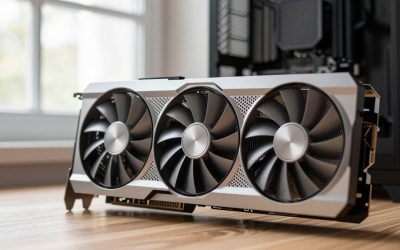
The RX 6800 XT is the better gaming card for 1440p and for anyone who plays new AAA games with high textures: it is roughly 10-25% faster in raster and has twice the VRAM (16 GB vs 8 GB), which avoids the stutter and texture problems reviewers documented on 8 GB cards. The RTX 5060 Ti 8GB makes more sense for 1080p esports players who want a new card with warranty, much lower power draw, better ray tracing and DLSS 4 Multi Frame Generation, as long as they accept turning textures down in demanding games.
This is a classic old-flagship-versus-new-mainstream matchup. The RX 6800 XT launched in October 2020 at $649 as AMD’s second-best RDNA 2 card. The RTX 5060 Ti 8GB arrived in April 2025 at $379 as the cheaper of two RTX 5060 Ti memory configurations. One is mostly found on the used market today, the other is a current-generation card, and that shapes the whole comparison.
Quick answer: Our top pick in 2026 is the Architecture — our #1 rated choice. See the full ranked comparison, alternatives and buying advice below.
Specifications Compared
| Specification | RX 6800 XT | RTX 5060 Ti 8GB |
|---|---|---|
| Architecture | RDNA 2.0 | Blackwell 2.0 |
| Release date | 28 October 2020 | 16 April 2025 |
| Launch MSRP | $649 | $379 |
| Shaders / CUDA cores | 4608 | 4608 |
| Boost clock | 2250 MHz | 2572 MHz |
| Process | 7 nm | 5 nm |
| TDP | 300 W | 180 W |
| Memory | 16 GB GDDR6 | 8 GB GDDR7 |
| Memory bus | 256-bit | 128-bit |
| Bandwidth | 512.0 GB/s | 448.0 GB/s |
| Cache | 4 MB L2 + 128 MB Infinity Cache | 32 MB L2 |
| Interface | PCIe 4.0 x16 | PCIe 5.0 x8 |
| Power connectors | 2x 8-pin | 1x 8-pin |
| Length / width | 267 mm, 2-slot | 241 mm, 2-slot |
| Outputs | 1x HDMI, 2x DP, 1x USB-C | 1x HDMI 2.1b, 3x DP 2.1b |
The identical 4608 shader count is a coincidence of naming, not a sign of equal performance; AMD stream processors and NVIDIA CUDA cores are not directly comparable. The meaningful differences are the RX 6800 XT’s doubled memory, wider bus and large Infinity Cache versus the RTX 5060 Ti’s far lower power use and newer feature set.
Rasterization: The Old Flagship Still Leads
In games without ray tracing, the RX 6800 XT is the faster card. Benchmark aggregators spread the gap between roughly 11% and 24% in the 6800 XT’s favor depending on test suite and resolution, and the lead grows at higher resolutions. Tom’s Hardware’s coverage places the RTX 5060 Ti within about 10% of an RTX 4070, which puts the 16 GB version a little below the 6800 XT; the 8 GB version matches it only when memory is not a limit.
That last point is critical. In VRAM-heavy games, the 8 GB card falls much further behind. Hardware Unboxed’s review of the RTX 5060 Ti 8GB, published on TechSpot under the headline “Instantly Obsolete,” showed the 16 GB version running up to around 80% faster in Horizon Forbidden West at 1080p very high and far ahead in Hogwarts Legacy with ray tracing, with huge 1% low differences. Those are the same scenarios where the 16 GB RX 6800 XT keeps running smoothly.
Typical experience, varying by settings, CPU and patch:
- 1080p: Both cards are fast. The RTX 5060 Ti 8GB is fine at medium-high settings; at ultra textures in recent AAA games it can stutter.
- 1440p: The RX 6800 XT is the clear choice, generally delivering high double-digit frame rates at high settings in demanding games.
- 4K: Only the 6800 XT is a reasonable option, and even then with upscaling in heavy titles.
Ray Tracing, DLSS 4 and FSR
The RTX 5060 Ti has the advantage once ray tracing is enabled, as long as VRAM holds. Blackwell’s RT cores are far more capable than RDNA 2’s first-generation hardware, and in titles like Cyberpunk 2077 or Black Myth: Wukong the newer card generally pulls ahead with RT on. The catch is that ray tracing adds memory pressure, so the 8 GB card often has to drop textures or resolution to use it.
Upscaling and frame generation:
- RTX 5060 Ti 8GB: DLSS 4 with the transformer model, plus Multi Frame Generation (up to three generated frames per rendered frame). This is a big plus for high-refresh 1080p play.
- RX 6800 XT: FSR 3.1 upscaling and frame generation, driver-level AMD Fluid Motion Frames and XeSS. FSR 4 is officially aimed at RDNA 4, so the 6800 XT does not get it as a supported feature.
Frame generation itself uses some VRAM, which again puts the 8 GB card in a tight spot in demanding games.
How Much VRAM Do You Actually Need?
| Resolution | Comfortable VRAM (2026 AAA) | RX 6800 XT (16 GB) | RTX 5060 Ti (8 GB) |
|---|---|---|---|
| 1080p medium | 6-8 GB | Plenty | OK |
| 1080p ultra / RT | 9-12 GB | Plenty | Often over budget |
| 1440p high | 10-12 GB | Plenty | Requires texture cuts |
| 4K high | 12-16 GB | Adequate | Not recommended |
One more factor: the RTX 5060 Ti uses a PCIe 5.0 x8 link. On a PCIe 5.0 or 4.0 motherboard that is fine, but on a PCIe 3.0 board the reduced bandwidth hurts more when VRAM overflows and data spills into system memory. Owners of older platforms should weigh this.
Power Draw, PSU and Case Fit
Here the RTX 5060 Ti is clearly better. Sizing a PSU as GPU TDP + CPU + about 150 W headroom:
- RX 6800 XT: 300 W + 125 W CPU + 150 W = 575 W, so a quality 650-750 W PSU with two PCIe cables.
- RTX 5060 Ti 8GB: 180 W + 125 W CPU + 150 W = 455 W, so a quality 550 W PSU with a single 8-pin cable.
That 120 W gap also shows up as heat and noise in a small case. The RTX 5060 Ti’s 241 mm reference length and single 8-pin plug make it easy to fit in compact builds, while the 6800 XT’s 267 mm reference card (and often longer, thicker partner models) needs more room. If you game around 3 hours a day, the 6800 XT draws roughly 0.36 kWh more per day at full load, which adds up over a year depending on local electricity rates.
Value Math: Launch Price vs Used Market
At launch MSRPs, treating the 5060 Ti 8GB as 100 and the 6800 XT as about 117 (middle of the published range):
- RTX 5060 Ti 8GB: $379 / 100 = about $3.79 per performance point.
- RX 6800 XT: $649 / 117 = about $5.55 per performance point.
On launch prices, the new card wins easily. But the RX 6800 XT is now mainly a used-market card, and used examples usually sell somewhere around $280-$350. At that level the 6800 XT gives more raster performance and double the VRAM for a similar or slightly lower price than a new RTX 5060 Ti 8GB, at the cost of warranty, efficiency and NVIDIA features. Inspect used cards for fan noise, coil whine and thermal throttling, and prefer sellers who allow a test run.
Pick X If, Pick Y If
| Situation | Pick |
|---|---|
| 1440p gaming on a budget, used is fine | RX 6800 XT |
| 1080p esports, want new with warranty | RTX 5060 Ti 8GB |
| New AAA games at high or ultra textures | RX 6800 XT |
| Ray tracing at 1080p with DLSS | RTX 5060 Ti (with lower textures) |
| Small case or 550 W PSU | RTX 5060 Ti 8GB |
| Want both features and VRAM | Consider the RTX 5060 Ti 16GB instead |
Frequently Asked Questions
Is the RX 6800 XT faster than the RTX 5060 Ti 8GB?
Yes, in raster games. Benchmark compilations put it roughly 10-25% ahead, with the gap growing at 1440p and 4K and in games that exceed 8 GB of VRAM. With ray tracing enabled, the RTX 5060 Ti can come out ahead when memory is not a limit.
Is 8 GB of VRAM enough in 2026?
For esports and older games at 1080p, yes. For many new AAA releases at high or ultra textures, 8 GB causes stutter, texture pop-in or forces lower settings. Reviewers found the 16 GB version of the same card dramatically faster in those cases.
Does the RX 6800 XT support DLSS?
No. DLSS is NVIDIA-only. The RX 6800 XT uses FSR 3.1 and XeSS for upscaling and frame generation, which generally trail DLSS 4 in image quality.
What PSU do I need for an RX 6800 XT?
A quality 650-750 W unit with two separate PCIe 8-pin cables is the safe choice. RDNA 2 cards can produce short power spikes, so avoid budget PSUs near their limit.
Should I buy the RTX 5060 Ti 16GB instead?
If your budget stretches, the 16 GB version removes the VRAM weakness while keeping DLSS 4 and low power draw. It is the more future-proof NVIDIA option and closes most of the raster gap to the RX 6800 XT.
Ready to decide? Our #1 pick for 2026 is the Architecture.
Live price & availability on Amazon.