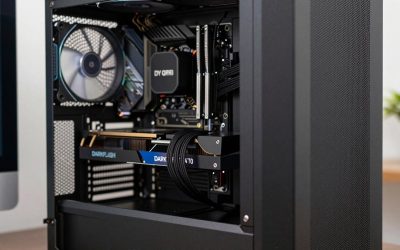
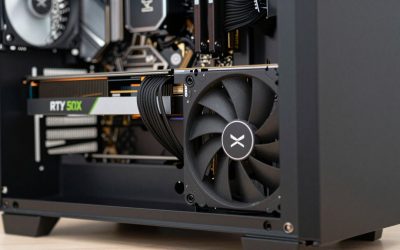
The gap between the fastest consumer GPU of two consecutive generations has never been wider, and the decision it forces on buyers has never been harder. The RTX 5090 lands with a meaningful lead over the RTX 4090 across every resolution, but that lead comes with a higher price tag, a substantially higher power draw, and a thermal profile that demands more from your case and PSU. Meanwhile the RTX 4090, now nearly three years into its lifecycle, has become available on the used and open-box market at prices that make its raw performance-per-dollar equation genuinely competitive.
This comparison matters most for a specific buyer: someone with a 4K monitor or a creator workstation who is deciding whether the jump to Blackwell justifies the cost, or whether an existing 4090 (or a used one) remains the smarter purchase in 2026. We will not pretend one card wins every scenario. The answer depends on your resolution target, your PSU, your budget, and whether you care about the new features stack that Blackwell unlocks. Below is the full breakdown.
As an Amazon Associate we earn from qualifying purchases at no extra cost to you.


Quick answer: Our top pick in 2026 is the Architecture — our #1 rated choice. See the full ranked comparison, alternatives and buying advice below.
Quick Verdict
The RTX 5090 is the faster card by a margin that ranges from roughly 20 to 45 percent depending on resolution and title, with the largest gaps appearing at 4K native rendering. If money is genuinely no object and you want the absolute ceiling of single-GPU performance, buy the 5090. If you already own a 4090, the upgrade is real but not transformative for most games at 1440p and below. If you are shopping used, a 4090 at the right price represents arguably the best high-end value on the market right now. The 5090’s extra VRAM, 512-bit bus, and DLSS 4 Multi Frame Generation give it a longer future-proofing runway, but the 4090 is nowhere near obsolete.
Specs Side by Side
| Specification | RTX 5090 | RTX 4090 |
|---|---|---|
| Architecture | Blackwell (GB202) | Ada Lovelace (AD102) |
| CUDA Cores | 21,760 | 16,384 |
| Base Clock | ~2,010 MHz | ~2,235 MHz |
| Boost Clock | ~2,407 MHz | ~2,520 MHz |
| Memory Size | 32 GB GDDR7 | 24 GB GDDR6X |
| Memory Bus Width | 512-bit | 384-bit |
| Memory Bandwidth | ~1,792 GB/s | ~1,008 GB/s |
| TGP / TDP | 575W | 450W |
| Interface | PCIe 5.0 x16 | PCIe 4.0 x16 |
| Display Outputs | 3x DP 2.1b, 1x HDMI 2.1b | 3x DP 1.4a, 1x HDMI 2.1a |
| RT Cores | 4th Gen | 3rd Gen |
| MSRP (Launch) | $1,999 | $1,599 |
Gaming Performance
1080p
At 1080p the gap narrows considerably because most titles become CPU-bound or engine-limited before the GPU hits its ceiling. Reviewers at TechPowerUp and Hardware Unboxed observed ranges of roughly 15 to 30 percent in favor of the 5090 depending on the title, with esports workloads showing the smallest delta and heavier rasterization titles showing the largest. In practice, if you are targeting 360 or 500 Hz at 1080p, the 5090 helps sustain frame rates in the most demanding titles, but the difference between 400 and 480 fps is marginal for competitive play where your CPU and monitor response time are the real bottlenecks.
1440p
At 1440p the picture sharpens. Tom’s Hardware and Gamers Nexus reported the 5090 leading by approximately 25 to 40 percent across a mix of rasterization and ray-traced workloads. This is the resolution where the 5090’s extra bandwidth and shader throughput begin to matter more consistently. For a high-refresh 1440p monitor, the 5090 can push past 200 fps in titles where the 4090 hovers near 140-160 fps without upscaling assistance. The practical takeaway: if you own a 1440p 240 Hz display and want to max settings with ray tracing enabled, the 5090 is a meaningful step forward.
4K
This is where Blackwell earns its premium. Across multiple outlets, TechPowerUp, TechSpot, and Hardware Unboxed all converge on the 5090 holding a roughly 35 to 50 percent lead at 4K native rasterization in the most demanding titles. In some specific workloads like Alan Wake 2 or Cyberpunk 2077 with path tracing enabled, the gap can exceed 50 percent. For 4K without DLSS, the 5090 is the only consumer card that consistently delivers over 100 fps in the heaviest new releases. The 4090 remains capable at 4K but increasingly leans on upscaling to maintain that threshold in unoptimized or future titles.
Power, Heat and Noise
The RTX 5090 is a 575W part at reference design. That is 125 watts more than the 4090’s 450W envelope, and it shows in thermal and acoustic behavior. Card designs reviewed by Gamers Nexus and others consistently run hotter and louder than their Ada predecessors under sustained load, though partner coolers vary widely in effectiveness. If your case has marginal airflow or you are sensitive to fan noise, the 5090 demands more planning: a high-wattage PSU (850W minimum, 1000W recommended), adequate case ventilation, and realistic expectations that dual-slot quiet operation is difficult to maintain. The 4090, by contrast, is well-understood by now, with aftermarket coolers and case solutions tuned specifically to its thermal profile.
Features
Blackwell introduces DLSS 4, which adds Multi Frame Generation (up to three generated frames per rendered frame) on top of the single-frame generation that defined DLSS 3 on Ada. Early reviews from TechSpot and Tom’s Hardware characterize MFG as impressive in raw fps numbers but acknowledge that latency and visual artifacts remain tradeoffs, particularly at lower refresh rates. The 5090 also benefits from the 4th generation RT cores for ray-traced and path-traced rendering, which deliver a measurable improvement over Ada’s 3rd generation hardware even in identical workloads.
On the encoding side, the 5090 carries a more capable NVENC block with support for higher-quality AV1 presets, relevant to streamers and video creators. The 4090 already offered solid AV1 encoding, so the delta here is an improvement rather than a paradigm shift. Platform-wise, the 5090’s PCIe 5.0 interface and DP 2.1b outputs support higher bandwidth displays and future peripherals, while the 4090’s DP 1.4a is a known constraint at 8K or high-DSC refresh configurations.
Price and Value
At MSRP, the 5090 costs $400 more than the 4090 did at launch, and the actual lead is roughly 35-45 percent at the resolutions that matter most for this tier. If you calculate cost per frame at 4K using launch MSRPs and conservative performance estimates, the 4090 edges out the 5090 by a modest margin. The used market changes the calculus further. RTX 4090 units are appearing at prices well below original MSRP as owners upgrade, and a 4090 acquired at 70-75 percent of its original price while retaining 85-90 percent of the 5090’s 4K performance represents arguably the strongest value proposition in the high-end GPU market.
Who Should Buy Which
Competitive 1080p Players
The RTX 4090 is almost certainly sufficient. At 1080p the 5090’s advantage is small and often masked by CPU limitations. Your money is better spent on a faster CPU, a higher-refresh monitor, or both.
1440p High-Refresh Enthusiasts
If you own a 240 Hz or 360 Hz 1440p panel and want to run max settings with ray tracing enabled without upscaling, the 5090 delivers the headroom to make that consistent. If you are fine relying on DLSS Quality mode or native settings with RT off, the 4090 still handles 1440p at 144-200 fps in the vast majority of titles.
4K Gamers
The 5090 is the clear choice for anyone targeting 4K without aggressive upscaling. The 32GB GDDR7 buffer and 1.7 TB/s bandwidth also give it a longer runway as textures and memory demands increase across the generation. The 4090 remains capable at 4K but will lean on DLSS more heavily in two to three years.
Creators and Streamers
Content creators working in DaVinci Resolve, Blender, or Unreal Engine will appreciate the extra 8GB of VRAM and the higher bandwidth, which translate directly into shorter render times and the ability to hold larger scenes in memory. Streamers will benefit from the improved encoder. For creators specifically, the productivity uplift often justifies the price gap more cleanly than the gaming case does.
Upgraders from Two Generations Back
Coming from an RTX 3080 or RTX 3090, either the 4090 or 5090 represents a massive leap. If you can find a 4090 at a good price and your PSU and case support it, you will get 80-90 percent of the 5090 experience for significantly less money and power. The 5090 is the upgrade for people who want the absolute best regardless of cost, or who need the extra VRAM for professional workloads.
FAQ
Is the RTX 5090 worth it over the 4090?
It depends on your resolution and budget. At 4K, the performance gap is large enough to justify the premium for many buyers. At 1080p or 1440p, the value proposition is weaker. If you already own a 4090, the upgrade is real but not urgent for most use cases.
Do I need a new PSU for the RTX 5090?
Most likely yes. The 5090’s 575W TGP requires a high-quality 1000W PSU as a baseline, especially if you pair it with a power-hungry CPU. If your current system runs a 450W GPU on an 850W unit, you are probably already pushing the margin for the 5090.
Does the RTX 4090 support DLSS 4?
No. DLSS 4 and Multi Frame Generation are exclusive to Blackwell GPUs (RTX 50 series). The 4090 supports DLSS 3 with single-frame generation. This is one of the software-side differentiators that gives the 5090 a practical advantage in frame-rate ceilings within supported titles.
Will the 24GB of VRAM on the 4090 become a limitation?
It already is in a small number of unoptimized or poorly managed titles at 4K ultra settings with maximum texture quality. For gaming, most titles remain well within 24GB. For professional workloads like 3D rendering or AI inference, the 32GB on the 5090 is a meaningful advantage that will widen over the coming years.
Sources and Methodology
All performance ranges in this article are approximate and derived from launch and follow-up reviews published by TechPowerUp, Tom’s Hardware, Gamers Nexus, Hardware Unboxed, and TechSpot. No benchmarks were conducted by this site. Percentage gaps reflect the median of each outlet’s tested title set and may vary based on specific game configuration, driver version, and resolution. Where outlets diverged, wider ranges are presented rather than narrower ones.
Ready to decide? Our #1 pick for 2026 is the Architecture.
Live price & availability on Amazon.