

- Top Pick: ASUS TUF Gaming NVIDIA GeForce RTX 3070 Ti OC Edition Graphics Card (PCIe 4.0, 8GB GDDR6X, HDMI 2.1, DisplayPort 1.4a, Dual Ball Fan Bearings, Military-Grade Certification, GPU Tweak II) (Renewed)
- Best Value: NVIDIA – GeForce RTX 3070 Ti 8GB GDDR6X PCI Express 4.0 Graphics Card – Dark Platinum and Black (Renewed)
- Premium Choice: ZOTAC Gaming GeForce RTX™ 3090 Ti AMP Extreme Holo 24GB GDDR6X 384-bit 21 Gbps PCIE 4.0 Gaming Graphics Card, HoloBlack, IceStorm 2.0 Advanced Cooling, Spectra 2.0 RGB Lighting, ZT-A30910B-10P
Moving from an RTX 3070 Ti to an RTX 3090 Ti is a big performance jump, roughly 35-50% at 1440p and well over double in some 4K and ray traced games, but it only pays off for 4K gamers or creators who need 24 GB of VRAM and have the power supply and case for a 450 W, 3-slot card. For most 1440p players, a current RTX 5070 Ti or RX 9070 XT is the more sensible way to leave 8 GB behind.
As an Amazon Associate we earn from qualifying purchases at no extra cost to you.


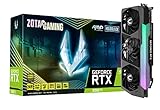

The Upgrade in One Look
Both cards are NVIDIA Ampere designs from the RTX 30 generation, now two generations behind the RTX 50 series. The RTX 3070 Ti uses the full GA104 chip with 6144 CUDA cores and 8 GB of GDDR6X. The RTX 3090 Ti uses the full GA102 chip with 10752 CUDA cores and 24 GB of GDDR6X on a 384-bit bus. That is 75% more shaders, three times the memory and about 66% more bandwidth, but also 160 W more power.
| Specification | GeForce RTX 3070 Ti | GeForce RTX 3090 Ti |
|---|---|---|
| Architecture | Ampere | Ampere |
| Release date | 31 May 2021 | 27 January 2022 |
| Launch MSRP | $599 | $1,999 |
| CUDA cores | 6144 | 10752 |
| Boost clock | 1770 MHz | 1860 MHz |
| Process | 8 nm | 8 nm |
| Power (TDP) | 290 W | 450 W |
| Memory | 8 GB GDDR6X | 24 GB GDDR6X |
| Memory bus | 256-bit | 384-bit |
| Memory bandwidth | 608.3 GB/s | 1.01 TB/s |
| L2 cache | 4 MB | 6 MB |
| Interface | PCIe 4.0 x16 | PCIe 4.0 x16 |
| Power connector | 1x 12-pin (Founders Edition) | 1x 16-pin |
| Length / width | 267 mm / 2-slot | 336 mm / 3-slot |
| Display outputs | 1x HDMI, 3x DisplayPort | 1x HDMI 2.1, 3x DisplayPort 1.4a |
Performance Gains by Resolution
According to Tom’s Hardware’s 2022-2024 GPU hierarchy, the RTX 3090 Ti is roughly 25% faster than the RTX 3070 Ti at 1080p ultra, about 36% faster at 1440p ultra and close to 60% faster at 4K ultra. In Tom’s Hardware’s 2026 retest, which uses newer and more memory-hungry games, the gap widens to about 39% at 1080p, about 49% at 1440p and more than double at 4K, where the RTX 3070 Ti’s 8 GB buffer becomes a serious bottleneck. Tech4Gamers’ own 4K comparison likewise found the RTX 3090 Ti more than 60% ahead on average.
Put in frame terms, a game that runs in the mid-60s fps on an RTX 3070 Ti at 1440p ultra can run near 100 fps on an RTX 3090 Ti. At 4K the RTX 3070 Ti often falls into the 20s or 30s in recent titles, while the RTX 3090 Ti tends to sit in the 50s to 70s. These ranges depend heavily on the game, settings, CPU and driver.
Ray tracing
Ray tracing amplifies the gap. Tom’s Hardware’s 2026 ray tracing results show the RTX 3090 Ti roughly 70% faster at 1080p ultra, close to 90% faster at 1440p ultra and more than three times as fast at 4K, again because ray tracing adds significant VRAM pressure. If ray tracing at 1440p or 4K is the goal, the RTX 3070 Ti simply runs out of memory and shader resources first.
DLSS and frame generation: identical support
Both are Ampere cards, so the feature list does not change. Both support DLSS 4 Super Resolution with the transformer model and NVIDIA Reflex. Neither supports DLSS Frame Generation, which requires an RTX 40 or newer card, or Multi Frame Generation, which requires RTX 50. Both can use FSR 3 frame generation in games that offer it. The upgrade buys raw performance and memory, not new features.
VRAM: The Real Reason to Leave 8 GB
The RTX 3070 Ti’s 8 GB has aged poorly. As a rough guide:
- 1440p ultra: many current games use 9-12 GB, so 8 GB forces texture reductions.
- 4K ultra or ray tracing: 12-16 GB is common; 8 GB causes stutter and big frame drops.
- Content creation and local AI: 24 GB allows larger 3D scenes, high-resolution video timelines and bigger AI models that will not fit in 8 GB at all.
For gaming, 24 GB is more than needed. For creators and AI users, it is the RTX 3090 Ti’s strongest selling point and the reason used prices stay relatively high.
Power, PSU and Connectors
The upgrade requires careful power planning. Using GPU power plus CPU power plus about 150 W of headroom:
- RTX 3070 Ti: 290 W + 150 W (high-end CPU) + 150 W = about 590 W, so 650-750 W.
- RTX 3090 Ti: 450 W + 150 W + 150 W = about 750 W, so a quality 850-1000 W unit.
NVIDIA’s guidance for the RTX 3090 Ti Founders Edition was an 850 W power supply, and some heavily overclocked partner cards push board power higher. Connectors differ too. The RTX 3070 Ti Founders Edition uses a 12-pin plug with an adapter, while most partner RTX 3070 Ti cards use standard 8-pin connectors, typically two. The RTX 3090 Ti uses a 16-pin connector, either through a native cable on a newer ATX 3.0/3.1 PSU or an adapter fed by multiple 8-pin cables. Make sure the 16-pin plug is fully seated and not bent sharply near the card.
Case Fit
At 336 mm long and three slots thick, the RTX 3090 Ti is much larger than the 267 mm, 2-slot RTX 3070 Ti. Check front radiator and fan clearance, the number of available expansion slots, and whether the case supports a GPU sag bracket. Heat output also climbs by about 160 W, so a case with good front intake airflow is important.
Cost of the Jump
Using launch prices and Tom’s Hardware’s 2026 1440p ultra averages (about 67 fps for the RTX 3070 Ti and about 100 fps for the RTX 3090 Ti):
- RTX 3070 Ti: $599 / 67 fps = about $8.95 per frame
- RTX 3090 Ti: $1,999 / 100 fps = about $20 per frame
At launch the RTX 3090 Ti cost more than three times as much for roughly 50% more performance at 1440p. Used prices narrow the gap, with broad ranges like roughly $230-$300 for an RTX 3070 Ti and roughly $650-$900 for an RTX 3090 Ti, the latter held up by AI demand for 24 GB cards. Even then, the upgrade costs several hundred dollars net.
Who Should Make the Move
| Profile | Upgrade to RTX 3090 Ti? |
|---|---|
| 1080p high-refresh gamer | No: gains are CPU-limited; tune settings instead. |
| 1440p gamer hitting VRAM limits | Maybe, but an RTX 5070 Ti or RX 9070 XT is a better buy. |
| 4K gamer | Yes, if the used price is good and the PSU is 850 W+. |
| Ray tracing at 1440p/4K | Yes over the 3070 Ti, though RTX 50 cards add frame generation. |
| Creator or local AI user | Strong yes: 24 GB is the key benefit. |
| Small case or 650 W PSU | No: size and power make it impractical. |
Alternatives Worth Weighing
Current-generation cards change the calculation. The RTX 5070 Ti brings 16 GB of VRAM, DLSS Multi Frame Generation and much lower power than the RTX 3090 Ti, and AMD’s RX 9070 XT offers 16 GB with FSR 4. For pure gaming, those are the more balanced upgrades from an RTX 3070 Ti. The RTX 3090 Ti remains the pick mainly when 24 GB matters more than efficiency or new features.
Frequently Asked Questions
How much faster is the RTX 3090 Ti than the RTX 3070 Ti?
Roughly 25-40% at 1080p, 35-50% at 1440p and 60% to more than double at 4K, based on Tom’s Hardware’s hierarchy data. The biggest gaps appear in newer games where the RTX 3070 Ti runs out of VRAM. Ray tracing widens the difference further.
Does the RTX 3090 Ti support DLSS Frame Generation?
No. Like all RTX 30 cards, it supports DLSS Super Resolution and Reflex but not DLSS Frame Generation, which needs an RTX 40 or newer GPU. It can use FSR 3 frame generation in games that support it.
What PSU does the RTX 3090 Ti need?
NVIDIA recommended at least 850 W for the Founders Edition. A quality 850-1000 W unit is the safe choice with a high-end CPU. It uses a 16-pin connector, supplied through a native cable or an adapter.
Is 8 GB enough on the RTX 3070 Ti in 2026?
For 1080p and lighter 1440p settings, it is workable. Many new games exceed 8 GB at 1440p ultra or 4K, leading to stutter or forced texture reductions. That limit is the main reason RTX 3070 Ti owners consider upgrading.
Is a used RTX 3090 Ti better than a new RTX 5070 Ti?
For gaming, the RTX 5070 Ti is generally the better choice thanks to lower power, Multi Frame Generation and a warranty. The RTX 3090 Ti wins only when 24 GB of VRAM is essential, such as for AI models or large creative projects.
Ready to decide? Our #1 pick for 2026 is the Architecture.
Live price & availability on Amazon.













