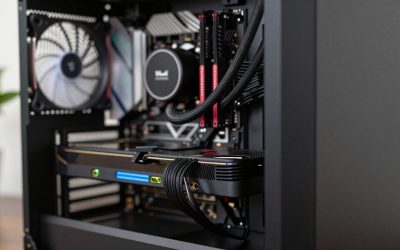
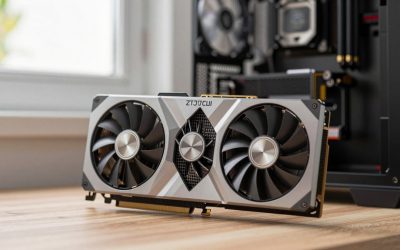
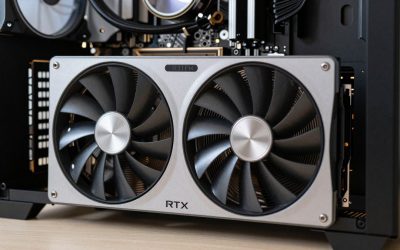
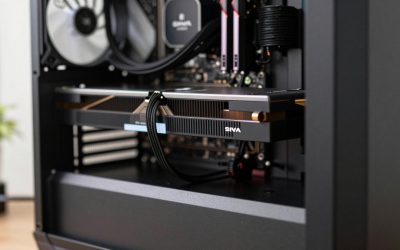
- Top Pick: msi Gaming GeForce RTX 3060 Ventus 2X 12G OC V1 Graphics Card – 15 Gbps GDRR6 Boost Clock: 1807 MHz 192-Bit HDMI/DP PCIe 4 Torx Twin Fan Ampere
- Best Value: GIGABYTE GeForce RTX 3060 WINDFORCE OC 12G (rev. 2.0) Graphics Card, 2X WINDFORCE Fans, 12GB 192-bit GDDR6, GV-N3060WF2OC-12GD Rev2.0 Video Card
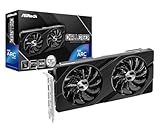
- Premium Choice: ASRock Intel Arc A580 Challenger 8GB OC Graphics Card, Intel Xe HPG Architecture, 8GB GDDR6, PCIe 4.0, Dual Fans, 0dB Silent Cooling, DisplayPort 2.0
The RTX 3060 is the better all-round card: it is about 10% faster than the Arc A580 in TechPowerUp’s launch testing, has 12 GB of VRAM instead of 8 GB, supports DLSS, and runs more consistently across older games. The Arc A580 is worth choosing only when it is meaningfully cheaper, your system supports Resizable BAR, and you mainly play modern DirectX 12 and Vulkan titles where Intel’s drivers are strongest.
The RTX 3060 launched in January 2021 at $329 and became one of the most widely used gaming GPUs of its era. Intel’s Arc A580 arrived in October 2023 as a cut-down Alchemist card, priced at $179 at launch to compete with budget cards like the RX 6600 and RTX 3050. Both are now previous generation: NVIDIA’s RTX 50 series and Intel’s Arc B570 and B580 have replaced them in current lineups.
As an Amazon Associate we earn from qualifying purchases at no extra cost to you.


How the Two Cards Stack Up on Paper
| Specification | RTX 3060 | Arc A580 |
|---|---|---|
| Architecture | Ampere | Xe-HPG (Generation 12.7, Alchemist) |
| Release date | 12 January 2021 | 10 October 2023 |
| Launch MSRP | $329 | $179 |
| Shaders / cores | 3584 | 3072 |
| Boost clock | 1777 MHz | 2000 MHz |
| Process | 8 nm | 6 nm |
| Board power | 170 W | 175 W |
| Memory | 12 GB GDDR6 | 8 GB GDDR6 |
| Bus width | 192-bit | 256-bit |
| Bandwidth | 360.0 GB/s | 512.0 GB/s |
| L2 cache | 3 MB | 8 MB |
| Interface | PCIe 4.0 x16 | PCIe 4.0 x16 |
| Power connectors | 1x 12-pin (reference spec) | 2x 8-pin |
| Length / width | 242 mm, 2-slot | Varies by model, 2-slot |
| Outputs | 1x HDMI 2.1, 3x DisplayPort 1.4a | 1x HDMI 2.1, 3x DisplayPort 2.0 |
The Arc A580 looks strong on paper, with a 256-bit bus and 512 GB/s of bandwidth, about 42% more than the RTX 3060. In practice, Alchemist did not convert its hardware into frame rates as efficiently as Ampere, and its performance depends heavily on drivers and the graphics API a game uses. The RTX 3060’s 12 GB of memory is its standout spec.
Performance in Games
According to TechPowerUp’s Arc A580 review, the RTX 3060 was about 10% faster than the A580 across its game suite at launch, and the step-up Arc A750 was only about 9% faster than the A580. In that same review, the A580 averaged in the mid-70s FPS at 1080p and the mid-50s at 1440p across all tested games, which places it in RX 6600 to RX 6600 XT territory. Other comparisons show a similar picture, with the RTX 3060 leading at both 1080p and 1440p by roughly 10-15%.
Results vary more by game than with most matchups. Intel’s Arc cards perform best in modern DirectX 12 and Vulkan games, where the A580 can match or occasionally beat the RTX 3060. In older DirectX 11 and DirectX 9 titles, Arc relies on translation layers and driver work that Intel has improved substantially since 2022, but performance can still be less consistent. Treat any FPS figures as broad ranges that shift with settings, CPU and driver version.
Ray tracing
Both cards support hardware ray tracing. Intel’s Alchemist RT units are competitive with NVIDIA’s second-generation RT cores for their performance class, but neither card is fast enough for heavy RT at high settings. Light RT effects at 1080p with upscaling are the realistic target on either card.
Upscalers: DLSS Versus XeSS
The RTX 3060 supports DLSS Super Resolution, including the DLSS 4 transformer model, plus Ray Reconstruction. DLSS has the widest game support of any machine-learning upscaler. NVIDIA’s DLSS frame generation is limited to RTX 40 and RTX 50 cards, so the RTX 3060 cannot use it, though FSR 3 frame generation works where games offer it.
The Arc A580 supports XeSS, which runs in its best-quality XMX mode on Arc hardware and looks noticeably better there than on other vendors’ cards. Intel’s XeSS 2 package adds frame generation and low-latency features, and supports Arc Alchemist cards in games that implement it. XeSS game support is growing but is still narrower than DLSS. Both cards can also use FSR in any game that offers it.
The VRAM Question
The RTX 3060’s 12 GB is a real long-term advantage over the A580’s 8 GB. A simple guide to VRAM needs in modern AAA games:
- 1080p medium-high: around 6-8 GB, so both cards cope.
- 1080p ultra textures or 1440p high: often 8-11 GB, where the A580 needs compromises and the 3060 does not.
- Ray tracing and frame generation: both add memory overhead, which favors the 12 GB card.
The A580 has much more bandwidth, but bandwidth cannot replace capacity once a game’s textures overflow the buffer. For players who keep cards for several years, the RTX 3060’s memory is likely to age better.
Resizable BAR and Platform Requirements
This is the most important practical difference. Intel’s Arc cards depend on Resizable BAR (also called Smart Access Memory on AMD platforms) for good performance. Without it, frame rates and frame pacing can drop significantly. Resizable BAR is generally available on Intel 10th-generation and newer platforms and on AMD Ryzen 3000 and newer platforms with a recent BIOS, but older systems often lack it.
The RTX 3060 benefits from Resizable BAR in some games but does not depend on it. For upgrades to older PCs, the RTX 3060 is the far safer choice.
Power, PSU and Idle Draw
Rated board power is nearly identical: 170 W for the RTX 3060 and 175 W for the A580. Using GPU board power plus CPU gaming power plus about 150 W of headroom:
- RTX 3060: 170 W + ~125 W (typical midrange CPU while gaming) + 150 W = about 445 W, so a quality 500-550 W unit is ideal.
- Arc A580: 175 W + ~125 W + 150 W = about 450 W, so a quality 500-550 W unit is ideal.
The A580 needs two 8-pin connectors, which some budget power supplies cannot provide. The RTX 3060 reference specification lists a 12-pin connector, but nearly all partner models use a single 8-pin. Intel’s Alchemist cards are also known for relatively high idle power draw unless PCIe ASPM power saving is enabled in the BIOS and Windows, a step worth taking on any Arc build. TechPowerUp noted the A580 is slightly less efficient than the larger A750 and A770.
Value Calculation
Using launch MSRP and TechPowerUp’s relative performance (Arc A580 = 100, RTX 3060 = about 110):
- RTX 3060: $329 / 110 = about $2.99 per performance point.
- Arc A580: $179 / 100 = $1.79 per performance point.
On launch pricing, the A580 was the much better value per frame, which was its whole purpose. Today both cards are mostly used or leftover-stock purchases. The RTX 3060 12GB usually sells around $170-$230 used, and the Arc A580 around $110-$160 used. If the A580 is roughly 30% or more cheaper and the system has Resizable BAR, its value case holds. If the gap is small, the RTX 3060’s memory and broader compatibility win.
Pick the RTX 3060 If / Pick the Arc A580 If
| Buyer profile | Recommendation |
|---|---|
| Older PC without Resizable BAR | RTX 3060 |
| Large library of older DX11 and DX9 games | RTX 3060 |
| 1440p or high-texture 1080p gaming | RTX 3060 (12 GB) |
| Modern DX12 and Vulkan games on a recent platform, tight budget | Arc A580 |
| Video encoding with AV1 | Arc A580 (hardware AV1 encode) |
| PSU with only one 8-pin cable | RTX 3060 |
For new purchases, Intel’s own Arc B570 and B580 are significantly improved successors, and the RTX 5050 and 5060 cover NVIDIA’s budget tier. Both are worth pricing before settling on either older card.
Frequently Asked Questions
Is the RTX 3060 faster than the Arc A580?
Yes, by about 10% on average according to TechPowerUp’s launch review. The gap varies by game, and the A580 can come close or win in some modern DirectX 12 titles. In older games, the RTX 3060 tends to be more consistent.
Does the Arc A580 need Resizable BAR?
Effectively, yes. Without Resizable BAR enabled, Arc cards can lose a large share of their performance and suffer from uneven frame pacing. Check that the motherboard and CPU support it and that it is enabled in the BIOS before buying.
Is 8 GB on the Arc A580 enough?
For 1080p at medium to high settings, 8 GB is generally enough. Some recent AAA games need texture settings lowered, especially with ray tracing. The RTX 3060’s 12 GB gives more room for high textures over time.
Can the RTX 3060 use DLSS frame generation?
No. DLSS frame generation requires RTX 40 or RTX 50 hardware. The RTX 3060 supports DLSS Super Resolution and Ray Reconstruction, and it can use FSR 3 frame generation in games that support it.
What power supply do these cards need?
Both run well on a quality 500-550 W power supply in a typical gaming build. The Arc A580 needs two 8-pin PCIe connectors, while most RTX 3060 partner cards need a single 8-pin. Check the specific model’s connector layout before buying.
Which card is better for streaming?
Both include capable hardware encoders. The Arc A580 supports hardware AV1 encoding, which offers better quality per bitrate on platforms that accept AV1. The RTX 3060’s NVENC encoder supports H.264 and HEVC and has very broad software support, plus NVIDIA Broadcast for noise removal.