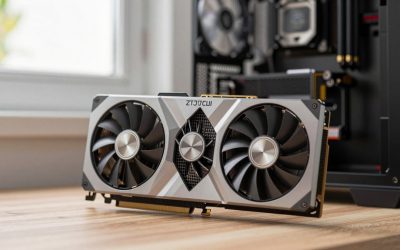
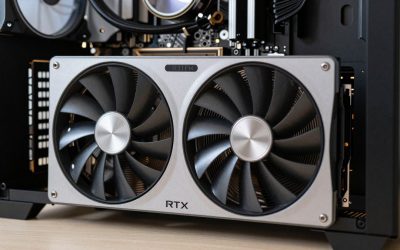
- Top Pick: NVIDIA GeForce RTX 3060 Ti Founders Edition 8GB GDDR6 PCI Express 4.0 Graphics Card (Renewed)
- Best Value: Dell Gaming OEM Nvidia GeForce RTX 3060 Ti 8GB GDDR6 256-bit 14Gbps PCIe 4.0 x16 Graphics Video Card 0MTVG8 08GXMM (Renewed)
- Premium Choice: ASRock Intel Arc A770 Phantom Gaming 16GB OC Graphics Card, 2200 MHz GPU Clock, 16GB GDDR6, DisplayPort 2.0, HDMI 2.1, Triple Fan Cooling, Polychrome SYNC
The RTX 3060 Ti is the faster card in most games and the better pick for 1080p and 1440p players who want consistent drivers, DLSS and good ray tracing, while the Arc A770 16GB is the better choice for buyers who prioritize VRAM capacity, frame generation support on older-generation hardware and longevity in texture-heavy games. If both cost the same, frame-rate chasers should lean toward the 3060 Ti and memory-conscious buyers toward the A770.
Nvidia’s RTX 3060 Ti launched in December 2020 at $399 and became one of the most popular Ampere cards. Intel’s Arc A770 16GB arrived in October 2022 at $329, aiming at the RTX 3060 but offering twice the VRAM of the 3060 Ti. Both are previous-generation parts in 2026, bought mostly used or as remaining stock.
As an Amazon Associate we earn from qualifying purchases at no extra cost to you.


Specification Table
| Specification | GeForce RTX 3060 Ti | Arc A770 16GB |
|---|---|---|
| Architecture | Ampere | Xe-HPG (Generation 12.7) |
| Release date | 1 December 2020 | 12 October 2022 |
| Launch MSRP | $399 | $329 |
| Shaders | 4864 CUDA cores | 4096 |
| Boost clock | 1665 MHz | 2400 MHz |
| Process | 8 nm | 6 nm |
| TDP | 200 W | 225 W |
| Memory | 8 GB GDDR6 | 16 GB GDDR6 |
| Bus width | 256-bit | 256-bit |
| Bandwidth | 448.0 GB/s | 512.0 GB/s |
| L2 cache | 4 MB | 16 MB |
| Interface | PCIe 4.0 x16 | PCIe 4.0 x16 |
| Power connectors | 1x 12-pin (Founders Edition) | 1x 6-pin + 1x 8-pin |
| Length | 242 mm (Founders Edition) | Varies by model |
| Width | 2-slot | 2-slot |
| Outputs | 1x HDMI, 3x DisplayPort | 1x HDMI 2.1, 3x DP 2.0 |
Both cards use a 256-bit bus, so the A770’s bandwidth edge is modest. The decisive spec differences are the memory capacity, where the A770 has double, and the architecture, where Ampere’s mature design and drivers deliver more frames from fewer clock cycles.
Performance in Games
Tom’s Hardware’s launch review of the Arc A770 Limited Edition found it faster than the RTX 3060 but clearly slower than the RTX 3060 Ti. Later published results in recent releases continue that trend: comparisons of 2025 games show the 3060 Ti ahead by roughly 15-35% in titles such as Dying Light: The Beast and Battlefield 6 at 1080p, with larger gaps in some outliers. Digital Trends’ launch testing showed the A770 winning a few DirectX 12 titles such as Red Dead Redemption 2, so results swing by game. Taken together, a fair summary is that the 3060 Ti is about 10-25% faster on average, with the gap varying by API and title.
- 1080p high: the 3060 Ti often delivers roughly 80-120 fps in mainstream games, with the A770 typically somewhat lower. Frame rates vary with settings, CPU and patch.
- 1440p high: the 3060 Ti usually holds 60 fps or more in many titles; the A770 narrows the gap at this resolution thanks to its bandwidth, but generally still trails.
- VRAM-heavy games: in titles that exceed 8 GB at high textures, the A770 can deliver smoother frame times than the 3060 Ti even if average fps is similar or lower.
Ray Tracing
Both cards have dedicated ray tracing hardware. Ampere’s second-generation RT cores generally keep the 3060 Ti ahead, though Arc’s RT implementation is strong for its class and sometimes comes close in individual titles. DLSS ray reconstruction gives the 3060 Ti an image-quality advantage in supported ray-traced games. For light ray tracing at 1080p, either works; for heavier RT at 1440p, the 3060 Ti is the more capable card.
Upscaling and Frame Generation
- RTX 3060 Ti: DLSS 4 super resolution with the transformer model and DLSS ray reconstruction, supported in a very large game library. No DLSS frame generation, which requires RTX 40 or newer. It can use FSR 3.1 frame generation where available.
- Arc A770: XeSS on XMX units with good image quality, plus XeSS 3 multi-frame generation, which Intel’s February 2026 driver extended to Arc A-series cards through an override in XeSS 2 games. FSR 3.1 also works.
The 3060 Ti has the broader upscaler support thanks to DLSS, while the A770 now offers native multi-frame generation that the 3060 Ti cannot use through Nvidia’s own stack.
Driver Maturity and Game Compatibility
Driver consistency is a real part of this comparison. Nvidia’s Ampere drivers have years of game-specific tuning behind them, so the 3060 Ti behaves predictably across new releases, older DirectX 9 and 11 titles and niche indie games. Intel’s Alchemist drivers have improved dramatically since launch, with large gains in DirectX 11 and older APIs, but Arc still shows more variance from game to game and occasionally needs a driver update before a new release runs as expected. Players with large back catalogs of older games, or who want a card that simply works on day one, will find the 3060 Ti less demanding to live with. Intel’s newest optimization work also centers on its Battlemage cards, although Alchemist continues to receive updates and gained XeSS 3 frame generation in 2026.
VRAM: The A770’s Main Argument
The A770’s 16 GB is its strongest selling point against the 3060 Ti. A simple estimate for 2026 games:
- 1080p: 6-8 GB at high textures for most titles; 8 GB cards are mostly fine.
- 1440p: 8-11 GB at high to ultra in demanding releases; 8 GB cards often need texture reductions.
- Creative and AI workloads: 16 GB opens larger models and projects than 8 GB allows.
The 3060 Ti handles 8 GB well at 1080p, but anyone planning to keep a card for several more years at 1440p should give real weight to the A770’s buffer.
Power, PSU, Fit and Platform
The 3060 Ti has a 200 W TDP versus 225 W for the A770, while also being faster, so it is the more efficient card. Using TDP plus CPU plus around 150 W headroom:
- RTX 3060 Ti + 125 W CPU: 200 + 125 + 150 = 475 W, so a quality 550-600 W PSU.
- Arc A770 + 125 W CPU: 225 + 125 + 150 = 500 W, so a quality 600-650 W PSU.
The Founders Edition 3060 Ti uses a 12-pin connector with an included adapter, while partner cards commonly use standard PCIe plugs; check the specific model. The A770 needs one 6-pin and one 8-pin. Both are 2-slot designs; the Founders Edition 3060 Ti is 242 mm long, and partner models of both cards range from compact to long triple-fan boards.
Arc needs Resizable BAR for proper performance. On older platforms without ReBAR, the 3060 Ti is the clear choice. The A770 also benefits from ASPM settings to keep idle power down.
Cost per Performance
Using launch MSRPs and treating the A770 as 100 and the 3060 Ti as about 115:
- RTX 3060 Ti at $399: about $3.47 per performance point.
- Arc A770 16GB at $329: about $3.29 per performance point.
At launch prices the A770 was slightly better value per frame while doubling the memory. In the used market, the 3060 Ti usually sells in roughly the $180-$240 range and the A770 16GB in a similar or slightly lower band. If both sell for the same price, the 3060 Ti gives more frames now and the A770 gives more headroom later.
Decision Matrix
| Priority | Choose |
|---|---|
| Highest average fps at 1080p | RTX 3060 Ti |
| 1440p for several more years | Arc A770 16GB |
| Ray tracing with best image quality | RTX 3060 Ti (DLSS ray reconstruction) |
| Frame generation | Arc A770 (XeSS 3 FG) |
| Older PC without ReBAR | RTX 3060 Ti |
| Large texture mods, AI or video work | Arc A770 16GB |
| Broadest game compatibility | RTX 3060 Ti |
For context, the current Arc B580, Radeon RX 9060 XT and GeForce RTX 5060 Ti all improve on both cards with newer features, so check their prices before committing to an older model.
Frequently Asked Questions
Is the RTX 3060 Ti faster than the Arc A770?
Yes, in most games. Tom’s Hardware’s launch review placed the A770 clearly behind the 3060 Ti, and later results in 2025 releases still show the 3060 Ti ahead. A reasonable estimate is a 10-25% average lead for the 3060 Ti, varying by title.
Does the Arc A770’s 16 GB of VRAM make it future-proof?
It gives the A770 more headroom for high-resolution textures and 1440p gaming than the 8 GB 3060 Ti. It does not make up for lower raw performance in every case. It is most valuable in memory-heavy games and creative or AI workloads.
Can the RTX 3060 Ti use DLSS frame generation?
No. DLSS frame generation requires an RTX 40 or RTX 50 card. The 3060 Ti still supports DLSS 4 super resolution and ray reconstruction, and it can use FSR 3.1 frame generation in games that support it.
Which card needs a bigger power supply?
The Arc A770 has the higher TDP at 225 W versus 200 W. A quality 600-650 W PSU is a comfortable target for the A770 with a mainstream CPU, while 550-600 W suits the 3060 Ti. Both should be paired with reputable units with the correct PCIe connectors.
Is the Arc A770 good for streaming and video editing?
Yes. Arc cards include hardware AV1 encoding, and the 16 GB buffer helps with larger editing projects. The RTX 3060 Ti has Nvidia’s well-supported encoder but lacks AV1 encoding, which arrived with RTX 40 cards.