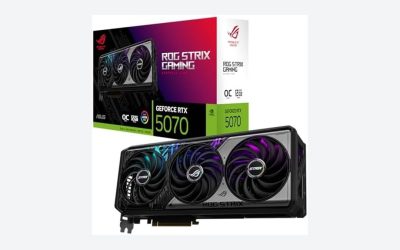
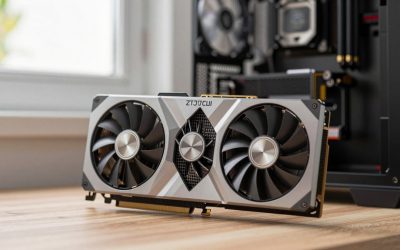
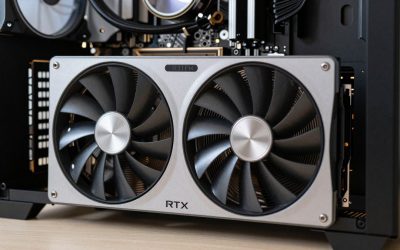
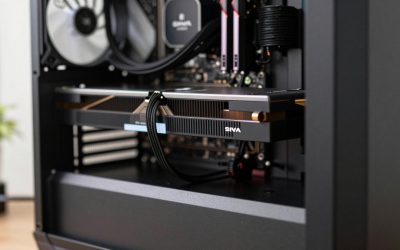
For most buyers, the Arc B580 is the better buy. It delivers gaming performance roughly in the RTX 2080 Ti’s class for far less power, with a warranty, a newer feature set, and 12 GB of VRAM. A used RTX 2080 Ti makes sense only if you find one at or below B580 money, play many older DirectX 11 titles, or run an older platform without Resizable BAR where Arc cards struggle. Raw raster speed is close. The bigger differences are age, efficiency, and platform fit.
- Two Very Different Paths to the Same Performance Tier
- Spec Sheet Comparison
- Raster Performance: Closer Than the Price Gap Suggests
- Ray Tracing, DLSS, and XeSS
- VRAM and Memory: 11 GB vs 12 GB
- Power, PSU, Connectors, and Case Fit
- Buying a Used RTX 2080 Ti in 2026
- Cost per Performance
- Decision Table
- Frequently Asked Questions
As an Amazon Associate we earn from qualifying purchases at no extra cost to you.
Two Very Different Paths to the Same Performance Tier
The RTX 2080 Ti was Nvidia’s flagship in 2018. It launched at $999 with a big 352-bit memory bus, 11 GB of GDDR6, and the first generation of RT and Tensor cores. Six years later, Intel’s Arc B580 arrived at $249 on the Xe2 “Battlemage” architecture. It hits a similar performance tier with fewer shading units, much higher clocks, a large 18 MB L2 cache, and a 190 W power rating. One card is a used former halo product and the other is a current budget GPU, so the comparison is mostly about trade-offs beyond average frame rate.
Spec Sheet Comparison
| Spec | RTX 2080 Ti | Arc B580 |
|---|---|---|
| Architecture | Turing | Xe2 |
| Release date | 20 September 2018 | 13 December 2024 |
| Launch MSRP | $999 | $249 |
| Shading units | 4352 CUDA cores | 2560 |
| Boost clock | 1545 MHz | 2670 MHz |
| Process | 12 nm | 5 nm |
| VRAM | 11 GB GDDR6 | 12 GB GDDR6 |
| Memory bus | 352-bit | 192-bit |
| Bandwidth | 616.0 GB/s | 456.0 GB/s |
| L2 cache | 5.5 MB | 18 MB |
| TDP | 250 W | 190 W |
| Power connectors | 2x 8-pin | 1x 8-pin |
| Interface | PCIe 3.0 x16 | PCIe 4.0 x8 |
| Length / width | 267 mm, 2-slot | 272 mm, 2-slot |
| Outputs | 1x HDMI 2.0, 3x DP 1.4a, 1x USB-C | 1x HDMI 2.1a, 3x DP 2.1 |
Raster Performance: Closer Than the Price Gap Suggests
Benchmark sources do not fully agree on these two cards, so treat the numbers below as a range. Aggregate databases that combine many user-submitted game results show the B580 and RTX 2080 Ti as essentially tied on average. Their 3DMark Time Spy graphics scores are within about 1% of each other. Other comparison sites and some newer-game test suites put the 2080 Ti ahead, in a few cases by a wide margin, especially in games where Arc drivers are less optimized. In major reviews, the B580 tends to land a little below RTX 3070-class performance at 1440p, and that is roughly where the 2080 Ti has always sat.
A fair summary is that the two trade blows in modern DirectX 12 and Vulkan games. The RTX 2080 Ti is anywhere from even to a meaningful margin ahead in older DirectX 11 titles and some less common engines. At 1440p high settings, both typically run demanding current games at roughly 50-80 fps without upscaling. Esports titles run much higher. Results vary with settings, CPU, and game patch.
The CPU overhead caveat
After the B580 launched, Hardware Unboxed and others found that Arc’s driver overhead is higher than Nvidia’s or AMD’s. Paired with older or budget CPUs, the B580 can lose a noticeable share of its performance in CPU-heavy games. With a modern mid-range or better CPU this mostly goes away. If your system has an older six-core chip, the 2080 Ti’s lower CPU overhead can matter more than its spec sheet suggests.
Ray Tracing, DLSS, and XeSS
Both cards have hardware ray tracing, but they are years apart. Turing was Nvidia’s first-generation RT design. Intel’s Xe2 RT units are newer and, by most review accounts, competitive in this class, so the B580 generally matches or beats the 2080 Ti once ray tracing is on. Neither card gives smooth heavy path tracing.
Upscaling is where the 2080 Ti holds up surprisingly well. As an RTX card, it supports DLSS super resolution, including the newer transformer-based DLSS 4 upscaling model that Nvidia extended to all RTX generations. That gives it access to one of the best-looking upscalers in a huge library of games. What it does not get is DLSS Frame Generation, which requires RTX 40 or newer, or DLSS 4 Multi Frame Generation, which is RTX 50 only. The B580 supports XeSS 2, including XeSS super resolution, XeSS frame generation, and Xe Low Latency in supported games. Both cards can also use AMD’s FSR 3 frame generation where games offer it.
In practice, the 2080 Ti has the wider and more polished upscaling support, while the B580 has native frame generation the 2080 Ti lacks.
VRAM and Memory: 11 GB vs 12 GB
The two are nearly level on memory. The B580’s 12 GB is slightly more, but the 2080 Ti’s 352-bit bus gives it about 35% more raw bandwidth (616 vs 456 GB/s). The B580’s 18 MB L2 cache reduces that disadvantage. Both have enough memory for 1440p high textures in the large majority of current games, which is a real advantage over 8 GB cards in the same price range. For 4K ultra textures, both are at their limit.
Power, PSU, Connectors, and Case Fit
The B580 is rated at 190 W and uses a single 8-pin connector. The RTX 2080 Ti is rated at 250 W and needs two 8-pin connectors, and many factory-overclocked partner cards draw more. PSU sizing using GPU TDP + CPU + about 150 W of headroom:
- B580 + 105 W CPU: 190 + 105 + 150 = 445 W, so a quality 550 W unit is comfortable.
- RTX 2080 Ti + 105 W CPU: 250 + 105 + 150 = 505 W, so aim for a quality 600-650 W unit with two separate PCIe cables.
At 267 mm and 272 mm (reference figures), the two cards have nearly identical footprints and are both two slots wide. Partner versions vary, so measure your case. The 2080 Ti uses a PCIe 3.0 x16 link and does not care whether your board is PCIe 3.0 or 4.0. The B580 uses PCIe 4.0 x8, which can lose a little performance on PCIe 3.0 boards, and it needs Resizable BAR enabled to perform properly. On an older Intel 8th/9th-gen or Ryzen 1000/2000 system without ReBAR, the 2080 Ti is the more reliable upgrade.
Outputs also differ. The B580 has HDMI 2.1a and DisplayPort 2.1, which are useful for high-refresh 4K monitors and modern TVs. The 2080 Ti is limited to HDMI 2.0 and DP 1.4a, plus a VirtualLink USB-C port that few people use today.
Buying a Used RTX 2080 Ti in 2026
Used RTX 2080 Ti cards usually sell for somewhere around $200-$300, depending on condition and cooler design. Because these cards are around eight years old, check a few things:
- Ask about previous use. Long mining or rendering duty can wear out fans and thermal paste.
- Watch for artifacts and crashes under load. Early 2080 Ti boards had a known memory-failure reputation.
- Expect to repaste and possibly replace thermal pads to restore temperatures.
- Assume there is no remaining manufacturer warranty.
A new B580 usually costs about the same or slightly more and comes with full warranty coverage. That alone often decides the matter.
Cost per Performance
At launch prices the comparison is lopsided. Roughly equal performance at $249 versus $999 means the B580 costs about a quarter as much per frame. On today’s market the realistic comparison is a used 2080 Ti at around $200-$300 versus a new B580 near its $249 list price. Assuming similar performance, a 2080 Ti priced at $200 offers slightly better cost per frame. Once you factor in about 60 W of extra power draw, the lack of frame generation, and no warranty, most of that saving disappears.
Decision Table
| Scenario | Pick |
|---|---|
| New build, modern CPU, 1080p/1440p gaming | Arc B580 |
| Older PC without Resizable BAR | RTX 2080 Ti |
| Older or budget CPU in CPU-heavy games | RTX 2080 Ti |
| Large library of DLSS games, no need for frame gen | RTX 2080 Ti |
| Want frame generation and modern display outputs | Arc B580 |
| PSU around 500-550 W, single 8-pin | Arc B580 |
| Want warranty and low risk | Arc B580 |
| 2080 Ti offered well below B580 price, healthy condition | RTX 2080 Ti |
Frequently Asked Questions
Is the Arc B580 as fast as an RTX 2080 Ti?
Broadly, yes, though sources disagree on the exact margin. Several aggregate benchmark databases put the two close to even, while some game-by-game comparisons favour the 2080 Ti, particularly in older APIs. In modern DirectX 12 games at 1080p and 1440p, expect similar performance.
Does the RTX 2080 Ti support DLSS 4?
The 2080 Ti supports DLSS super resolution, including the newer transformer-based upscaling model Nvidia added with DLSS 4. It does not support DLSS Frame Generation or Multi Frame Generation, which need RTX 40 and RTX 50 cards respectively. It can use FSR 3 frame generation in games that support it.
Will the Arc B580 work in my older PC?
The B580 needs Resizable BAR enabled to perform as intended, and it is sensitive to CPU overhead on older processors. Most Intel 10th-gen or Ryzen 3000-series and newer systems support ReBAR after a BIOS update. Without ReBAR, a used RTX 2080 Ti is usually the safer choice.
Which uses less power?
The Arc B580 is rated at 190 W and needs a single 8-pin connector, compared with the 2080 Ti’s 250 W rating and two 8-pin connectors. Over years of gaming, the B580 also produces less heat and fan noise in most cases.
Is a used RTX 2080 Ti risky?
It can be. These cards are about eight years old, are almost always out of warranty, and some suffered memory failures. If you buy one, test it under load, check temperatures, and budget for fresh thermal paste and pads.