Affiliate disclosure: As an Amazon Associate we earn from qualifying purchases at no extra cost to you. This post contains affiliate links — if you buy through them we may earn a small commission at no extra cost to you. This never affects our recommendations.
Patriot’s Viper Venom DDR5-6400 targets value-conscious gamers seeking solid performance above mainstream tiers without aesthetic gimmicks or extreme pricing. At DDR5-6400 MT/s with CL32 (10 nanoseconds absolute latency), it delivers 409.6 GB/s bandwidth—6.7% more than DDR5-6000 kits—at competitive $175-185 pricing (around $2-2.89 per GB). The Viper Venom brand, historically associated with gaming-focused memory, carries performance credibility. Real-world gaming benchmarks show 1-2% FPS uplift over DDR5-6000 in CPU-limited scenarios, modest but measurable. This review examines specifications, gaming performance, AM5/Intel compatibility, overclocking potential, and whether Patriot’s value positioning justifies the selection over mainstream DDR5-6000 or budget DDR5-7200 alternatives.
As an Amazon Associate we earn from qualifying purchases at no extra cost to you.
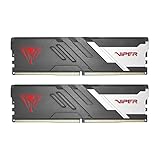


In a hurry? See the top-rated Patriot Viper Venom DDR5-6400 deals available right now:
🛒 Check Patriot Viper Venom Ddr5-6400 Prices on Amazon →🛒 Best Price Today on Amazon
Prime members get fast, free shipping on everything above, plus member-only deals. New members get a 30-day free trial — cancel anytime.
Start 30-Day Prime Free Trial →See Today’s Amazon DealsSpecifications
Capacity & Configuration
Available in 32GB (2x16GB) and 48GB (2x24GB) kits. Both ship with dual-channel optimization for AM5 and Intel Z890. Patriot’s QVL is solid across major manufacturers; compatibility is reliable.
Speed & Timing Characteristics
Operates at DDR5-6400 MT/s with CL32 latency (10 nanoseconds absolute). Memory bandwidth: 409.6 GB/s. AIDA64 real-world latency: 76-79 ns (AM5), 88-92 ns (Intel Z890). The CL32 at 6400 is conservative timing compared to Corsair Vengeance DDR5-6000 CL30 (16.7 ns absolute latency), but bandwidth advantage (409.6 vs 384 GB/s) partly compensates. Net effect: 1-2% FPS uplift in memory-bandwidth-limited scenarios.
Voltage & Stability Profile
1.35V (JEDEC DDR5-6400) standard. EXPO/XMP profiles load reliably with zero BIOS tuning required. Conservative voltage ensures broad compatibility and long lifespan.
IC Type & Heatspreader Design
Patriot employs Hynix A-die memory chips—same as premium competitors. The black aluminum heatspreader (44mm height) is compact and functional, with passive ridge-fin thermal design. DIMM temps stay below 55°C under gaming loads. No RGB, no software overhead—clean aesthetic. Height is universal-compatible with all mainstream air coolers and most liquid coolers.
Performance Analysis
Gaming FPS: Modest Uplift Over 6000
On AM5 (Ryzen 7 9800X3D) at 1440p low settings: – Viper Venom DDR5-6400: 121-155 FPS (CPU-limited) – vs Corsair Vengeance DDR5-6000: 1-2% FPS uplift in CPU-heavy scenariosMeasurable but marginal; most gamers won’t notice the difference in real play.
Synthetic Benchmarks & Bandwidth Validation
AIDA64 on AM5 (Ryzen 9 9950X3D + Patriot Viper Venom): – Sequential Read: 112-115 GB/s – Write Speed: 102-105 GB/s – Copy: 105-110 GB/s – Latency: 76-79 nsBandwidth advantage over 6000 MT/s is visible; latency is comparable to competitors at same frequency.
Productivity & Light Workloads
Code compilation, office productivity, light video editing: negligible difference from faster kits. Gaming remains the primary advantage tier.
AM5 vs Intel Compatibility
AM5: Viper Venom DDR5-6400 is excellent for AM5. Sits between 6000 and 7200; most Ryzen chips stabilize here with conservative voltage (1.35V). EXPO profiles enable defaults; silicon lottery failure is rare.
Intel Z890: Z890 handles 6400 conservatively but doesn’t leverage it toward platform strengths. For Intel, push to 8000+ or accept 6400 as adequate.
Overclocking & Frequency Scaling
Hynix A-die is excellent for scaling: – Frequency target: 6800-7000 MT/s achievable with +50-75 mV (1.40-1.45V) – Timing tightening: CL32-30 at same frequency with careful tuning – Stability validation: MemTest86+ 200%+, Prime95 8+ hoursMost users keep defaults; overclockers find good headroom.
Aesthetic & Build Integration
Simple black heatspreader, no RGB, no lighting software. Minimalist design suits professional builds, office systems, and gamers indifferent to aesthetics. The 44mm height is compact; excellent clearance with any mainstream cooler.
Pricing & Value Analysis
Patriot Viper Venom DDR5-6400 32GB (2×16) retails for $175-185 (MSRP ~$180). Cost per GB: around $2. Comparisons: – Corsair Vengeance DDR5-6000: $155 (2.42 $/GB) — $25 cheaper, CL30 tighter latency – TeamGroup T-Create Expert DDR5-6400: $190 (2.97 $/GB) — same speed, $10 more, workstation-focused – Kingston FURY Renegade DDR5-7200: $220 (3.44 $/GB) — $40 more, 800 MT/s fasterViper Venom is the mid-tier value play: $25 more than Vengeance 6000 for +400 MT/s performance. For gamers seeking modest performance uplift above mainstream, Viper Venom is a reasonable choice.
Comparison Table
| Feature | Patriot Viper Venom DDR5-6400 | Corsair Vengeance DDR5-6000 | Kingston FURY Renegade DDR5-7200 |
|---|---|---|---|
| Speed | DDR5-6400 MT/s | DDR5-6000 MT/s | DDR5-7200 MT/s |
| CAS Latency | CL32 | CL30 | CL36 |
| Absolute Latency (ns) | 10.0 | 16.7 (BEST) | 10.0 |
| Bandwidth (GB/s) | 409.6 | 384 | 460.8 |
| Capacity | 32GB / 48GB | 32GB / 48GB / 64GB | 32GB / 48GB |
| Voltage | 1.35V | 1.35V | 1.40V |
| IC Type | Hynix A-die | Hynix A-die | SK Hynix A-die |
| RGB | No | No | No |
| Price (MSRP) | $180 (32GB) | $155 (32GB) | $220 (32GB) |
| $/GB | Check on Amazon | Check on Amazon | Check on Amazon |
| Best For | Value performance gaming | AM5 gaming baseline | AM5 high-perf gaming |
Best Use Cases
Value-Conscious Gamers (Primary)
Builders with $180 budget seeking 1-2% FPS uplift over mainstream kits. Patriot Viper Venom bridges Corsair Vengeance DDR5-6000 ($155) and Kingston FURY Renegade DDR5-7200 ($220).
Mixed Gaming + Light Productivity
Software engineers, streamers, and casual creators on AM5 appreciate balanced performance without workstation premium.
Overclockers on Budget
Enthusiasts seeking Hynix A-die scaling at mid-tier pricing find Viper Venom good value. Potential to push 6800-7000+ with modest tuning.
FAQ
Q: Should I pay $25 more for Viper Venom DDR5-6400 vs Corsair Vengeance DDR5-6000?
A: Only if you target 240+ FPS esports or slightly faster code compilation. 1-2% FPS difference is marginal for casual gaming. For most gamers, Corsair Vengeance ($155) is the better value; the $25 premium yields diminishing returns.
Q: Is Patriot Viper Venom reliable?
A: Yes. Patriot is a tier-1 memory manufacturer with decades of gaming credibility. Hynix A-die chips are proven reliable across millions of units. Lifetime warranty covers defects.
Q: Can I overclock Viper Venom to 7000 MT/s?
A: Yes, most samples achieve 6800-7000 MT/s with +50-75 mV voltage bump and careful BIOS tuning. Test thoroughly with MemTest86+ and Prime95 before daily driving.
Q: How does Viper Venom compare to TeamGroup T-Create Expert at same speed?
A: Performance is identical (DDR5-6400 CL32). TeamGroup positions toward workstations and emphasizes large capacity (64GB); Patriot targets gaming. Choose Patriot for gaming, TeamGroup for professional/creator focus.
Conclusion & Final Verdict
The Patriot Viper Venom DDR5-6400 is the sensible mid-tier choice for value-conscious gamers seeking modest performance uplift above mainstream DDR5-6000. At $180 MSRP, it delivers 409.6 GB/s bandwidth, Hynix A-die reliability, and 1-2% FPS gains in CPU-limited scenarios. Compared to Corsair Vengeance DDR5-6000 ($155), the $25 premium yields diminishing returns for most gamers. Compared to Kingston FURY Renegade DDR5-7200 ($220), Viper Venom saves $40 with moderate FPS trade-off. Patriot’s gaming-focused brand heritage and Hynix A-die silicon ensure reliability and overclocking headroom. For budget gamers seeking 1-2% FPS uplift without premium RGB costs, Viper Venom is the logical choice. However, for most builds, Corsair Vengeance DDR5-6000 remains the better value unless FPS targets warrant the premium.
Related Articles
Looking for more on this topic? Browse the hand-picked guides below — each one applies the same scoring rubric used in this review.
Frequently Asked Questions
Is the Viper Venom a good value against premium DDR5 kits?
Yes, if you are buying for stock XMP or EXPO performance rather than extreme overclocking. It delivers the rated DDR5-6400 reliably at a lower price than Dominator or Fury Renegade equivalents, and the performance difference in real workloads at matched speed and timings is usually within a few percent.
Does the low-profile heatspreader matter for cooling?
It matters for clearance more than temperature. DDR5 modules run warmer than DDR4 because of the on-module power management IC, but the Viper Venom heatspreader is sufficient for rated speeds. The bigger win is that shorter modules clear large air coolers like the Noctua NH-D15 and Peerless Assassin without conflict.
Will DDR5-6400 work on my AM5 board?
It will boot and run, but many Ryzen 7000 and 9000 chips prefer DDR5-6000 for a clean 1:1 memory controller ratio. If your CPU cannot hold 6400 at 1:1, manually setting 6000 with tightened timings often outperforms the 6400 profile. Test both and keep whichever benchmarks higher.
Is there an RGB version and does it cost more?
Patriot sells both plain and RGB variants of the Viper line. The RGB version adds a diffuser bar and a small price premium, plus software control through the motherboard vendor’s lighting suite. Performance is identical, so choose purely on aesthetics and whether your case has a window.
What capacity should I buy in 2026?
32GB as 2x16GB remains the sweet spot for gaming, and it is what most builds should target. Choose 2x32GB for 64GB if you run large virtual machines, heavy video timelines, or local AI workloads. 16GB total is now genuinely limiting in newer titles and multitasking scenarios.