Nvidia Tesla cards show up on eBay and in used server liquidation lots at tempting prices, and every few months someone on a budget-build forum asks whether a Tesla K80 or M40 is a secret path to cheap VRAM for gaming or AI work. The short answer is almost never, and this article explains why, plus what to actually buy instead depending on what you’re trying to do.
What the Tesla line actually is
Tesla was Nvidia’s brand for datacenter compute GPUs before the name got retired in favor of “Nvidia Data Center GPUs” and later the A100/H100 naming you see now. Cards like the K40, K80, M40, M60, P40, P100, and V100 were built for servers doing scientific computing, rendering farms, or early deep learning workloads. They were never meant to go in a desktop PC, and that’s the root of almost every problem people run into when they try.
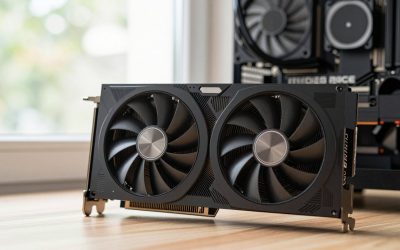
These cards typically have no display outputs at all. No HDMI, no DisplayPort, nothing. They’re passively cooled, meaning they rely on the forced airflow of a rackmount server chassis moving a lot of air through a shroud. Drop one in a mid-tower case with a couple of case fans and it will thermal throttle or shut down under load. Some older models also need auxiliary power connectors that don’t match standard ATX PSU cables, and a few need a riser or specific PCIe slot power delivery that consumer boards don’t guarantee.
Why they’re so cheap
Companies retire server fleets every few years and the GPUs flood secondary markets. A Tesla K80, which had a combined 24GB of GDDR5 across two GPU dies, can sell for well under $50 now. On paper that VRAM figure looks appealing next to a $300 gaming card with 12GB. The catch is that the K80’s individual GPUs are weaker than a modern midrange card, the architecture (Kepler) is from 2014, there’s no video output, and Nvidia dropped driver support for Kepler-era datacenter cards years ago on current driver branches. You can get it running with old drivers in Linux, but you’re fighting software rot the whole way.
Newer Teslas like the P40 (24GB, Pascal) or V100 (16/32GB HBM2, Volta) are more usable for compute tasks and still get reasonable driver support, which is why they show up in budget AI/ML homelab builds. But for gaming they’re a dead end: no display output, no DirectX gaming optimization in the driver stack, and no warranty.
Gaming builds vs compute/AI builds
This is the fork in the road that determines whether a Tesla card makes any sense at all.
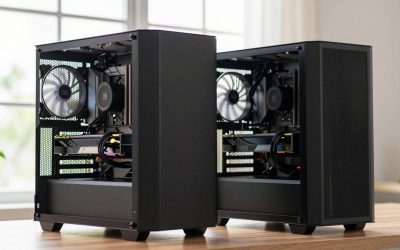
For gaming, skip Tesla entirely. You need a card with video outputs, a gaming-tuned driver (Game Ready drivers vs the datacenter driver branch), and cooling designed for an open-air case. A used GTX 1660 Super or RTX 3060 will outperform a Tesla K80 or M40 in every game you’d actually want to play, cost about the same once you account for a cooling shroud and power adapter, and just work out of the box. If you’re assembling a budget gaming rig, your money is better spent browsing gaming graphics cards in your price range than chasing server surplus.
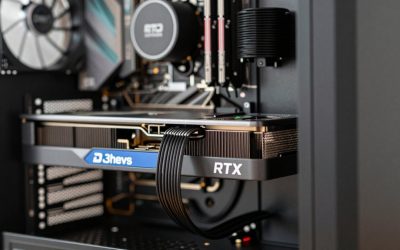
For compute and local AI inference, the calculus changes. If you’re running local LLMs, Stable Diffusion, or CUDA workloads and don’t need a display output on that card (you’d use your motherboard’s integrated graphics or a second cheap GPU for display), a Tesla P40 or V100 can be a legitimately cheap way to get a lot of VRAM. But you need to budget for the extras: a 3D-printed or purchased shroud with a blower fan to force air through the heatsink, a power adapter if your PSU doesn’t have the right connector, and a case with enough airflow and clearance. People doing this seriously often move to an open-frame mining-style chassis rather than a normal case.
How Tesla compares to consumer options
| Card type | Display output | Cooling | Driver support | Best for |
|---|---|---|---|---|
| Tesla K80 / M40 (older) | None | Passive, needs server airflow | Legacy/Linux only | Not recommended for new builds |
| Tesla P40 / V100 | None | Passive, needs shroud + blower | Current, datacenter branch | Local AI/compute homelabs |
| Used RTX 30-series | Yes | Standard case fans | Full Game Ready support | Gaming and light AI work |
| Current RTX 40-series | Yes | Standard case fans | Full Game Ready support | Gaming, streaming, serious AI work |
Who should actually consider a Tesla card
Honestly, a narrow group: people who already run a home server or NAS chassis with real airflow, who are comfortable with Linux driver management, and who want VRAM for compute workloads more than raw speed. If that’s not you, the extra fiddling isn’t worth the savings. For most PC builders, including anyone gaming, doing video editing, or wanting a GPU that just works when plugged in, you want a consumer card with proper cooling and outputs. Shopping for a current-generation RTX card find alternatives or a well-reviewed case fan set to keep any build cool will get you further than hunting server surplus.
If you do go the Tesla route for a compute project, buy from a seller who states the card passed a load test, not just a power-on test. These GPUs sit in warm datacenters running at high utilization for years, and failure rates climb once they hit the used market. There’s no manufacturer warranty waiting to bail you out.
FAQ
Can I use a Tesla GPU for gaming if I add a graphics card adapter for display output?
Not really. Even if you rig up a workaround for video output, the driver stack is built for compute, not gaming, and the hardware itself is old relative to its price. You’ll get worse performance and more hassle than a budget gaming card.
Will a Tesla card fit and run in a normal desktop case?
It will physically fit in most full-size cases, but it won’t cool itself without the airflow a server chassis provides. You need an aftermarket shroud and a dedicated blower fan, or it will overheat under sustained load.
Is the extra VRAM on old Tesla cards worth it for AI image generation?
Sometimes, for compute-only setups where you already have a display GPU and don’t mind Linux driver work. For most people wanting local AI tools to just run, a modern consumer card with 12-16GB is simpler and faster per dollar once you factor in the adapters and cooling you’ll need for a Tesla.
Why don’t Tesla cards have HDMI or DisplayPort?
They were designed to live in racks of servers doing calculations, not driving monitors. Removing display hardware saved cost and space on cards meant to be managed remotely over a network, not plugged into a monitor.