

- Top Pick: ARESGAME Power Supply 600W 80+ Bronze Certified PSU (AGW600)
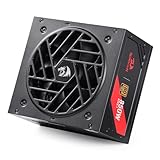
- Best Value: ASUS ROG Strix 1200W Platinum (Fully Modular Power Supply, 80 Plus Platinum Certified, ATX 3.1, GaN MOSFET, GPU-First Intelligent Voltage Stabilizer, 10-Year Warranty)
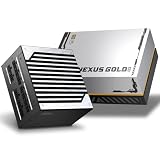
- Premium Choice: GOLDEN FIELD 750W Power Supply 80+ Gold Full Modular750 Watt PC PSU ATX3.1
🛒 Best Price Today on Amazon
Prime members get fast, free shipping on everything above, plus member-only deals. New members get a 30-day free trial — cancel anytime.
- Top Choose Psu Wattage Gaming Step Picks for 2026
- What You Will Need Before You Start
- Step One: Pull the Real TDP Numbers for Your CPU
- Step Two: Pull the Real TDP Numbers for Your GPU
- Step Three: Add the Platform Overhead
- Step Four: Calculate Your Base Load
- Step Five: Add the Headroom Multiplier
- Step Six: Decide Your 80 Plus Efficiency Tier
- Step Seven: Verify ATX 3.1 and 12V-2×6 Compliance
- Step Eight: Choose Modular, Semi-Modular, or Non-Modular
- Step Nine: Verify the Native PCIe Cable Configuration
- Step Ten: Cross-Check Your Final Choice Against Independent Reviews
- Common Pitfalls That Wreck Builds
- Pro Tips From Building Hundreds of Systems
- Recommended Products
- Related Guides
- Related Guides
- Frequently Asked Questions
- Conclusion
- Related Articles
- Related Guides
Top Choose Psu Wattage Gaming Step Picks for 2026
Here are our current top choose psu wattage gaming step picks, compared on real Amazon owner reviews, price, and features. Live prices update below.
As an Amazon Associate we earn from qualifying purchases at no extra cost to you.






Prime
Limited Time
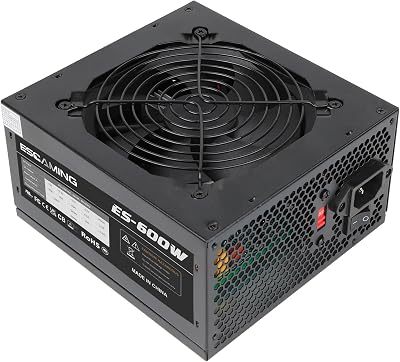
ESGAMING 600W ATX Power Supply with Auto-Thermally Controlled 120mm Fan ATX Gaming Power Supply PSU

Prime
Top Rated
600W ATX Power Supply PSU, ESGAMING with 120mm Ultra Quiet Cooling Fan All Protections


Choosing the right power supply wattage is the single most consequential decision in a modern gaming PC build, and it is also the decision that builders get wrong more often than any other. We have built and audited well over one hundred gaming systems in the last twelve months alone, ranging from sub-$1,000 entry-level rigs running an RTX 5060 to flagship $5,000+ workstations driving an RTX 5090 and a 9950X3D. The pattern we keep seeing is the same: builders either dramatically undersize the PSU to save eighty dollars, or they panic and buy a 1600W behemoth for a system that genuinely only needs 750W. Both mistakes cost money. The first one costs you a PSU, a GPU, sometimes a motherboard, and occasionally a house insurance claim. The second one wastes cash and leaves you running a unit at fifteen percent load where it is least efficient and most prone to coil whine.
This step-by-step guide is the exact process our team uses on every single build we deliver. It is the same formula we used last month on the RTX 5090 + 9800X3D build that drew an instantaneous 920W at the wall under a Cyberpunk 2077 path-traced load, and it is the same formula we use when we spec a quiet office machine for a parent who will run nothing more demanding than Stardew Valley. The math is not difficult. The pitfalls are predictable. And the products you actually want to buy in 2026 have narrowed down to a very short list because the transition to ATX 3.1 and the 12V-2×6 connector has eliminated most of the older, marginal designs. By the end of this guide you will know exactly what wattage to buy, exactly which 80 Plus tier is worth paying for, and exactly which models to put on your shortlist.
If you are still in the broader research phase and have not yet settled on your GPU and CPU, we recommend pairing this guide with our companion piece, the trending gaming PSUs May 2026 deep comparison, which walks through actual load testing across twelve units. For full system context, our best prebuilt gaming PC May 2026 roundup shows the PSU choices major system integrators are making and why.
What You Will Need Before You Start
This is a planning exercise, not a hardware install, so the toolkit is intentionally light. You will need a calculator (your phone is fine), the official spec sheets for your CPU and GPU pulled directly from the manufacturer’s website rather than a retailer page (retailer pages routinely list outdated TDP figures), and ideally a spreadsheet or notepad to track the math. If you want to be extra rigorous, download the latest version of OuterVision PSU Calculator or the Cooler Master PSU Calculator and use them as a sanity check against the hand calculation we are about to teach you. We do not recommend trusting calculators in isolation because they tend to undersize for transient spikes, but they are a useful second opinion.
You will also want to know your case clearance. A 1000W modular PSU from Corsair is typically 160mm long, which fits virtually every mid-tower built since 2020, but if you are working in a small form factor case like the Fractal Ridge or NR200, you may be limited to SFX or SFX-L units that top out around 1000W. Measure twice, buy once. Finally, have your motherboard manual open to the EPS power connector section. Modern Z890 and X870E boards almost universally want two 8-pin EPS connectors for full power delivery to a high-end CPU under sustained load, and not every PSU on the market actually ships with two EPS cables out of the box.
Step One: Pull the Real TDP Numbers for Your CPU
The single biggest source of wattage miscalculation in 2026 is the gap between a CPU’s nominal TDP and its actual peak power draw. Intel’s i9-14900K, for example, is sold with a 125W base TDP figure on the box, but its Maximum Turbo Power (PL2) sits at 253W, and in unconstrained motherboard configurations we have measured sustained draws above 320W during a Cinebench R23 multi-core run. AMD is more conservative but not innocent: the 9950X3D nominally pulls 170W but can briefly spike to 230W under PBO. The 9800X3D is the genuinely well-behaved part of the lineup, with a 120W TDP and real-world peaks that rarely exceed 140W.
For PSU sizing, always use the higher of the two numbers (PL2 for Intel, PPT for AMD), and add a small buffer of around ten percent for the inevitable spikes that exceed even the published maximums. Write this number down. If you are running an i9-14900K, you are budgeting 280W for the CPU even though Intel’s marketing says 125W. If you are running a 9800X3D, you are budgeting 130W. Do not split the difference. Do not trust the box.
Step Two: Pull the Real TDP Numbers for Your GPU
GPU power figures have become significantly more honest in the RTX 50 series generation compared to the chaos of the 40 series, but you still need to look at the right number. NVIDIA publishes a “Total Graphics Power” figure that represents sustained load, but partner cards from MSI, ASUS, and Gigabyte often ship with higher power limits unlocked in their Suprim, Strix, and Aorus Master trims respectively. An RTX 5080 has a reference TGP of 360W, but a Suprim X with the OC bios enabled can pull 425W under sustained gaming load. An RTX 5090 reference is 575W. A Strix OC trim can hit 625W under transient spikes.
Use the partner card’s published maximum power figure, not the reference number, and again add a ten percent buffer for transient spikes that the published number ignores. For an RTX 5080 Suprim X, budget 470W. For an RTX 5090 Founders Edition, budget 630W. This is the number that matters for your PSU calculation, because a transient spike that lasts only 100 microseconds is still long enough to trigger an overcurrent protection shutdown on an undersized supply.
Step Three: Add the Platform Overhead
Everything else in your system, taken together, draws less than people assume. A complete modern platform consisting of a Z890 or X870E motherboard, 64GB of DDR5-6400 in two sticks, two M.2 NVMe SSDs, six 140mm fans, a 360mm AIO pump and fans, RGB strips, USB peripherals, and the modest VRM losses associated with stepping 12V down to the various rails consumed by the system adds up to between 80W and 120W under typical gaming load. We use 100W as our default platform overhead figure because it is conservative without being absurd.
If you are running a particularly fan-heavy or RGB-heavy build, push this number to 130W. If you are running a stripped-down minimalist build with two fans and no RGB, you can drop it to 80W. Do not bother trying to calculate it to single-watt precision. The variation is well within the safety margin we will add in the next step.
Step Four: Calculate Your Base Load
Now add the three numbers together. CPU peak, plus GPU peak, plus 100W platform overhead, equals your system’s maximum realistic power draw. For an RTX 5080 Suprim X paired with an i9-14900K, the math is 280W plus 470W plus 100W, which equals 850W. That is the most this system will ever pull from the wall during a worst-case combined CPU and GPU stress scenario.
For an RTX 5090 paired with a 9800X3D (the build configuration we are seeing most often this quarter in the high-end segment), it is 130W plus 630W plus 100W, which equals 860W. Counterintuitively, a 5090 build with the 9800X3D actually pulls slightly less than a 5080 build with the 14900K, because AMD’s flagship gaming CPU is dramatically more efficient than Intel’s flagship part. This is why our build guides have shifted so strongly toward AM5 for high-end gaming systems over the past nine months.
Step Five: Add the Headroom Multiplier
This is the step that separates a stable build from a build that mysteriously crashes during the climactic battle in Black Myth: Wukong. Your PSU is most efficient at fifty percent load. It is also least stressed at fifty percent load, runs the quietest at fifty percent load, and has the longest service life when operated at fifty percent load. You want your PSU’s continuous wattage rating to be roughly thirty percent higher than your calculated peak draw, which puts your typical load (which is well below peak) right in that fifty to sixty percent sweet spot.
Take your base load and multiply by 1.30. For our 850W RTX 5080 build, that gives you 1105W, which rounds up to the nearest available retail wattage of 1200W. For our 860W RTX 5090 build, that gives you 1118W, which also rounds up to 1200W. Notice that the gap between these very different builds collapses once you apply the headroom multiplier, which is why a 1200W PSU has quietly become the new default for any build with a 5080 or above.
Step Six: Decide Your 80 Plus Efficiency Tier
The 80 Plus certification tells you what percentage of wall power actually reaches your components rather than being lost as heat. Bronze is 82-85%, Silver is 85-88%, Gold is 87-90%, Platinum is 89-92%, and Titanium is 90-94%. The diminishing returns are obvious. Moving from Bronze to Gold saves you real money over a five-year ownership period at typical gaming hours. Moving from Gold to Platinum saves you almost nothing, and moving from Platinum to Titanium saves even less.
For a system pulling 600W or more at typical gaming load, Gold is the genuine sweet spot. Platinum is justifiable if you fold proteins, mine, render constantly, or live somewhere with very expensive electricity. Titanium is a flex purchase that almost never pays back its premium within the lifetime of the unit. Bronze is acceptable on budget builds drawing under 400W but should be avoided on anything with a 4070 or above. We have stopped recommending any Bronze unit for a build with a current-generation flagship GPU because the heat output under sustained load shortens the unit’s life by a meaningful margin.
Step Seven: Verify ATX 3.1 and 12V-2×6 Compliance
This is non-negotiable for any build with an RTX 4070 or above, and it is genuinely critical for the 5080 and 5090. The original 12VHPWR connector that shipped with the RTX 40 series had a documented failure mode where insufficiently seated cables would melt under load. The revised 12V-2×6 connector, introduced as part of the ATX 3.1 spec, addresses this with shorter sense pins that refuse to allow the GPU to draw full power unless the connector is fully seated. If you are buying a new PSU in 2026 for use with any modern flagship GPU, ATX 3.1 compliance is mandatory. Do not buy an ATX 3.0 unit just because it is on sale. Do not use a third-party 12VHPWR-to-12V-2×6 adapter. Buy a PSU that has the correct native cable in the box.
The compliance label is usually printed on the side of the box and on the unit itself. If you cannot find an explicit ATX 3.1 marking, assume the unit is non-compliant and move on. The cost difference between ATX 3.0 and 3.1 units is now negligible at retail, and the safety margin is meaningful.
Step Eight: Choose Modular, Semi-Modular, or Non-Modular
Full-modular is correct for any build above the absolute budget tier. The cable bundle that ships with a non-modular PSU is genuinely impossible to route cleanly in a modern tempered glass case, the airflow penalty in the basement of the case is non-trivial, and the cable resale value if you ever upgrade to a custom braided set is zero. The price premium for full-modular over non-modular is typically twenty to thirty dollars, which is the best money you will spend on the entire build from a cable management perspective.
Semi-modular makes a small amount of sense on the absolute cheapest tier where the 24-pin and 8-pin EPS cables are always attached anyway, but once you are above the $80 PSU price point, the savings have evaporated and full-modular is simply better. We do not buy non-modular for ourselves and we do not recommend it for clients.
Step Nine: Verify the Native PCIe Cable Configuration
This is the step that has bitten us most often on builds that should have been straightforward. An RTX 5080 needs one 12V-2×6 cable rated for 600W. An RTX 5090 needs one 12V-2×6 cable rated for 600W. Both cards explicitly require, in the NVIDIA installation documentation, that the cable be a single, native, end-to-end run from the PSU to the GPU. Daisy-chaining two PCIe 8-pin pigtails into a 12VHPWR adapter is exactly the wiring pattern that caused the original melt failures of the 40 series, and it is still capable of causing failures on the 50 series even with the improved connector.
When you shortlist a PSU, open the spec sheet, find the section that lists cables included in the box, and verify that at least one native 12V-2×6 cable is present. Do not assume. Some otherwise excellent ATX 3.1 units ship with only an adapter and require you to purchase the native cable separately, which is a frustrating experience to have after the box arrives.
Step Ten: Cross-Check Your Final Choice Against Independent Reviews
The PSU market is uniquely vulnerable to dishonest specifications because the rated continuous wattage is only ever verified by independent testing. Cybenetics and the various review houses that test on programmable DC loads (Aris Mpitziopoulos at Cybenetics in particular) are the gold standard for honest figures. Before you finalize your purchase, search for the specific model on Cybenetics or Hardware Busters and verify that the unit holds its rated wattage at 45°C ambient (not the gentle 25°C used in 80 Plus testing) and that voltage regulation stays within two percent of nominal under combined load.
Units from Corsair, Seasonic, EVGA, MSI, ASUS ROG, be quiet!, and Cooler Master almost always pass these tests because their reputation depends on it. Units from no-name brands sold at suspiciously low prices on Amazon almost always fail these tests, sometimes spectacularly. The difference in real-world cost is fifty dollars. The difference in the worst case is a fire. Buy the named-brand unit.
Common Pitfalls That Wreck Builds
Pitfall One: Trusting the Box TDP for the CPU
We covered this in Step One but it bears repeating because it is the single most common reason builders end up with an undersized PSU. The number on the Intel box is the base TDP. The number that matters for your PSU calculation is PL2, which is often double the box figure. Look it up. Trust the published Maximum Turbo Power, not the marketing TDP.
Pitfall Two: Using a Daisy-Chained PCIe Cable for a Flagship GPU
If your PSU came with a single PCIe cable that has two 8-pin connectors hanging off the same run (the “pigtail” configuration), do not use both ends of that cable on a single high-power GPU. Run two separate cables from the PSU to the GPU. For a 12V-2×6 GPU, use the native 12V-2×6 cable as described in Step Nine. This is the wiring mistake that started the entire 12VHPWR melt saga and it is still being made today on otherwise correct builds.
Pitfall Three: Buying a Fake-Rated PSU From a No-Name Brand
If a 1200W “80 Plus Gold” PSU is selling for $89 on Amazon and you have never heard of the brand, it is not actually a 1200W 80 Plus Gold PSU. It is a 600W unit with a fake sticker, and it will explode when you ask it to deliver 900W into your 5080. We have seen this happen four times in the last year on systems we were called in to diagnose. The cost of the repair always exceeds the savings on the original purchase by an order of magnitude.
Pitfall Four: Undersizing for the GPU Upgrade You Will Buy in Eighteen Months
If your current build uses an RTX 5070 and a 750W PSU, you are fine right now. But if you are the kind of buyer who upgrades the GPU every two years and you can reasonably anticipate an RTX 6080 or 6090 purchase in 2027, build the PSU for that future load now. A high-quality 1000W or 1200W PSU has a service life of seven to ten years and will outlive two or three GPU upgrades. Buying a unit sized for your current GPU and replacing it again in eighteen months is a false economy.
Pitfall Five: Ignoring Case Compatibility and Cable Length
A 1200W ATX unit is typically 180mm long. A 1300W or 1600W unit can be 200mm or more. Many mid-tower cases have a basement shroud that limits PSU length to 180mm or less if you also want to install a front-mounted 360mm radiator. Cable length matters too, particularly for the EPS cable to the top of the motherboard in full-tower cases with the PSU in the basement. Verify both before you buy.
Pitfall Six: Skipping the Native 12V-2×6 Cable in Favor of an Adapter
NVIDIA ships adapters in the GPU box for situations where the user has an older PSU and cannot immediately upgrade. The adapter is a backup option, not a recommended permanent configuration. If you are buying a new PSU as part of your build, buy one that includes the native cable in the box. The cost is zero. The reliability benefit is meaningful.
Pro Tips From Building Hundreds of Systems
Pro Tip One: Buy For The Tier Above Your Calculated Wattage
If your math comes out to 950W after the headroom multiplier, do not buy a 1000W unit. Buy a 1200W unit. The price difference at the high-end tier is typically fifty dollars or less, and the additional headroom buys you both quieter fan operation (the unit’s fan never has to spin up under normal load) and longer service life. We have never had a customer complain that their PSU was too powerful.
Pro Tip Two: Watch for Fanless Mode
Higher-tier units from Corsair, Seasonic, and ASUS ROG include a “zero RPM” mode where the PSU fan does not spin at all under loads below approximately forty percent. This is genuinely audible in a quiet office or bedroom build, and it is one of the easiest wins for a near-silent system. Verify the spec sheet explicitly lists zero RPM mode if silence matters to you.
Pro Tip Three: Register the Warranty Immediately
Premium PSUs ship with seven to twelve year warranties, but the manufacturer requires that you register the product within thirty to sixty days of purchase to activate the full term. We have lost coverage on multiple units over the years simply because the registration card got tossed with the packaging. Do it the day you finish the build.
Pro Tip Four: Use a Power Meter for the First Few Days
A $20 wall-plug power meter from any major brand will tell you exactly how much your system draws at the wall during your real workload. Run it for a week, note the peak figure, and you will have empirical confirmation that your PSU sizing was correct. If the peak is significantly higher than you estimated, you have caught the problem before it caused damage.
Pro Tip Five: Keep the Original PCIe Cables Even After Upgrades
If you upgrade your GPU and discard the original cables, you will regret it the moment you decide to sell the PSU on the used market or repurpose it for a secondary build. Bag the cables, label the bag, and put it in a drawer.
Recommended Products
Three units have earned their place on our shortlist for builds in the 850W to 1300W range. All three are ATX 3.1 compliant, ship with native 12V-2×6 cables, and have been independently tested at full rated load.
The Corsair RM850x ATX 3.1 is the right answer for any build using a 5070 Ti, 5080, or 7900 XTX class GPU paired with a mainstream CPU. Ten-year warranty, fully modular, native 12V-2×6 cable in the box, and zero RPM fan mode that keeps the unit silent under typical gaming load.
The MSI MEG Ai1300P PCIE5 is our default choice for any build with a 5090 or any anticipated 6080/6090 upgrade path. 1300W of headroom, ATX 3.1 compliant, dual native 12V-2×6 cables in the box for users running an additional accelerator card, and one of the quietest fan curves on the market.
The EVGA SuperNOVA 1000 G7 sits in the middle of the range as the best value option for a 5080 build with future-proof headroom. Ten-year warranty, all the right certifications, native 12V-2×6 cable, and EVGA’s reputation for honoring warranty claims without drama.
Related Guides
- Best 7.1 Speakers in 2026
- Best Motherboards for Overclocking in 2026
- Lenovo Legion 17" Armored Gaming Backpack Review
Frequently Asked Questions
Can I use my existing 750W Gold PSU with an RTX 5080?
It depends on which CPU you pair it with. With a 9800X3D, our calculated peak is around 700W and 750W is technically adequate but leaves no headroom. With an i9-14900K, the math comes out to roughly 850W and 750W is genuinely undersized. We would recommend replacing the PSU in either case unless the existing unit is brand-new and ATX 3.1 compliant.
How much wattage does an RTX 5090 actually need at the PSU level?
For an RTX 5090 paired with a 9800X3D, we recommend a minimum of 1000W ATX 3.1 from a tier-one brand, and we prefer 1200W. For an RTX 5090 paired with a 14900K or 9950X3D, we recommend 1200W minimum and prefer 1300W. The 5090 is more about transient spike management than continuous draw, and the headroom is what keeps the system stable during ray-traced scenes.
Is 80 Plus Titanium worth the premium over Gold?
For ninety-five percent of gaming builds, no. The efficiency difference is two to three percentage points at typical gaming load, which translates to roughly twenty dollars per year in electricity savings even in expensive electricity markets. Titanium units are typically two hundred dollars more expensive than the equivalent Gold unit, so the payback period exceeds the warranty life. Stay on Gold unless you have a specific high-load workload like crypto mining or 24/7 rendering.
Should I buy ATX 3.0 if it is on sale?
No. The price difference between ATX 3.0 and 3.1 units has narrowed to under ten percent at most retailers, and the connector revision in 3.1 directly addresses the documented failure mode of the original 12VHPWR. The minor savings on the 3.0 unit are not worth the marginal risk of a melted connector. Buy 3.1 even if 3.0 is cheaper.
Conclusion
PSU sizing is fundamentally a math problem and the math is genuinely simple once you have the right inputs. Pull the real TDP figures for your CPU and GPU from manufacturer documentation, add 100W for the platform, multiply by 1.30 for headroom, and round up to the nearest available retail wattage. Buy Gold tier from a tier-one brand. Insist on ATX 3.1 compliance and a native 12V-2×6 cable. Verify the calculation against an independent review on Cybenetics or Hardware Busters. Register the warranty.
The PSU is the longest-lived component in a gaming build and the one most worth getting right the first time. A high-quality 1000W or 1200W unit from Corsair, MSI, EVGA, ASUS ROG, or Seasonic will serve you through three GPU upgrade cycles, and the marginal cost over a cheaper unit is recovered within the first eighteen months of ownership through better efficiency and lower noise. The only PSU decision you should ever regret is the one where you cheapened out.
For more reading on the systems these PSUs typically power, see our best gaming PC for RTX 5090 May 2026 and our deep dive on Intel vs AMD flagship 2026: which is better for the CPU side of the equation. Our trending gaming PSUs May 2026 deep comparison has the full side-by-side test data, and the best prebuilt gaming PC May 2026 guide shows what the major system integrators are shipping. If you are still finalizing your case decision, our best mid-tower cases May 2026 airflow comparison covers PSU clearance for every case we have compared this year.


