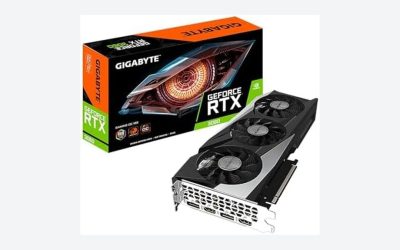
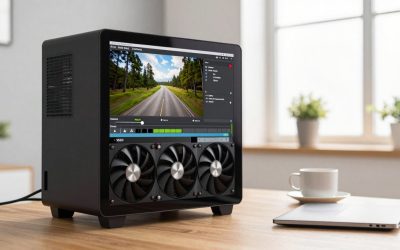
- Top Pick: ASUS Prime GeForce RTX 5070 12GB GDDR7 OC Edition Gaming Graphics Card find alternatives
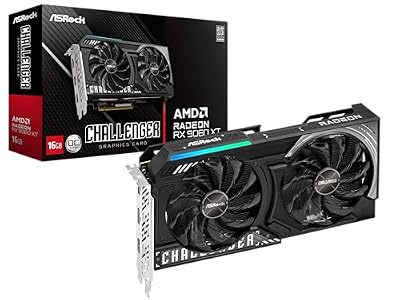
- Best Value: ASRock Radeon RX 9060 XT Challenger 16GB OC, RDNA 4, 3290MHz Boost, 16GB GDDR6 128-bit, PCIe 5.0, Dual Fans, 0dB Silent, LED Indicator, DisplayPort 2.1a, HDMI 2.1b
- Premium Choice: GIGABYTE Radeon RX 9070 XT Gaming OC 16G Graphics Card, PCIe 5.0, 16GB GDDR6, GV-R9070XTGAMING OC-16GD Video Card
How to Read a Graphics Card Review
Most GPU reviews boil down to three questions: how fast is it, how hot and loud does it run, and what does it cost per frame compared to the alternatives. The marketing slide always looks good. What matters is sustained performance after 20 minutes of gaming, not the first 30 seconds before the cooler ramps up and clocks settle. If a review doesn’t mention sustained clocks, fan noise under load, or power draw, it’s not telling you the whole story.
Price-to-performance also shifts constantly because street prices move around MSRP, especially in the first few months after launch. A card that looked like a bad deal at launch can become the best option six months later once prices settle.
As an Amazon Associate we earn from qualifying purchases at no extra cost to you.



The Three Tiers That Actually Matter
Ignore the dozen SKUs each generation and think in three buckets: entry-level (1080p), mid-range (1440p), and high-end (4K or high-refresh 1440p). Buying above your actual monitor resolution is the single most common waste of money I see people make.
| Tier | Typical use case | What to expect | Common failure mode |
|---|---|---|---|
| Entry-level | 1080p, 60-100fps, esports titles | Solid for competitive games, struggles with ray tracing or max settings in AAA titles | VRAM too low (8GB) for newer games at high texture settings, causing stutter |
| Mid-range | 1440p, 60-144fps | Best overall value tier; handles most games well at high settings | Pairing with a weak CPU bottlenecks it in CPU-heavy games |
| High-end | 4K or 1440p ultra-high refresh | Strong ray tracing performance, future-proofing | Power supply undersized for transient spikes, causing random shutdowns |
If you’re shopping entry-level, it’s worth browsing budget graphics cards rather than fixating on one model, since availability and pricing shift weekly and a near-identical card from a different brand is often $20-30 cheaper for the same chip.
What to Actually Check Before Buying
VRAM matters more than people think. 8GB is getting tight for 1440p gaming in newer titles with high-res textures and ray tracing enabled; you’ll see stutter and texture pop-in before the GPU core itself is the bottleneck. 12GB is a safer floor if you plan to keep the card three-plus years.
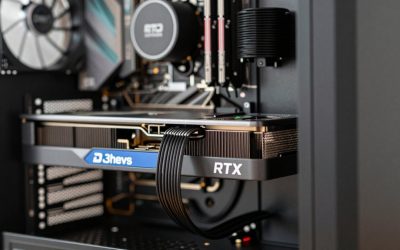
Physical size is the most ignored spec. High-end cards now routinely run 320-340mm long and three slots wide. Measure your case before you buy, not after. Also check the power connector: newer high-end cards use a 12V-2×6 (or older 12VHPWR) connector, and if your power supply doesn’t have a native cable for it, you’re using an adapter, which has had well-documented failure reports when not seated fully. Push it in until it clicks, every time.
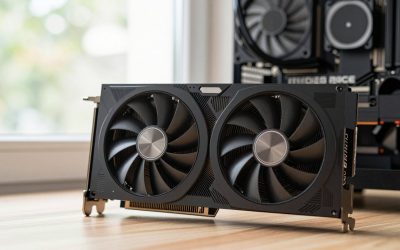
Cooler design affects noise more than it affects temperature. Two cards with the same chip can differ by 10+ dB under load depending on fan curve and heatsink size, and that’s the difference between inaudible and annoying at your desk.
New vs. Used vs. Previous Generation
Buying the previous generation’s mid-range or high-end card once the new generation launches is usually the best value move in the entire market. You give up a bit of ray tracing performance or a new feature set, but you often save 20-30% for 90% of the performance. The exception is if you specifically want a feature tied to the newest architecture (better frame generation, a new encoder for streaming, etc.).
Used cards are fine if you can verify they weren’t run hot 24/7 for mining and the seller allows returns. Check for scratched thermal pads or recently replaced coolers in listings, which can be a sign of a card that was refurbished to hide a problem. If you want current-generation reliability without the premium of the newest flagship, scanning gaming graphics cards find alternatives from the prior generation often turns up the better deal.
Who Should Actually Upgrade
If you’re consistently under 60fps at your target resolution and settings, or your card is lacking enough VRAM to avoid stutter, that’s a real reason to upgrade. “It’s two generations old” by itself is not a reason — plenty of 2-3 year old mid-range cards still handle 1440p gaming comfortably. Benchmark your actual games before assuming you need new hardware; a CPU bottleneck or outdated drivers sometimes masquerade as a GPU problem.
If you’re building a new PC from scratch rather than upgrading one part, it’s worth looking at complete graphics card and PC bundles only if you’ve confirmed the other components (PSU wattage, case clearance) match what the card needs — bundles save shopping time but don’t guarantee compatibility for your specific case.
FAQ
How much should I spend on a graphics card?
As a rough guideline, the GPU should be roughly a third to 40% of your total PC budget. Spending more than that on the GPU while running it with a weak CPU or slow RAM just shifts the bottleneck elsewhere.
Is more VRAM always better?
Not if the core itself is too weak to use it. A weak GPU with 16GB of VRAM won’t suddenly run demanding games well; it’ll just avoid running out of memory. VRAM capacity and core performance need to be matched to your target resolution together.
Do I need to upgrade my power supply when I upgrade my GPU?
Often yes, especially moving into the high-end tier. Check the card’s rated power draw and recommended PSU wattage, add some headroom for transient spikes, and make sure your PSU has the correct native connector rather than relying on an adapter.
Are AMD cards worse than Nvidia for gaming?
Not generally. Nvidia tends to lead in ray tracing performance and has broader support for its upscaling and frame generation tech, while AMD often offers more VRAM per dollar at the same price point. Which one is “better” depends on whether ray tracing and those specific features matter for the games you actually play.