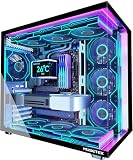
- Top Pick: darkFlash ATX Mid-Tower PC Case, Pre-Install 4 PWM ARGB Fans Computer Case, Full View Dual Tempered Glass Gaming PC Case, Type C Port, Supports up to 360mm Water Cooling Radiator, Black(DS900)
- Best Value: MUSETEX PC CASE ATX 6 PWM ARGB Fans Pre-Installed, Type-C Mid Tower Computer Case with Full-View Dual Tempered Glass, Gaming PC Case,Black(K2)
- Premium Choice: MUSETEX ATX PC Case Pre-Install 6 PWM ARGB Fans, Polygonal Mesh Computer Gaming Case, Opening Tempered Glass Side Panel Mid-Tower Case, USB 3.0 x 2, Black, NN8
Affiliate disclosure: GamingPCGuru is reader-supported. When you buy through links on our site, we may earn an affiliate commission at no extra cost to you. This does not influence our independent reviews.



By Alex Rivera, Hardware Reviewer · May 2026
As an Amazon Associate we earn from qualifying purchases at no extra cost to you. Product prices and availability are accurate as of the date shown and are subject to change.


🛒 Best Price Today on Amazon
Prime members get fast, free shipping on everything above, plus member-only deals. New members get a 30-day free trial — cancel anytime.
How to Choose a PC Case for Gaming: The Mesh-Front Revolution Made Most Cases Obsolete
Quick Answer (TLDR)
In 2026, the case decision is simpler than it has been in a decade. If your case does not have a perforated mesh front panel, walk away. Glass-front and solid-front cases lost the thermal argument permanently when GPUs started routinely drawing 350-450W and CPUs pushed past 200W package power. For most gaming builds, a mid-tower ATX case with mesh front, 7+ PCIe slots, support for 360mm radiators in the top, and at least three pre-installed 140mm fans hits the sweet spot at $90-$140. Lian Li Lancool 217, Fractal North XL, Corsair 3500X, Phanteks G400A — all deliver thermal performance within 2-3 degrees of each other. Spend money instead on fans, cable management, and aesthetics. Avoid sub-$60 cases (they cost you in fans you’ll buy later) and avoid $300+ “showcase” cases unless you are genuinely building a display piece — they rarely cool better than a $130 mesh tower.
The Five Criteria That Matter
1. Front panel airflow defines your thermal ceiling. A solid or glass-front case can lose 10-15C on GPU temperatures versus an identical interior with a mesh front. With modern 4090-class and 5080-class GPUs dumping 350W+ into the case air, restricted intake is the difference between a quiet build and a screaming one. Mesh front is non-negotiable for any build with a high-end GPU.
2. Radiator and fan clearance dictate your cooling options. Verify before purchase: top radiator clearance (280mm vs 360mm vs 420mm), front radiator clearance, GPU length tolerance (modern 4-slot cards push 350mm+), CPU cooler height for air-cooler builds (165mm+ for Noctua NH-D15), and PSU shroud cutouts for modern ATX 3.1 cables.
3. Cable management depth and routing options. Look for at least 25mm of clearance behind the motherboard tray, multiple velcro straps pre-installed, dedicated routing channels for the 12V-2×6 GPU power cable, and PSU shroud cutouts positioned for your motherboard’s connector locations. Bad cable management adds 3-5C to component temperatures and makes future upgrades miserable.
4. Fan inclusion and PWM hub presence. A case that ships with three quality 140mm PWM fans plus an included PWM splitter hub saves you $60-90 in aftermarket fans. Many “premium” cases ship with only two cheap fans, expecting you to upgrade. Calculate the true cost: case price plus the fans you’ll inevitably add.
5. Front I/O and modern connector support. USB-C 3.2 Gen 2×2 (20Gbps) front panel is now standard expectation for any case above $100. Verify your motherboard has the corresponding internal header. Older cases with only USB-A 3.0 front panels feel dated immediately.
Buying Checklist
- Confirm mesh or perforated front panel (or substantial side ventilation)
- Verify GPU length clearance with at least 20mm headroom over your card
- Verify CPU cooler clearance for your specific cooler (air or AIO)
- Confirm radiator support matches your cooling plans (top 360mm minimum recommended)
- Check included fan count and quality (3x 140mm PWM is ideal)
- Verify PSU compatibility (ATX 3.1, 180mm+ length tolerance for high-watt PSUs)
- Check front I/O includes USB-C 3.2 Gen 2 or better
- Verify motherboard form factor support (E-ATX vs ATX vs mATX vs ITX)
- Check drive bay count if you need 2.5″ or 3.5″ storage beyond M.2
- Read recent reviews for build quality and thermal performance benchmarks
Spec Primer: What the Numbers Actually Mean
Mid-tower vs full-tower. Mid-tower (~450mm tall) supports ATX motherboards, dual radiators, and any consumer GPU. Full-tower (550mm+) supports E-ATX, triple radiators, and workstation cards. 90% of gaming builds need only mid-tower. Full-tower is for HEDT, dual-GPU compute, or extreme custom loops.
Mesh vs glass front. Mesh is perforated metal allowing ~70% airflow through. Glass is solid panel allowing ~20% airflow through tiny side gaps. Glass-front cases need fans pulling air in through side panels — typically less effective.
Fan size and pressure. 140mm fans move ~25% more air at the same RPM and noise level versus 120mm fans. Cases supporting 140mm in front and top are generally quieter at the same cooling performance.
Radiator clearance. “360mm support in top” means the case can fit a 360mm AIO with fans. Verify thickness clearance (typically 60mm for radiator + fans, more if you want push-pull configuration).
GPU sag and support. Cards over 1300g typically need vertical bracket support. Some cases include anti-sag brackets in the box; others require aftermarket purchase.
Common Buyer Mistakes
Buying for looks first, thermals second. A gorgeous glass-front showcase case looks great empty, then runs your $1500 GPU 15C hotter than it should under load. The fans spin loud trying to compensate. You regret the purchase within a week.
Underestimating modern GPU dimensions. The RTX 5090 and high-end 5080 partner cards are 3.5-4 slots tall, 350mm long, and weigh 2kg. Many older cases technically “support” the length but the card crashes into front fans or doesn’t leave room for cable routing.
Buying cheap cases to save money. A $50 case typically ships with one cheap intake fan, no cable management, thin steel that resonates, and front panel restrictions. You’ll spend $80 fixing it. Buy a $120 case with three good fans and proper internal layout.
Ignoring PSU shroud cable cutout placement. Modern motherboards have power connectors near the front edge. Some cases position PSU shroud cutouts only at the back, forcing cables across the visible compartment. Verify routing matches your motherboard layout.
Skipping the dust filter check. All intake openings (front, bottom, side) need removable, washable dust filters. Cases without proper filtration accumulate dust into your radiators within 6 months, slashing thermal performance.
FAQ
Is a $300 case worth it over a $130 case? Only for aesthetics, unique form factors (like dual-chamber Lian Li O11 Vision), or specialized cooling layouts. Thermally, the $130 mesh tower competes with or beats most premium cases. The premium pays for materials (aluminum vs steel), build precision, and visual design — not better cooling.
Should I get a dual-chamber case like the Lian Li O11? Dual-chamber separates components from cables/PSU into separate compartments. Great for clean aesthetics and water-cooling loops. Thermally neutral compared to single-chamber mesh towers. Choose for the look and water-cooling, not for cooling improvement.
How many fans should I run total? Three intake (front), one exhaust (rear), and optional two top exhaust (if no top radiator). For builds with top-mounted AIO radiator, the radiator fans handle top exhaust. More than 7 fans rarely improves thermals meaningfully and adds noise and complexity.
Are vertical GPU mounts a good idea? Only if your case has at least 80mm clearance between the GPU and the side glass panel — otherwise you suffocate the card. Even with clearance, vertical mounting typically adds 3-5C versus horizontal. Vertical is a pure aesthetics choice with thermal cost.
Form Factor Reality Check
The 2026 mid-tower ATX case market is so well-developed that even $100 cases deliver excellent thermals. The interesting innovation is happening at the extremes: dual-chamber showcase cases for water cooling enthusiasts, and clever SFF cases like the Fractal Terra and Lian Li A4-H2O that fit full ATX GPUs into 15-liter footprints. For most buyers, the boring answer is the right one: get a mid-tower mesh case from a reputable brand, spend $100-140, and stop optimizing.
Final Take
Cases are a solved problem in 2026 — but only if you ignore the showcase models with restricted airflow. Buy mesh-front, mid-tower, ATX-compatible, with three included 140mm fans and a top 360mm radiator mount. The Lian Li Lancool 217, Fractal North XL, Corsair 3500X, and Phanteks G400A all hit this brief perfectly at $100-140. Spend extra money on aesthetics or unusual form factors only when you have a specific reason — not because expensive cases automatically cool better. They don’t.
Related Guides
- $1200 Gaming PC Build 2026 — Sweet-Spot Gaming PC for 1440p comfortable
- RX 9070 XT Review 2026 — AMD's High-End Value Champion
- RTX 5070 Ti Review 2026 — The 4K Gaming Sweet Spot
Frequently Asked Questions
Which clearance numbers matter most?
Three: maximum GPU length, maximum CPU cooler height and maximum radiator size per mounting position. Current high-end graphics cards run past 330mm and three slots thick, and dual-tower air coolers reach 165mm. Measure against the spec sheet before buying rather than assuming a mid tower will fit everything.
Is mesh really better than tempered glass at the front?
For thermals, yes, and the difference is not subtle. A solid glass front panel can add 5 to 10C to GPU temperatures because intake fans are starved of air. If you want the glass look, choose a case with generous side or bottom intake channels and accept slightly higher fan speeds.
How many fans do I need and in what configuration?
Three intake at the front and one exhaust at the rear is the reliable baseline, producing slight positive pressure that reduces dust ingress. Adding top exhaust helps with an air-cooled CPU. More fans running slowly is always quieter than fewer fans running fast at the same airflow.
What about ATX versus micro-ATX versus ITX?
Mid-tower ATX gives the easiest builds, best airflow and most expansion. Micro-ATX saves desk space with almost no compromise and is often the best value. Mini-ITX is genuinely compact but limits cooler height, GPU size and power supply choice, and costs more for both the case and the components.
Which quality-of-life features are worth paying for?
A front USB Type-C header, a removable and washable dust filter set, tool-free side panels, a PSU shroud for cable tidiness, and at least 25mm of cable routing space behind the motherboard tray. Vertical GPU mounts look good but often restrict airflow into the card unless the riser sits well away from the glass.