- Top Pick: Pterying Work Benches for Garage, 3-Tier, A3 Steel
- Best Value: CAMMOO 120" Garage Work Bench with Power Outlet, Pegboard, Ships in 2 Boxes
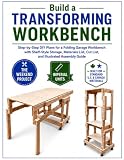
- Premium Choice: Build a Transforming Workbench: Step-by-Step DIY Plans for a Folding Garage Workbench with Shelf-Style Storage, Materials List, Cut List, and Illustrated Assembly Guide (Weekend Projects)
Best Workbenches for a Home Garage
The best workbench for a home garage is the one that matches your available wall space, working height, heaviest project, and need for storage: choose a sturdy adjustable steel bench for a permanent workstation, a folding bench for a compact garage, or a modular cabinet-style bench when organized storage matters as much as the work surface.
- Best Workbenches for a Home Garage
- Quick comparison
- Best permanent heavy-duty choice: Husky 72-inch Adjustable-Height Workbench
- Best for organized hobby work: Seville Classics UltraHD
- Best modular option: Gladiator Modular Workbench
- Best compact and portable choice: Worx Pegasus WX051
- Best fold-away platform: BORA Centipede
- Match the bench to your garage
- How much bench capacity do you actually need?
- Features that matter more than advertised capacity
- Final buying recommendation
Quick comparison
| Workbench | Approx. work surface | Height | Load capacity | Storage | Best fit |
|---|---|---|---|---|---|
| Husky 72-inch Adjustable-Height Workbench | 72 x 24 inches | Adjustable, roughly 38–48 inches | Up to about 3,000 lb, depending on version | Usually open lower shelf; drawers on some variants | Large, permanent work areas and heavy projects |
| Seville Classics UltraHD Workbench | Usually 48–72 x 24 inches, depending on model | Adjustable on many versions | Often several hundred pounds to around 1,000 lb, depending on model | Drawers and lower shelf | Organized hobby, electronics, and repair work |
| Gladiator Modular Workbench | Commonly about 60 x 24 inches | Fixed or adjustable, depending on configuration | Often rated around 1,500 lb | Can pair with Gladiator cabinets and gear | Modular garages that may expand over time |
| Worx Pegasus WX051 | 31 x 25 inches when used as a work table | About 32 inches | Up to 300 lb as a work table | Integrated clamps; no enclosed storage | Small garages, apartments, and occasional projects |
| BORA Centipede Work Stand | Varies by top, commonly 2 x 4 feet or larger | About 30 inches with common setups | Up to about 1,500 lb with a suitable top and configuration | None built in | Fold-away cutting, assembly, and renovation work |
Manufacturer ratings can change between sizes and revisions, so confirm the exact model’s manual before loading it. The listed capacity also assumes an evenly distributed load; a heavy vise or engine part concentrated at one corner puts more stress on the frame than the same weight spread across the top.
As an Amazon Associate we earn from qualifying purchases at no extra cost to you.



Best permanent heavy-duty choice: Husky 72-inch Adjustable-Height Workbench
The Husky 72-inch Adjustable-Height Workbench is a strong choice when the garage has a dedicated wall and the bench will stay assembled. Its 6-foot by 2-foot surface leaves enough room for a vise, hand tools, a small parts tray, and a project without forcing everything into one crowded zone. The thick wood top and steel frame suit woodworking, automotive maintenance, sharpening, and general fabrication better than a lightweight folding table.
Height adjustment is its most useful feature. A height near 36–38 inches works well for heavier tasks where you apply downward force. Raising the surface toward 42–46 inches can reduce bending during electronics repair, model building, or detailed assembly. If two people of different heights share the bench, adjustability is more valuable than a permanently fixed “standard” height.
Allow clearance for the legs and lower shelf before buying. A 72-inch bench needs more than 72 inches of wall width once you account for side clearance, a power strip, and access to nearby drawers or a garage door. It is usually a poor choice if the car must pass within a few inches of the work area.
Best for organized hobby work: Seville Classics UltraHD
Seville Classics UltraHD workbenches favor organization over maximum brute force. Versions with drawers keep sockets, soldering tools, measuring equipment, and fasteners close to the surface instead of consuming the worktop. That matters in a garage because lost tools often create more wasted time than a slightly smaller bench.
Choose a 48-inch version for a narrow wall or a 72-inch version when you regularly work on assemblies wider than a laptop or small appliance. The stainless-steel-style or hardwood surfaces found across the range are suitable for general repair, but use a sacrificial plywood sheet or a rubber mat for welding, aggressive grinding, and oil-soaked automotive work. Check the exact drawer and shelf capacity: UltraHD models are not identical.
A drawer bench is also a practical middle ground for a garage that cannot support a full cabinet system. It offers real storage without requiring the floor depth of a rolling tool chest.
Best modular option: Gladiator Modular Workbench
A Gladiator Modular Workbench makes sense when the garage is part workshop and part storage room. Its approximately 60-inch work surface provides useful space without occupying as much wall as a 72-inch bench, while compatibility with Gladiator storage components makes it easier to add cabinets, shelves, or a rolling unit later.
This is a good match for homeowners who expect their needs to change. Start with the bench and one wall cabinet, then add storage rather than buying a large all-in-one system immediately. The trade-off is cost: modular steel storage generally reaches a higher market range than a basic open-frame bench, often roughly $400–$900 for a bench-centered setup and more as cabinets are added.
Best compact and portable choice: Worx Pegasus WX051
The Worx Pegasus WX051 is better viewed as a portable work table than a traditional garage workbench. Its roughly 31-by-25-inch surface and folding frame make it useful where every square foot matters. It can be stored against a wall, carried to a driveway, or set up only when a project requires it.
Its integrated clamping system is especially useful for cutting trim, sanding boards, drilling, and holding irregular pieces. The approximately 300-pound work-table rating is ample for many household jobs, but it is not a substitute for a steel bench when you need to mount a large vise or work on heavy machinery.
The relatively low working height can be comfortable for seated work but tiring for prolonged standing. If you are choosing a portable bench for detailed electronics or repairs, plan to place it on a stable platform only if that platform cannot slide or raise the center of gravity dangerously.
Best fold-away platform: BORA Centipede
The BORA Centipede is a collapsible support system rather than a complete storage workstation. Add a plywood, MDF, or compatible top and it becomes a broad temporary work surface. When folded, it takes far less wall and floor space than a fixed bench, making it suitable for garages that must remain available for a vehicle.
Its strength is rapid setup for sheet goods, cabinet assembly, painting, and renovation work. Its weakness is the absence of drawers, a permanent vise, and built-in tool organization. It also needs a suitable top: a thin or warped panel can flex even when the frame itself has a high rated capacity.
Match the bench to your garage
| Your situation | Recommended type | Why | Minimum practical target |
|---|---|---|---|
| One-car garage, car must remain inside | Worx Pegasus or folding BORA setup | Can be removed after each project | 24–30 inches of depth; folding legs or casters |
| One-car garage with a permanent side wall | 48-inch drawer bench | Useful storage without excessive footprint | 48 x 24 inches; at least 500 lb capacity |
| Two-car garage and regular woodworking | 60–72-inch heavy-duty bench | Supports long stock, clamps, and a vise | 24–30 inches deep; 1,000 lb or higher capacity |
| Automotive repairs and heavy parts | Steel-framed adjustable bench | More stable under impact and concentrated loads | Boltable feet, thick top, and at least 1,000 lb capacity |
| Electronics, model making, and small repairs | Drawer-equipped adjustable bench | Seated or standing height and small-tool storage | 36–48 inches wide; cable access and a smooth top |
How much bench capacity do you actually need?
Estimate the load before relying on a manufacturer’s headline number. Add the weight of the project, the vise, stored tools, and the force you may apply. For example:
- Project or engine component: 180 lb
- Bench vise: 45 lb
- Tools and parts on the surface: 125 lb
- Downward force while pressing or hammering: approximately 150 lb
The working total is 500 lb. Applying a safety factor of two gives a target capacity of at least 1,000 lb. The calculation is 500 x 2 = 1,000 lb. This does not replace the manufacturer’s rating, but it prevents choosing a 300-pound folding table for a task that repeatedly creates high concentrated loads. For a vise, position it close to a leg or frame upright rather than at the unsupported middle of a wide top.
Features that matter more than advertised capacity
Height and posture
For power-tool or heavy assembly work, a surface around elbow height minus 4–6 inches often provides useful leverage. For fine work, a surface close to elbow height can reduce hunching. A seated setup may need to be around 28–30 inches, while standing benches often land near 36–42 inches. Adjustable feet or legs are valuable on an uneven garage slab.
Mobility
Casters make a large bench easier to reposition but can reduce stability. Locking casters should lock both the wheel and swivel, and the bench should not rock when you push diagonally against it. For heavy work, fixed feet or leveling feet are preferable. A mobile bench also needs enough cable slack and wall clearance so it does not pull equipment off the surface.
Storage and electrical access
Drawers are best for small tools, while an open lower shelf handles bins, compressors, and bulky cases. Check whether the shelf height accommodates your storage boxes before assembly. A rear cable grommet, power strip mount, and space for a task light can be more useful than an extra few inches of surface width.
Assembly time and access
Expect a simple folding stand to be ready in minutes, a bolt-together bench to take roughly 30–90 minutes, and a drawer or modular cabinet system to require several hours. Assemble a permanent bench near its final position: a 72-inch steel frame can be awkward to carry through a narrow garage door after the top and shelf are installed.
Final buying recommendation
Choose the Husky 72-inch adjustable bench for a spacious garage and demanding projects. Choose a Seville Classics UltraHD model when drawers and day-to-day organization are priorities. Choose a Gladiator setup if you want a workshop that can grow. For a compact garage, the Worx Pegasus is the more convenient all-purpose portable table, while the BORA Centipede is better when you need a larger temporary platform and already have a suitable top.
Before ordering, measure the wall, door swing, vehicle clearance, and the path needed to bring the assembled bench into place. Then reserve at least 6 inches of usable surface for a vise, mat, or parts tray; a bench that is technically large enough but constantly covered by tools will feel smaller than its dimensions suggest.
Ready to decide? Our #1 pick for 2026 is the Husky 72-inch Adjustable-Height Workbench.
Live price & availability on Amazon.