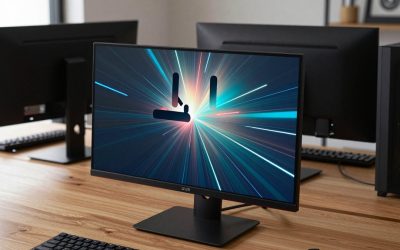
- Top Pick: STORMCRAFT Falcon AI Gaming PC R7 7800X3D,RX 9070 XT 16G,32GB DDR5,1TB SSD
- Best Value: STORMCRAFT Falcon Prebuilt RTX 5070 Gaming PC,R7 7800X3D,32GB DDR5,1TB SSD
- Premium Choice: The Horizon RGB I9 RTX Gaming Desktop Computer PC || Core I9 CPU Upto 5.4GHz || 32GB RAM || 2TB Storage || RTX 5070 || 360MM AIO || 1.2GB/s WiFi, VR and Gaming Ready || Windows 11 Home
Virtual reality is one of the most demanding things you can ask a PC to do. A headset renders two high-resolution images at a high, rock-steady frame rate, and any stutter shows up instantly as discomfort. That puts unusual weight on the CPU: VR rewards strong single-core speed to keep frame times consistent, plus enough cores and threads to handle physics, tracking and the simulation running behind the scenes. Sim racing and flight sims, the bread-and-butter of serious VR rigs, lean especially hard on a fast processor. This guide rounds up the best VR CPUs in 2026 across the budgets people actually shop.
- Best VR CPUs at a Glance
- 1. AMD Ryzen 7 7800X3D 8-Core, 16-Thread Desktop Processor
- 2. AMD RYZEN 7 9800X3D 8-Core, 16-Thread Desktop Processor
- 3. AMD Ryzen 5 5600 6-Core, 12-Thread Unlocked Desktop Processor
- 4. AMD Ryzen 7 5700G 8-Core, 16-Thread Desktop Processor with Radeon Graphics
- 5. AMD Ryzen 5 5500 6-Core, 12-Thread Unlocked Desktop Processor
- 6. Corsair Vengeance i5200 Gaming PC, Core Ultra 9 285K, Liquid Cooled
- How to Choose a CPU for VR
- Frequently Asked Questions
- Related Guides
- Related Articles
Our picks were chosen on what genuinely matters for a smooth headset experience: single-thread performance, core and thread count for simulation workloads, platform value, and overall fit. We have included a deliberate spread — from an affordable around-$84 six-core up to a flagship gaming chip around $420 — because the best VR CPU is the one that balances your headset, your GPU and your budget. One entry on this list is a complete prebuilt PC rather than a standalone processor, and we have called that out plainly so you know exactly what you are buying. Below is an at-a-glance comparison, then a closer look at each option and a buyer’s guide built around the things that decide VR smoothness.
As an Amazon Associate we earn from qualifying purchases at no extra cost to you.



🛒 Best Price Today on Amazon
Prime members get fast, free shipping on everything above, plus member-only deals. New members get a 30-day free trial — cancel anytime.
Best VR CPUs at a Glance
| Product | Best For | Standout Spec | Approx Price |
|---|---|---|---|
| AMD Ryzen 7 7800X3D | Best all-round VR CPU | 8-core, 3D V-Cache, AM5 | around $377 |
| AMD Ryzen 7 9800X3D | Flagship VR / sim racing | Newest 8-core 3D V-Cache | around $420 |
| AMD Ryzen 5 5600 | Best value VR entry | 6-core/12-thread, AM4 | around $146 |
| AMD Ryzen 7 5700G | Compact VR-ready APU | 8-core with Radeon graphics | around $208 |
| AMD Ryzen 5 5500 | Tightest-budget pick | 6-core/12-thread, low cost | around $84 |
| Corsair Vengeance i5200 (prebuilt PC) | Plug-and-play VR rig | Core Ultra 9 285K, liquid cooled | around $6,400 |
1. AMD Ryzen 7 7800X3D 8-Core, 16-Thread Desktop Processor


As an Amazon Associate we earn from qualifying purchases. Product prices and availability are accurate as of the date/time indicated.
The AMD Ryzen 7 7800X3D is our top all-round VR pick, and it is hard to overstate how well suited it is to the job. Its headline feature is 3D V-Cache — a large stacked L3 cache that keeps the game’s working data close to the cores — which is exactly the kind of advantage VR simulations love. With eight cores and sixteen threads on the modern AM5 platform, it pairs that cache with strong single-thread speed at around $377.
For VR and sim racing this is the intent it serves better than almost anything: the enormous cache and high effective gaming speed keep frame times tight and consistent, which is what your eyes and inner ear actually feel inside a headset. Eight cores comfortably handle the physics and background simulation of demanding titles, and AM5 gives you a clear upgrade path. If you want the single best balance of VR smoothness, efficiency and value, the 7800X3D is the chip to build around.
Pros: 3D V-Cache ideal for VR sims, strong single-core, efficient 8-core AM5, superb value.
Cons: Needs AM5 board and DDR5; X3D chips favour gaming over heavy production.
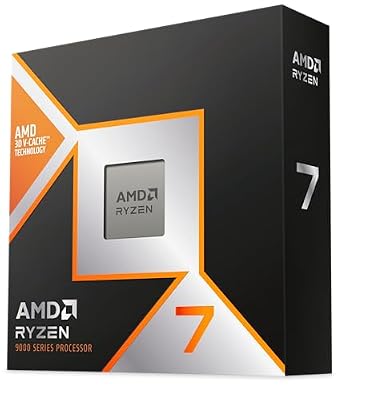
2. AMD RYZEN 7 9800X3D 8-Core, 16-Thread Desktop Processor


As an Amazon Associate we earn from qualifying purchases. Product prices and availability are accurate as of the date/time indicated.
The AMD Ryzen 7 9800X3D is the flagship VR pick — the newest generation of AMD’s celebrated X3D gaming line. It keeps the eight-core, sixteen-thread layout and the all-important 3D V-Cache, but moves to a newer architecture with higher clocks and an improved cache design, so it extends the single-core advantage that VR depends on. At around $420 it is the most expensive standalone processor here, and it is aimed at people who want the best.
This is the CPU for the enthusiast who runs a high-end headset and a top GPU and refuses to leave performance on the table. In sim racing, flight sims and the most demanding VR titles, its faster cores and large cache keep frame delivery extremely consistent, which is precisely what reduces discomfort and preserves immersion. It also overclocks more readily than its predecessor. If your priority is the highest-end VR experience and you have the GPU to match, the 9800X3D is the standout.
Pros: Newest 3D V-Cache, top-tier single-core for VR, 8-core/16-thread, very strong sim performance.
Cons: Highest-priced CPU here; AM5 platform cost adds up for a full build.
3. AMD Ryzen 5 5600 6-Core, 12-Thread Unlocked Desktop Processor

AMD Ryzen 5 5600 6-Core, 12-Thread Unlocked Desktop Processor with Wraith Stealth Cooler
As an Amazon Associate we earn from qualifying purchases. Product prices and availability are accurate as of the date/time indicated.
The AMD Ryzen 5 5600 is the best-value entry point into VR, and a remarkably capable one. It is a six-core, twelve-thread chip on the mature, affordable AM4 platform with solid single-thread speed, shipping with a Wraith Stealth cooler. At around $146 it lets you put more of your budget toward the GPU — which, alongside the CPU, does the heavy lifting for headset resolution.
This is the processor to choose for a sensible mid-range VR build where value matters. Six cores and twelve threads are enough to feed many headsets and handle the simulation behind mainstream VR titles, the single-core speed keeps frame times reasonable, and the cheap AM4 boards and DDR4 memory keep the whole platform affordable. For a balanced rig that gets you comfortably into VR without overspending on the CPU, the 5600 is a smart, well-proven choice.
Pros: Strong value, 6-core/12-thread, affordable AM4 platform, includes a cooler.
Cons: Lacks 3D V-Cache; not the pick for the most demanding high-end headsets.
4. AMD Ryzen 7 5700G 8-Core, 16-Thread Desktop Processor with Radeon Graphics

AMD Ryzen™ 7 5700G 8-Core, 16-Thread Desktop Processor with Radeon™ Graphics


As an Amazon Associate we earn from qualifying purchases. Product prices and availability are accurate as of the date/time indicated.
The AMD Ryzen 7 5700G is the VR-ready APU pick, notable for its integrated Radeon graphics. It is an eight-core, sixteen-thread AM4 chip that can drive a display on its own, which makes it handy for compact builds, troubleshooting without a discrete card, or a system you plan to add a GPU to later. At around $208 it offers a lot of CPU for the money.
An honest note on intent: the 5700G’s integrated graphics are not powerful enough for serious VR on their own — VR still requires a capable discrete GPU. Where this chip earns its place is as the processor in a VR-bound build, where its eight cores and sixteen threads give plenty of headroom for simulation and background tasks once you add a graphics card. Treat it as a strong, flexible eight-core CPU with the bonus of built-in graphics, rather than as a standalone VR solution, and it makes good sense.
Pros: 8 cores/16 threads, integrated Radeon graphics, flexible for compact or staged builds.
Cons: Integrated GPU cannot drive VR; you still need a discrete graphics card.
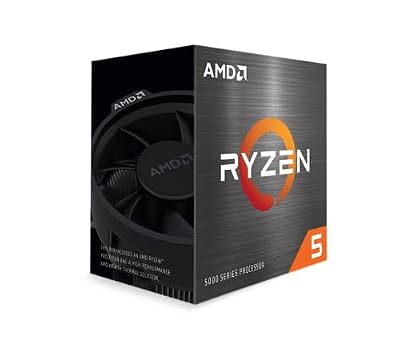
5. AMD Ryzen 5 5500 6-Core, 12-Thread Unlocked Desktop Processor
AMD Ryzen 5 5500 6-Core, 12-Thread Unlocked Desktop Processor with Wraith Stealth Cooler


As an Amazon Associate we earn from qualifying purchases. Product prices and availability are accurate as of the date/time indicated.
The AMD Ryzen 5 5500 is the tightest-budget pick on the list. It is a six-core, twelve-thread AM4 processor that ships with a Wraith Stealth cooler, and at around $84 it is by far the cheapest standalone CPU here. For a first VR-capable build on a strict budget, it gets you in the door for very little.
This is the chip for the budget builder who wants to reach VR and is funnelling every spare dollar into the GPU. Six cores and twelve threads cover the basics of running a headset and the simulation behind lighter VR titles, and the cheap AM4 ecosystem keeps the rest of the build affordable. It is the entry rung rather than the performance choice — its single-core speed and lack of large cache mean demanding sims will lean on it harder — but for getting started in VR cheaply, the 5500 does the job.
Pros: Lowest CPU price here, 6-core/12-thread, includes cooler, easy entry into VR.
Cons: Modest single-core and cache; best for lighter VR with a strong GPU.
6. Corsair Vengeance i5200 Gaming PC, Core Ultra 9 285K, Liquid Cooled

Corsair Vengeance i7500 Gaming PC – Black | Liquid Cooled Intel Core i9-14900KF CPU, NVIDIA GeForce RTX 5080 GPU, 32GB VENGEANCE RGB DDR5 Memory, 2TB M.2 SSD




As an Amazon Associate we earn from qualifying purchases. Product prices and availability are accurate as of the date/time indicated.
Rounding out the list is the Corsair Vengeance i5200 — and an important clarification: this is a complete, pre-built gaming PC, not a standalone CPU. It is built around Intel’s high-end Core Ultra 9 285K processor with liquid cooling, and at around $6,400 it is in a different category from the components above. We include it for buyers who want a finished, VR-ready machine rather than a chip to install themselves.
As a plug-and-play VR rig, the appeal is simplicity and a powerful processor. The Core Ultra 9 285K offers a large core count and strong performance to feed a high-end headset, and Corsair’s liquid cooling and assembly mean you skip the build entirely. Be clear-eyed about value, though: you are paying for a whole system — case, GPU, memory, cooling and labour — so the price is not comparable to the loose CPUs here. If you want a ready-made high-end VR PC and the budget allows, this is the turnkey option; if you are choosing a processor for a build, look to the X3D and Ryzen chips above instead.
Pros: Complete liquid-cooled VR-ready PC, powerful Core Ultra 9 285K, zero build effort.
Cons: It is a full prebuilt PC, not a CPU; far higher price covers the entire system.
How to Choose a CPU for VR
Choosing a CPU for VR starts with single-core speed, because virtual reality lives or dies on frame-time consistency. A headset renders two images at a high, fixed refresh, and any hitch is felt immediately as discomfort, so a processor that delivers strong, steady per-core performance keeps the experience smooth. This is exactly why AMD’s X3D chips — the 7800X3D and 9800X3D here — are so well regarded for VR and sim racing: their large 3D V-Cache keeps the simulation’s data close to the cores and holds frame times tight under load.
Core and thread count are the next consideration, because VR rarely asks the CPU to render alone. Behind the visuals sit physics, vehicle and flight dynamics, tracking and background processes, and modern sims spread that work across several threads. Six cores and twelve threads, as on the Ryzen 5 5600 and 5500, are a sensible floor for mainstream VR; eight cores, as on the X3D chips and the 5700G, give comfortable headroom for the most demanding simulations and any streaming or recording you run alongside.
Remember that the CPU is only half of a VR system — the GPU does the other half, and headset resolution is brutally demanding on graphics. There is no point pairing a flagship processor with a weak graphics card, or vice versa. On a tighter budget, a value CPU like the 5600 leaves more money for a stronger GPU, which is usually the right call for VR. Note too that the 5700G’s integrated graphics cannot drive VR on their own; treat it as a CPU that still needs a discrete card.
Finally, weigh the platform and the form of purchase. AM4 chips like the 5500, 5600 and 5700G ride a mature, affordable ecosystem of cheap boards and DDR4 memory, while AM5 X3D chips cost more up front but offer newer technology and a longer upgrade path. And decide whether you want to build at all: the Corsair Vengeance i5200 is a finished prebuilt PC for those who would rather buy a ready-made VR machine than assemble one. Set your headset and GPU first, match the processor’s strengths to them, and pick the option on this list that fits how you want to get into VR.
Frequently Asked Questions
What makes a CPU good for VR specifically?
Strong single-core speed and consistent frame times matter most, because a headset must hold a high, steady refresh to stay comfortable. Enough cores to run physics, tracking and background simulation alongside rendering come next. That combination is why AMD’s X3D chips like the 7800X3D and 9800X3D, with their large 3D V-Cache, are favourites for VR and sim racing — they keep frame delivery tight under load.
Is the Ryzen 7 5700G enough for VR on its own?
No — its integrated Radeon graphics are not powerful enough for serious VR, which requires a capable discrete GPU. The 5700G is still a strong eight-core CPU and a good processor for a VR build once you add a graphics card; it is also handy for compact systems or staged builds. Just treat its onboard graphics as a convenience, not a VR solution.
Do I need an expensive X3D CPU, or is a Ryzen 5 enough for VR?
It depends on your headset and budget. A six-core chip like the Ryzen 5 5600 or 5500 handles mainstream VR well and frees money for a stronger GPU, which VR badly needs. If you run a high-resolution headset and a top-tier graphics card and want the smoothest sim experience, an X3D chip like the 7800X3D or 9800X3D is worth the extra outlay.
Why is one of the picks a whole PC instead of a CPU?
The Corsair Vengeance i5200 is a complete, liquid-cooled prebuilt gaming PC built around the Intel Core Ultra 9 285K, included for buyers who want a ready-made VR-capable machine rather than a chip to install. Its price covers the entire system, so it is not comparable to the loose processors here. If you are choosing a CPU for a build, pick one of the standalone AMD chips instead.
Related Guides
- Best Gaming CPUs
- Best GPUs for Gaming and VR
- Best Gaming PCs
- Best RAM for Gaming
- Best Motherboards
- Best CPU Coolers
Affiliate Disclosure: As an Amazon Associate, we earn from qualifying purchases. If you click a link and make a purchase, we may earn a small commission at no extra cost to you. Prices and availability are accurate as of publication and may change.