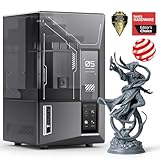
- Top Pick: ELEGOO Mars 5 Ultra Resin 3D Printer | 7" 9K Mono LCD, Smart Automatic Leveling, Intelligent Detection, Wi-Fi Transfer, Printing Size of 6.04 × 3.06 × 6.49 inch
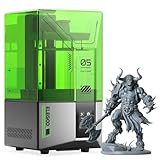
- Best Value: ANYCUBIC Photon Mono 4, Resin 3D Printer with 7'' 10K Mono LCD Screen | Stable LighTurbo Light Source and 70mm/h Fast Printing, Print Volume 6.04'' x 3.42'' x 6.49''
- Premium Choice: ELEGOO Mars 5 Resin 3D Printer | 4K Mono LCD, Automatic Leveling, Desktop 3D Printer with Printing Size of 5.65 × 3.53 × 5.91 inches
For most hobbyists who want fine detail, the Elegoo Saturn 4 Ultra 16K is the usual top pick, the Elegoo Mars 5 Ultra or Anycubic Photon Mono M7 suit newcomers who want a lower entry tier, the Anycubic Photon Mono M7 Max suits larger models, and the Formlabs Form 4 suits professionals such as dental labs and small production shops who value validated materials over price. Resin printing gives smoother surfaces than filament, but it adds washing, curing, gloves and careful waste handling, so decide whether you are ready for that workflow before you choose a machine.
- Resin 3D Printers at a Glance
- How Resin Printing Works and Why It Differs
- Best Resin Printers for Hobbyists and Miniatures
- Best Resin for 3D Printers: Choosing Materials
- Best Dental and Jewelry 3D Printers
- Best Large Resin Printers
- Running Costs and Workflow
- Pick X If… (Decision Table)
- Alternatives
- Frequently Asked Questions
As an Amazon Associate we earn from qualifying purchases at no extra cost to you.


Resin 3D Printers at a Glance
| Printer | Best for | Key stated specs | Limits |
|---|---|---|---|
| Elegoo Saturn 4 Ultra 16K | Miniatures, fine detail | 16K screen; 211.68 x 118.37 x 220 mm; 14 x 19 micron XY; heated tank at 30 C; up to 150 mm/h; tilt release | Mid-range tier; small footprint per batch |
| Elegoo Mars 5 Ultra | Budget-conscious beginners | 9K, 7-inch mono LCD; 153.36 x 77.76 x 165 mm; 18 micron XY; auto-levelling; camera | Smaller build area |
| Anycubic Photon Mono M7 | Balanced detail and size | 10.1-inch 14K screen; 223 x 126 x 230 mm; 16.8 x 24.8 micron XY; up to 150 mm/h with high-speed resin | No temperature-controlled vat (Pro adds it) |
| Anycubic Photon Mono M7 Pro | Faster production runs | Same volume as M7; temperature-controlled vat | Higher tier |
| Anycubic Photon Mono M7 Max | Large-format models | Roundups cite a 14.7-litre build volume | Bulky, resin-hungry |
| Formlabs Form 4 | Professional and dental work | Low Force Display; 50 micron XY pixel size; plus-minus 0.15 percent XY tolerance (maker) | Premium tier, closed ecosystem |
How Resin Printing Works and Why It Differs
Resin printers cure liquid photopolymer layer by layer. Most consumer models use masked stereolithography (MSLA): a UV light shines through an LCD screen that acts as a mask. The wider term SLA describes the family, and Formlabs’ Form 4 uses its own Low Force Display variant. Because every pixel on the screen cures at once, MSLA machines print a full plate in about the same time as a single part, which makes them efficient for batches of small items.
Screen resolution is quoted as 4K, 8K, 12K, 14K or 16K. Higher numbers mean smaller pixels and sharper surfaces on the same area. They do not make the build plate larger, and the pixel size in microns is the better number to compare. The Saturn 4 Ultra 16K lists 14 x 19 microns; the Mars 5 Ultra lists 18 x 18 microns; the Photon Mono M7 lists 16.8 x 24.8 microns.
Best Resin Printers for Hobbyists and Miniatures
Elegoo Saturn 4 Ultra 16K
Multiple 2026 roundups name this the best overall consumer resin printer. Reviewers cite the true 16K screen, the heated tank that keeps resin at about 30 C, the AI-assisted failure detection, and tilt-release peeling that reduces stress on delicate parts. Elegoo lists up to 150 mm/h printing speed. Tabletop-gaming reviewers use it for miniatures because of the fine surface. Sources disagree on the street price and on whether a 12K version is also sold, so check which variant you are looking at before comparing build volumes: the 12K is listed at 218.88 x 122.88 x 220 mm, the 16K at 211.68 x 118.37 x 220 mm.
Elegoo Mars 5 Ultra
Reviewers describe it as a strong budget alternative with sharper detail and more reliable tilt-vat peeling than older Mars models. It adds automatic levelling, a touchscreen and an AI camera. The compact 153.36 x 77.76 x 165 mm volume limits you to a few miniatures per plate or single busts.
Anycubic Photon Mono M7 and M7 Pro
The M7 has a 10.1-inch 14K screen and a 223 x 126 x 230 mm volume. Anycubic lists up to 90 mm/h on standard resin and 150 mm/h on high-speed resin. One roundup recommends it for beginners; another suggests it as the step up when you want 14K detail and more space without paying for the 16K tier. The M7 Pro adds a dynamic temperature-control vat, which helps consistency in cold rooms.
Best Resin for 3D Printers: Choosing Materials
Machines are only half the story. Common resin families include:
- Standard: good detail, brittle; the usual choice for display models and miniatures.
- Tough or ABS-like: better impact resistance for functional parts.
- Water-washable: cleans with water instead of alcohol, though parts and wastewater still need careful handling.
- Flexible and elastomeric: for gaskets and soft grips.
- Castable and dental: specialised, validated materials for jewelry casting and clinical use.
Always use resin that the printer maker or the resin maker lists as compatible with your light wavelength (most are 405 nm) and follow the stated exposure settings. Cheap, unprofiled resin tends to cause failed prints.
Best Dental and Jewelry 3D Printers
Dental and jewelry work is where the professional tier makes sense. Formlabs lists the Form 4 with a 50 micron XY pixel size and plus-minus 0.15 percent dimensional tolerance, validated print settings and an open material mode, and offers a separate Form 4B for medical use. Dental appliances that touch the body require biocompatible, appropriately certified materials and a validated post-processing routine; a hobby printer and general-purpose resin are not a substitute. Consult the material maker’s instructions and, for clinical use, your regulatory requirements.
For jewelry, hobbyists commonly print master patterns in castable resin and send them for lost-wax casting. High-resolution MSLA printers such as the Saturn 4 Ultra 16K suit fine pavé and filigree detail. Check that the resin burns out cleanly and follow the foundry’s guidance.
Best Large Resin Printers
If you need big pieces, such as helmets or large busts, the Photon Mono M7 Max is the large-format pick in roundups. Larger vats hold more resin, cost more to fill and make a failed print more expensive. Splitting a big model into parts on a mid-size machine is often more economical.
Running Costs and Workflow
- Resin: sold by the bottle, usually 1 kg. Standard resin is the lower tier; tough, castable and dental resins cost more.
- Cleaning: isopropyl alcohol at 90 percent or higher, or a washing solution the maker supplies. Used alcohol must be handled as chemical waste.
- Consumables: nitrile gloves, paper towels, filters for resin, spare FEP film or tanks and, on some models, replacement screens.
- Equipment: a wash-and-cure station is a practical addition for regular use.
Safety guidance from printer and resin makers is consistent. Liquid resin can cause skin sensitisation, so wear nitrile gloves and eye protection, ventilate the room, wash before curing, and never pour resin or contaminated alcohol down a drain. Cure leftover resin and contaminated towels under UV before disposal and follow local waste rules. If resin contacts skin, wash with soap and water and seek medical advice if irritation develops.
Pick X If… (Decision Table)
| If you want… | Pick | Why |
|---|---|---|
| Best overall detail for hobby use | Elegoo Saturn 4 Ultra 16K | 16K, heated tank |
| A lower entry tier | Elegoo Mars 5 Ultra | Auto-levelling, camera |
| More space than Mars | Anycubic Photon Mono M7 | 223 x 126 x 230 mm |
| Consistency in a cool room | Anycubic Photon Mono M7 Pro | Temperature-controlled vat |
| Large models | Anycubic Photon Mono M7 Max | Large-format volume |
| Professional, dental or production use | Formlabs Form 4 | Validated materials |
Alternatives
- Anycubic Photon Mono 4: named in roundups as the best resin option at the lowest tier.
- FDM printers: for functional parts and larger sizes, a Bambu Lab A1 or Elegoo Centauri Carbon avoids resin handling entirely.
- Print services: if you only need a few resin parts, outsourcing avoids equipment and safety overhead.
Frequently Asked Questions
Is a resin printer better than a filament printer?
Resin is better for small, detailed parts and smooth surfaces. Filament is better for large, strong and low-maintenance projects. Many owners eventually keep one of each.
Are resin printers safe at home?
They can be used at home with ventilation, nitrile gloves, eye protection and careful waste handling. Liquid resin is a skin sensitiser, so avoid contact and follow the safety data sheet. Keep them away from children and pets.
What is the difference between SLA and MSLA?
SLA traditionally uses a laser to trace each layer, while MSLA uses an LCD screen to cure the whole layer at once. Consumer machines are almost all MSLA, and the terms are often used interchangeably in shopping guides.
Does a higher K number mean a better print?
Higher resolution gives smaller pixels, which helps with fine detail on small models. It does not increase build size, and calibration and resin quality matter just as much. Compare the micron pixel size rather than the K number alone.
Can I use a resin printer for dental or medical parts?
Only with materials and workflows that are certified for that use. Hobby printers and general resins are not suitable for appliances worn in the mouth. Ask the material maker and a qualified professional.
How do I dispose of waste resin?
Cure leftover resin, failed prints and contaminated towels under UV light until solid, then dispose of them according to local rules. Do not pour liquid resin, alcohol or rinse water down a drain.