- Top Pick: Midea MRS25I7BST 24.5 Cu. Ft. Stainless Counter-Depth Side-by-Side Refrigerator with AutoFill Water Pitcher
- Best Value: Samsung 17.5 cu. ft. Smart Counter Depth 3-Door French Door Refrigerator, Stainless Steel, RF18A5101SR/AA
- Premium Choice: KoolMore 30-Inch and 18.5 cu. ft. Counter Depth French Door Refrigerator with Three Doors and Deep Freezer in Stainless-Steel (KM-RERFDSS-18C)
The best counter-depth refrigerators for most kitchens are the LG LRFLC2706S for maximum usable space, Bosch B36CL80ENS for precise temperature control, Samsung RF23A9675 for a flexible four-door layout, and GE Profile PYE22KYNFS for a balanced French-door design.
- Best counter-depth refrigerators compared
- Head-to-head: which refrigerator fits your kitchen?
- True dimensions: the measurement that prevents installation failures
- Usable capacity matters more than the cubic-foot headline
- Temperature control and energy use
- Ice systems: convenience versus storage
- Decision matrix
- Final buying checklist
Counter-depth does not mean every refrigerator will sit flush with your cabinets. The cabinet box may be around 24–25 inches deep, but doors, hinges, handles, air gaps, and rear plumbing can push the total installed depth to 30–34 inches. Compare the complete installation dimensions—not just the advertised cabinet depth—before choosing.
As an Amazon Associate we earn from qualifying purchases at no extra cost to you.

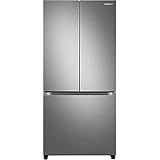


Best counter-depth refrigerators compared
| Model | Approx. capacity | Overall depth with handles | Layout | Best for | Typical market range |
|---|---|---|---|---|---|
| LG LRFLC2706S | 26.5 cu. ft. | About 32 inches | French door, bottom freezer | Maximum capacity in a counter-depth format | Usually $2,000–$3,000 |
| Bosch B36CL80ENS | About 20.5 cu. ft. | About 29 inches | French door, bottom freezer | Temperature stability and premium fit | Usually $3,000–$4,500 |
| Samsung RF23A9675 | About 23 cu. ft. | About 28.5 inches | Four-door, convertible lower-right compartment | Flexible storage and narrow door swing | Usually $2,000–$3,500 |
| GE Profile PYE22KYNFS | About 22.1 cu. ft. | About 31 inches | French door, bottom freezer | Balanced features and easy organization | Usually $2,000–$3,200 |
| Whirlpool WRQA59CNKZ | About 19.4 cu. ft. | About 31–32 inches | Four-door refrigerator/freezer | Separating frequently used frozen food | Usually $1,800–$2,800 |
Dimensions vary by trim, handle, hinge cover, and regional specification. Treat these figures as comparison ranges and confirm the installation drawing for the exact model before ordering.
Head-to-head: which refrigerator fits your kitchen?
LG LRFLC2706S: best for usable capacity
The LG LRFLC2706S is the strongest choice when a counter-depth refrigerator must replace a larger standard-depth appliance without making the household give up much storage. Its roughly 26.5-cubic-foot rating is unusually high for this category, with wide refrigerator shelves and a full-width cooling layout.
The important qualification is that rated capacity is not the same as usable capacity. Ice makers, drawer mechanisms, shelf thickness, and door bins consume space. A large French-door refrigerator can still be less convenient than a smaller model if the center divider prevents wide trays from fitting or the freezer drawers become difficult to sort.
Choose the LG when you regularly store large produce containers, party platters, or multiple gallon-size items. Its greater depth may require more clearance in a narrow walkway than a true shallow-depth model.
Bosch B36CL80ENS: best for temperature control
The Bosch B36CL80ENS prioritizes food-preservation features, compartment separation, and a built-in appearance. Its dual-compressor design and independent cooling approach are more meaningful than a long list of app features: separating refrigerator and freezer air reduces odor transfer and lets each compartment maintain its own temperature target.
It gives up several cubic feet to the LG, but that trade-off can improve day-to-day access. The interior is easier to manage for a smaller household that values stable temperatures over maximum bulk storage. Bosch models in this class also tend to be particularly sensitive to proper installation, including ventilation and accurate cabinet spacing.
Choose it when fresh-food quality, quiet operation, and a shallow visual profile matter more than storing the largest possible weekly shop.
Samsung RF23A9675: best for flexible four-door storage
The Samsung RF23A9675 uses a four-door configuration with a convertible lower-right compartment. That compartment can operate as freezer space or refrigerator space, giving the layout a practical advantage over a fixed freezer when your storage needs change.
Four-door models also reduce door-swing conflicts because each door is narrower. This is useful beside a wall, island, or perpendicular cabinet. The trade-off is more hinges, seals, and drawer partitions, plus less flexibility for very wide refrigerator shelves.
Choose this model when you need a separate zone for drinks, children’s snacks, deli items, or extra fresh food. Before buying, check whether the water and ice configuration consumes interior shelf space in a way that affects your preferred containers.
GE Profile PYE22KYNFS: best balanced French-door option
The GE Profile PYE22KYNFS is a sensible middle ground: a familiar French-door layout, around 22 cubic feet of capacity, external water and ice, and an interior that works well for everyday groceries. It is not the shallowest or roomiest option, but its proportions suit many existing 36-inch refrigerator openings.
The key advantage is predictability. French-door shelves keep fresh food at eye level, while the lower freezer separates frozen food from the main refrigerator. If you want a conventional arrangement without paying for a highly specialized layout, this class of GE Profile refrigerator is easy to justify.
Whirlpool WRQA59CNKZ: best for compartment access
The Whirlpool WRQA59CNKZ uses four separate compartments rather than one large lower-freezer drawer. That arrangement makes frequently used frozen food easier to reach and can reduce the amount of bending required.
Its approximately 19.4-cubic-foot capacity is modest, so it is better for one or two people, a secondary kitchen, or a household that shops frequently. It is a poor match for anyone who freezes large boxes, whole pizzas, or bulk packages.
True dimensions: the measurement that prevents installation failures
Measure these five dimensions before comparing models:
- Opening width: Measure at the top, middle, and bottom. Walls and cabinets are not always parallel.
- Opening height: Include the flooring thickness if the refrigerator will sit on a raised platform or new tile.
- Cabinet depth: Measure from the rear wall to the front face of the cabinet, excluding countertop overhang.
- Door and handle depth: This determines how far the refrigerator projects into the walking path.
- Delivery path: Measure doors, hallways, stair turns, and the final opening—not just the kitchen.
Allow room for the manufacturer’s specified top and side clearances. Also leave enough rear space for the water line, power cord, and air circulation. A refrigerator that technically fits but cannot open its doors far enough to remove drawers is not a successful installation.
Usable capacity matters more than the cubic-foot headline
Use this quick calculation to estimate whether a model will feel large enough. If a household normally needs 5 cubic feet of fresh-food space per person and 2 cubic feet of freezer space per person, a family of four needs roughly:
Fresh food: 4 × 5 = 20 cubic feet
Frozen food: 4 × 2 = 8 cubic feet
Total planning target: approximately 28 cubic feet
That target is generous and includes shopping habits, not a universal rule. A family that buys fresh food several times a week may be comfortable with 22–24 total cubic feet, while bulk shoppers may need a refrigerator plus a separate freezer. In practice, a refrigerator’s published capacity can overstate practical storage by roughly 10–20% because of ice makers, drawers, shelves, and unusable corners.
Temperature control and energy use
Look for independent cooling zones, multiple evaporators, vacation mode, and a clearly stated annual energy estimate. The yellow EnergyGuide label is more useful than a vague “energy efficient” claim because it estimates yearly electricity consumption under standardized conditions.
For a simple power-budget estimate, a refrigerator rated at 650 kilowatt-hours per year uses an average of:
650 kWh ÷ 8,760 hours = 0.074 kW, or about 74 watts averaged over the year.
The compressor will draw considerably more than 74 watts while running, but it cycles on and off. At an electricity rate of $0.18 per kWh, that example costs about 650 × $0.18 = $117 per year. Actual cost varies with room temperature, door openings, ice production, and the local utility rate.
For food safety, set the refrigerator near 37°F and the freezer at 0°F, then verify with an appliance thermometer. A display can show the target setting without proving that every shelf has reached that temperature. Avoid blocking air vents with tall containers, because poor airflow creates warm zones and forces longer compressor cycles.
Ice systems: convenience versus storage
In-door ice saves freezer space but uses door volume and can reduce shelf flexibility. A dedicated freezer ice maker usually offers better production capacity and simpler access, but it consumes freezer space. If your household fills a large cooler or hosts frequently, compare pounds of ice produced per day and the size of the ice bin rather than assuming every “dual ice” system performs the same.
Also check whether the model can dispense cubed and crushed ice, whether the dispenser requires a filter, and whether the ice maker can be turned off independently. These details affect maintenance more than the marketing name of the feature.
Decision matrix
| Your priority | Best match | Why | Main compromise |
|---|---|---|---|
| Largest interior in a 36-inch opening | LG LRFLC2706S | High rated capacity and broad fresh-food area | Projects farther into the room |
| Most controlled cooling | Bosch B36CL80ENS | Separated cooling architecture and premium temperature management | Higher price and less capacity |
| Narrow aisle or wall beside the refrigerator | Samsung RF23A9675 | Narrower four-door swing and convertible compartment | More internal dividers |
| Conventional family layout | GE Profile PYE22KYNFS | Familiar French doors and bottom freezer | Not the shallowest or largest |
| Small household and frequent freezer access | Whirlpool WRQA59CNKZ | Separate compartments reduce digging through drawers | Lower total capacity |
Final buying checklist
- Confirm the exact model’s width, height, cabinet depth, handle depth, and door-open depth.
- Check the manufacturer’s required top, side, and rear clearances.
- Measure the delivery route and remove doors if the installation guide permits it.
- Compare usable shelf and drawer arrangement, not only cubic feet.
- Read the EnergyGuide annual kWh figure and calculate cost using your utility rate.
- Decide whether in-door ice is worth the lost door storage.
- Confirm that drawers and shelves can be removed without hitting walls or adjacent cabinets.
For most buyers, the LG LRFLC2706S is the best capacity-first choice, Bosch’s B36CL80ENS is the best temperature-control choice, and Samsung’s RF23A9675 is the most adaptable for tight clearances and changing storage needs. The right answer depends less on the largest advertised number than on whether the refrigerator’s true installed depth, interior layout, and cooling system suit the way your kitchen is used.
Ready to decide? Our #1 pick for 2026 is the LG LRFLC2706S.
Live price & availability on Amazon.