The best real life simulation game for most households in 2026 is The Game of Life Board Game from Hasbro Gaming — it is the only pick on this list that plays in under an hour, works from age 8 upward, and asks for nothing beyond a table and the box. If your group wants sharper decisions and actual probability math instead of luck, Machi Koro from Pandasaurus Games is the better engine-builder. If your “table” is a phone, Real Parrot Life Simulator Game 3D is the strongest budget 3D animal sim, and My Success Story – Business Simulator 2020 is the pick for tycoon players who want a business loop in their pocket. This guide ranks the best real life simulation games by the three things that decide whether they actually get played: how honest the life loop is, how deep the customization runs, and the system requirements — table footprint, player count, storage and hardware — that determine whether a game fits your room and your device.
- Top 3 Picks
- Quick Comparison
- How We Chose
- 1. Redneck Life Board Game – Best for Comedy-First Groups
- 2. Medical Mysteries: NYC Emergency Room – Best for Cooperative Puzzle Nights
- 3. Life Sutra Bulls & Bears Board Game – Best for Learning Markets and Trading
- 4. Machi Koro Life Board Game – Best for Engine-Building Replayability
- 5. The Game of Life Board Game – Best Overall for Families
- 6. My Success Story – Business Simulator 2020 – Best for Phone-First Tycoon Players
- 7. Real Flying Horse Life Simulator Game – Best for Younger Animal-Sim Fans
- 8. Real Parrot Life Simulator Game 3D – Best Budget 3D Animal Sim
- 9. Fan Farm Life Stainless Steel Insulated Tumbler – Best for Farming-Sim Players Who Want Merch
- 10. Auto Clicker for Smart Phone – Best for Automating Idle-Game Taps
Top 3 Picks
Best overall: The Game of Life Board Game (Hasbro Gaming)
It is the reference implementation of the genre: a single board, a spinner, car tokens and six peg colors so everyone at the table has their own piece. The life loop — education, career, salary, family, retirement — is legible to an eight-year-old and still produces the occasional groan from adults when the insurance card shows up. Best for mixed-age family groups who want one box that covers a birthday, a holiday and a rainy Sunday without a rules teach longer than five minutes.
Best budget: Real Parrot Life Simulator Game 3D (ProTech Games S.r.l)
A free-to-play-tier 3D animal sim that runs on modest Android and iOS hardware and installs in the low-gigabyte class. You get flight, foraging and territory loops in a rendered world rather than a static board, and the storage cost is small enough to keep it alongside a dozen other apps. Best for casual players who want a 3D life sim without buying a console or a gaming PC.
Best premium: Life Sutra Bulls & Bears Board Game
Rated ages 14 and up and built specifically around investing, trading and market movement, including a crypto-flavored layer. It is the most systems-dense physical pick here — portfolios, volatility, and the uncomfortable experience of watching a position go against you. Best for teens and adults who want a life sim that teaches something transferable rather than just narrating a life.
Quick Comparison
| Product | Best for | Key specs | Price tier |
|---|---|---|---|
| Gut Bustin’ Games Redneck Life Board Game | Comedy-first adult groups | Roll-and-move life-path parody; group-sized player count; roughly an hour per game; teen-and-up humor | Premium |
| Buffalo Games Medical Mysteries: NYC Emergency Room | Cooperative puzzle nights | Scenario-based co-op escape-room format; one-sitting play; card and puzzle-sheet components; timer-driven | Mid-range |
| Life Sutra Bulls & Bears Board Game | Learning markets and trading | Ages 14+; stock, trading and crypto themes; portfolio and volatility systems; long-ish teach | Premium |
| Machi Koro Life Board Game (Pandasaurus Games) | Engine-building replayability | 2–4 players; ages 8+; dice-rolling and card-collecting; ~30-minute sessions; small box | Premium |
| The Game of Life Board Game (Hasbro Gaming) | Family night, all ages | Ages 8+; pegs in 6 colors; spinner-driven; car tokens; single-board footprint | Mid-range |
| My Success Story – Business Simulator 2020 | Phone-first tycoon players | Mobile business sim; free-to-play tier with in-app purchases; sub-gigabyte install class | Mid-range |
| Real Flying Horse Life Simulator Game (Tap2View) | Younger animal-sim fans | Mobile animal life sim; fantasy creature; simple controls; light install; mid-range phone recommended | Budget |
| Real Parrot Life Simulator Game 3D (ProTech Games S.r.l) | Budget 3D animal sim | Mobile 3D life sim; flight and foraging loops; low-gigabyte install; GPU-dependent smoothness | Budget |
| Fan Farm Life Stainless Steel Insulated Tumbler | Farming-sim merch, not play | Double-wall vacuum-insulated stainless steel; 20–30 oz category; lid; cup-holder class diameter | Mid-range |
| Auto Clicker for Smart Phone (Shker) | Automating idle-game taps | Mechanical screen tapper; adjustable rate advertised at 107 speed steps; clip-on mount; powered | Budget |
| The NPCs in this Village Sim Game Must Be Real! Vol. 1 | Sim-genre fiction readers | Light novel, volume 1 of a series; paperback and e-book; no hardware requirements | Budget |
How We Chose
Every entry here was selected on published product information, publisher documentation, and well-established facts about each brand and category — not on hands-on play, because we do not claim to have tested any of these. The shortlist had to satisfy four filters. First, category fit: the item has to actually simulate a life, a career, a market or a creature’s existence, rather than merely borrow the vocabulary. Second, depth of customization — how much the player’s own choices, rather than a die roll or a scripted cutscene, determine the outcome. Third, system requirements in the broad sense: table footprint, player count, age band and setup time for physical games; operating system, storage class and GPU demand for digital ones. Fourth, upgrade path and longevity — whether the game still has something to show you on the twentieth session, or whether it is a one-and-done scenario. We also flagged items that appear in life-sim search results but are not games at all, because buying a tumbler when you wanted a farming sim is a real and expensive mistake. Where an exact specification was not something we could verify, we described the item by spec class rather than inventing a number.
1. Redneck Life Board Game – Best for Comedy-First Groups
As an Amazon Associate we earn from qualifying purchases at no extra cost to you.

Redneck Life from Gut Bustin’ Games is the satirical branch of the life-simulation family tree. Where most life sims walk you politely from school to retirement, this one rolls you through a life path built for laughs: jobs, marriages, children and the occasional catastrophe, all delivered with a deliberately broad sense of humor. It suits adult and older-teen groups who already enjoy party-style board games and who are comfortable with comedy that would not pass a family-friendly filter. It is a poor fit for a table that includes young children, and it is not the pick for anyone shopping for a serious economic simulation.
Key specs
- Publisher: Gut Bustin’ Games
- Format: Roll-and-move life-path board game with dice-driven outcomes
- Theme: Satirical life progression — jobs, relationships, offspring, luck swings
- Player count: Group-sized, in the typical 2–6 band for this category
- Session length: Roughly the one-hour class, scaling with player count
- Age suitability: Teen and up; adult humor throughout
- Price tier: Premium
Strengths
The design understands its own joke. Because every life event is resolved by dice, the game generates a story rather than a strategy puzzle — and that story is the product. Two players can start on the same square and end the game in completely different situations, which is exactly the property that keeps a comedy game coming back to the table. The component set is built for a group: multiple player pieces, a board that reads clearly from across the table, and a rules set short enough to teach while people are still finding their seats.
It is also unusually good at producing the thing that life sims are supposed to produce and rarely do: consequences that feel disproportionate and therefore funny. A single bad roll can undo twenty minutes of progress, which would be infuriating in a competitive strategy game and is the entire point here. Groups that enjoy narrative chaos rate it far above groups that want to win on merit.
Pros
- Humor is the core mechanic, not a thin theme painted over a generic roll-and-move
- Very short teach — playable the same evening you open the box
- High variance means high replay value for a comedy game
- Handles a larger group than most strategy life sims
Cons
- Adult humor rules out family play with younger children
- Almost no strategic decision-making; outcomes are dice-driven
- Luck-heavy runs can feel arbitrary to competitive players
- Premium tier for what is fundamentally a party game
How it compares
Its nearest alternative on this list is The Game of Life Board Game. Both use the same spine — move along a track, resolve life events, accumulate or lose resources — but they occupy opposite ends of the tone spectrum. The Game of Life is deliberately neutral and family-safe from age 8; Redneck Life is deliberately not. If you are choosing between them, the decision is not about mechanics at all, it is about who is sitting at your table. Against Machi Koro, the contrast is sharper still: Machi Koro replaces dice-driven life events with dice-driven economic decisions, so it rewards repeat play in a way Redneck Life does not attempt.
2. Medical Mysteries: NYC Emergency Room – Best for Cooperative Puzzle Nights

Buffalo Games’ Medical Mysteries: NYC Emergency Room takes the escape-room format and points it at an emergency department. Instead of competing, the table works as a single team against a scenario: reading case information, cross-referencing clues, and working out what is actually wrong before the clock runs out. It suits groups of three to six who want a shared problem rather than a winner, and it is an excellent fit for couples or friend groups where one person reliably wins every competitive game. It is a poor fit for solo players who want a long-term progression loop, and a poor fit for anyone who wants to play the same box fifty times.
Key specs
- Publisher: Buffalo Games
- Format: Cooperative, scenario-based puzzle game in the escape-room tradition
- Structure: One-sitting scenario with a time pressure element
- Components: Cards, puzzle and information sheets, reference materials
- Table needs: Generous — clue layouts spread out and stay out
- Replay profile: Content-driven; the puzzle knowledge is consumed by playing
- Price tier: Mid-range
Strengths
The information-asymmetry design is the strongest part. Because clues are distributed across cards and sheets, no single player can solve the scenario alone, which forces genuine conversation rather than one person quarterbacking the table. That makes it a rare cooperative game that stays cooperative even with a dominant personality present. The medical framing also gives the puzzle logic an internal consistency that generic escape-room boxes often lack: the deductions tend to follow from the material rather than from arbitrary locks and keys.
Setup is straightforward by the standards of the genre — the box is designed to be opened and played, not assembled. Sessions run in the one-to-two-hour class, which makes it a clean single-evening commitment with a defined end point. For a game night that needs a shared story rather than a scoreboard, that structure is a feature: everyone leaves at the same moment, with the same memory.
Pros
- Genuinely cooperative — distributed information prevents one player running the show
- Zero rules overhead compared with competitive life sims
- Strong thematic coherence between the puzzles and the medical setting
- Works with a mixed-experience group; nobody needs to know the genre
Cons
- Content is largely consumed on the first play; limited long-term replay
- Needs a large, uninterrupted table and a dedicated block of time
- No persistent character or life progression between sessions
- Not a competitive life sim at all — wrong purchase if you want a winner
How it compares
Against Redneck Life, the split is competitive versus cooperative. Redneck Life hands every player their own life and a die; Medical Mysteries hands the whole table one problem and a clock. Against The Game of Life, the difference is longevity versus novelty: The Game of Life is designed to be replayed indefinitely with the same group, while Medical Mysteries is designed to be experienced once, properly, and then passed on or shelved. If your group meets monthly, the family board game is the better investment; if your group wants a single memorable evening, the co-op scenario is the better buy.
3. Life Sutra Bulls & Bears Board Game – Best for Learning Markets and Trading

Bulls & Bears from Life Sutra is the most explicitly educational pick in this roundup. It is rated for ages 14 and up and built around investing, trading, and market movement, with a crypto-flavored layer on top of the traditional stock-market material. It suits teenagers and adults who want a life sim that teaches a transferable skill — position sizing, diversification, the emotional cost of a losing trade — rather than narrating a life from graduation to retirement. It is a poor fit for a casual family night, and a poor fit for anyone who wants a light filler game.
Key specs
- Publisher: Life Sutra
- Age rating: 14 and up
- Theme: Investing and trading — stock market and cryptocurrency
- Core systems: Portfolio building, price movement, buy/sell decisions under uncertainty
- Teach time: Longest on this list; expect a full read-through before the first game
- Session length: Multi-hour class for a full playthrough with new players
- Price tier: Premium
Strengths
The realism here is conceptual rather than cosmetic. A player who over-concentrates in one position learns the lesson the way real investors learn it — by watching a single bad run erase several good ones. Because the game models both traditional equities and crypto, it can also start the conversation about why two assets with similar marketing behave completely differently under stress. That is the kind of information gain a rules sheet can deliver that a spec sheet cannot.
It is also one of the few board games in this category that scales with the players’ knowledge. New groups play it as a dice-and-cards game with a market theme; experienced groups start discussing position sizing, hedging and drawdowns mid-session. That ceiling is what justifies the premium tier and the long teach. Groups that treat it as a light game will be frustrated; groups that treat it as a workshop with a board attached will get their money’s worth.
Pros
- Teaches real market concepts — diversification, volatility, risk of ruin
- Crypto layer makes it current in a way most finance games are not
- Scales in depth as players get more financially literate
- Genuinely useful for teens approaching their first real investment account
Cons
- Longest teach and highest rules overhead in this roundup
- Market randomness can make good decisions lose, which frustrates new players
- Ages 14+ means it excludes younger family members
- Premium price for a game that needs a committed group to justify it
How it compares
Its nearest alternative is Machi Koro, and the two are aimed at different people. Machi Koro is a thirty-minute engine-builder where the economics are abstracted into dice probabilities — you learn that certain rolls are more likely and that income compounds. Bulls & Bears keeps the uncertainty but attaches real market vocabulary to it. If you want a game that gets played weekly, Machi Koro wins on session length and teach time. If you want a game that changes how a teenager thinks about money, Bulls & Bears is the one. Against My Success Story – Business Simulator 2020, the physical game wins on table talk and loses on convenience: the mobile title needs no teach and no table.
4. Machi Koro Life Board Game – Best for Engine-Building Replayability

Machi Koro from Pandasaurus Games is the pick for players who want a life sim with actual decisions in it. You roll dice, collect cards that represent businesses and landmarks, and build an income engine that eventually pays out on almost every roll. It seats two to four players, is rated for ages 8 and up, and plays in roughly half an hour — which means it hits the table on a weeknight, not just on a holiday. It suits players who have outgrown pure luck-driven life sims but are not ready for a two-hour economic simulation.
Key specs
- Publisher: Pandasaurus Games
- Player count: 2–4
- Age rating: 8 and up
- Session length: Approximately 30 minutes
- Mechanics: Dice rolling, card collecting, city and landmark building
- Footprint: Small — one of the easiest boxes here to fit on a crowded table
- Price tier: Premium
Strengths
Machi Koro’s central trick is that it makes probability legible. Cards pay out on specific dice totals, and because two dice produce a bell curve rather than a flat spread, players quickly internalize which numbers are worth investing in. A seven comes up six times as often as a two on two dice; that single fact drives every purchase decision in the game, and it is a genuinely useful intuition to carry into any other dice-based system.
Session length is the second strength. Thirty minutes is short enough that a bad game is not a wasted evening and long enough that an engine has time to matter. The result is a game that gets played four times in a row rather than once, which is where the real value in any premium box sits. The small footprint also means it works on a coffee table, a train tray or a hotel desk — rare among life sims, which tend to sprawl.
Pros
- Short sessions make it the most frequently played game in most collections
- Teaches dice probability through play rather than explanation
- Small table footprint and quick setup
- Ages 8+ means it works with children and adults in the same session
Cons
- Dice variance can hand a win to a player who made worse decisions
- Two-player games are swingier than three- or four-player games
- Theme is light; it is an economic engine, not a life story
- Premium tier for a small-box game
How it compares
Against The Game of Life, the difference is control. In The Game of Life you spin and react; in Machi Koro you choose what to buy and accept the dice you get. That single change is what turns a family activity into a hobby game. Against Bulls & Bears, Machi Koro is faster, cheaper to learn and far more likely to be played weekly, but it teaches abstract economics rather than real market behavior. If your group has both a thirty-minute weeknight slot and an occasional long weekend session, owning both is not redundant — they occupy different time budgets.
5. The Game of Life Board Game – Best Overall for Families
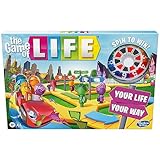
The Game of Life from Hasbro Gaming is the definitive real life simulation game, and in 2026 it remains the safest single purchase in the category. It is rated for ages 8 and up, the pegs come in six colors so everyone at the table gets a distinct piece, and the whole thing is driven by a spinner and a track of life events. It suits mixed-age family groups, grandparents playing with grandchildren, and anyone who wants one box that covers holidays, birthdays and rainy afternoons. It does not suit players looking for a strategy game with meaningful decisions.
Key specs
- Publisher: Hasbro Gaming
- Age rating: 8 and up
- Components: Game board, car tokens, pegs in 6 colors, spinner, money and action cards
- Player count: Family-sized — the six peg colors cover a full household
- Session length: Roughly 45–60 minutes at a relaxed family pace
- Teach time: Under five minutes; the board explains itself
- Price tier: Mid-range
Strengths
The life loop is the most complete of any game here, and it is complete in a way that matters educationally. Players make a real choice about whether to go to college or start working immediately, and then live with the salary consequences for the rest of the game. They encounter insurance, loans, a house purchase, children, and a retirement payout. None of it is deep, but all of it is named, and naming is what makes a mechanic teachable to an eight-year-old.
The second strength is durability of format. Because the spinner resolves almost everything, the game cannot be “solved” — there is no dominant strategy for an older sibling to exploit against a younger one, which keeps family sessions from turning into a rout. It is also unusually forgiving of interruptions, a property that matters more than most reviewers admit when the players are children. And with six peg colors, nobody has to sit out.
Pros
- Lowest barrier to entry in this roundup — playable minutes after opening
- Covers the full life arc: education, career, family, retirement
- Six peg colors accommodate a large family group
- Mid-range price for a box that gets used for years
Cons
- Almost entirely luck-driven; strategy is close to cosmetic
- Adults will find the decision space thin after a few plays
- Long track and sprawl require a proper dining table
- Some life events reflect an older social model that can feel dated
How it compares
Against Redneck Life, the choice is purely about audience: this one is safe from age 8, that one is not. Against Machi Koro, the trade is accessibility for depth — The Game of Life can be taught to a seven-year-old in three minutes, while Machi Koro asks players to reason about dice probability. Against Medical Mysteries: NYC Emergency Room, the contrast is replayability: this box can be opened fifty times, the co-op scenario essentially once. For a household that owns exactly one life simulation game, this is the correct one.
6. My Success Story – Business Simulator 2020 – Best for Phone-First Tycoon Players

My Success Story – Business Simulator 2020 from Rodan mobile Kft is the digital answer to the physical business sim. It is a mobile title built around the classic make-money-get-rich loop: start small, reinvest, expand, and watch the numbers climb. It suits players who want a business simulation they can run in five-minute bursts on a commute, and it suits anyone whose living situation does not include room for a board game. It is a poor fit for players who want a deep systemic model or a shared tabletop experience.
Key specs
- Publisher: Rodan mobile Kft
- Platform: Mobile (Android and iOS class)
- Genre: Business and tycoon simulation
- Business model: Free-to-play tier with in-app purchases
- Install size: Sub-gigabyte class — well under 1 GB for the base install
- Hardware needs: Modest; runs on mid-range and older handsets
- Price tier: Mid-range
Strengths
The onboarding is the best part of the design. Tycoon games often open with a spreadsheet and hope; this one opens with a single business and a clear next purchase, then widens the scope as the player’s income grows. That ramp is why the genre works on phones at all — the loop fits into the gaps in a day, and progress is visible after every session.
The second strength is the absence of system requirements in the physical sense. There is no table to clear, no box to store, no setup or teardown. For a player in a small flat, a shared house, or a long commute, that is not a convenience, it is the difference between playing and not playing. The install is also light enough that it will not push a 64 GB phone into storage-management territory alongside a dozen other apps.
Pros
- Zero table footprint and no setup or teardown
- Short, interruptible sessions that suit commuting
- Light install and modest hardware demands
- Clear early progression that teaches reinvestment intuitively
Cons
- Free-to-play pacing: progress can be gated behind purchases or waiting
- No face-to-face social component
- Systems are shallower than a physical market simulation
- Mobile OS updates occasionally break older titles in this category
How it compares
Against Bulls & Bears, the trade is depth for access. The board game models volatility, portfolios and crypto explicitly and demands a table and two hours; the mobile sim models a business growing and demands neither. Against Machi Koro, the mobile title is solo and endless where the board game is social and finite. If you have a group, buy the board game; if you have twenty minutes on a train, install the app. Plenty of players reasonably do both.
7. Real Flying Horse Life Simulator Game – Best for Younger Animal-Sim Fans

Real Flying Horse Life Simulator Game from Tap2View is a mobile animal life sim built around a fantasy creature rather than a realistic one. You fly, explore, and manage the survival loops that define the genre. It suits younger players and casual mobile gamers who want a creature sim that is easy to control and forgiving of mistakes. It is a poor fit for players who want a grounded simulation of a real animal, and a poor fit for anyone sensitive to advertising interruptions, which are typical at this price tier.
Key specs
- Publisher: Tap2View
- Platform: Mobile
- Genre: Animal life simulation with fantasy subject matter
- Controls: Simple, touch-driven; low learning curve
- Install size: Light — low-gigabyte or sub-gigabyte class
- Hardware needs: A mid-range handset is comfortable; older devices may see reduced frame rates
- Price tier: Budget
Strengths
The fantasy angle is a genuine differentiator in a category dominated by dogs, cats and farm animals. A flying creature gives the player vertical movement, which changes exploration from walking a map to gliding across one — and that alone makes the first few hours feel novel. The control scheme is also deliberately simple, which matters when the target audience includes children who may be using a phone without a controller.
Because the install is light and the hardware demands modest, this is one of the easiest games on the list to actually get running. There is no compatibility research to do, no storage to clear, no GPU tier to worry about. That friction-free start is underrated: a huge share of mobile life sims are abandoned during the first launch, and a title that loads quickly on a mid-range phone has already cleared the biggest hurdle.
Pros
- Fantasy creature adds verticality that ground-based animal sims lack
- Very simple controls — suitable for younger players
- Light install and modest hardware requirements
- Budget tier; low financial risk if it does not stick
Cons
- Advertising interruptions are typical at this price tier
- Shallow customization compared with premium animal sims
- Repetitive core loop after the first several hours
- Not a realistic simulation despite the naming convention
How it compares
Its closest sibling here is Real Parrot Life Simulator Game 3D. Both are budget mobile animal sims; the parrot title leans on 3D rendering and a real-world species, while the flying horse leans on fantasy appeal and simpler controls. If the player is young or new to mobile games, the flying horse is the gentler entry. If the player wants the more visually demanding 3D experience and has a phone that can carry it, the parrot sim is the step up. Neither competes with a physical board game for table time — they compete with screen time.
8. Real Parrot Life Simulator Game 3D – Best Budget 3D Animal Sim

Real Parrot Life Simulator Game 3D from ProTech Games S.r.l is the stronger of the two budget animal sims here. The 3D presentation is the headline: a rendered environment with flight, foraging and territory behavior, viewed from a bird’s perspective rather than a top-down map. It suits casual players who want a visually modern life sim without buying a console or a gaming PC, and it suits parents looking for a low-cost mobile option. It is a poor fit for anyone on a low-end handset, where 3D rendering is the first thing to suffer.
Key specs
- Publisher: ProTech Games S.r.l
- Platform: Mobile
- Genre: 3D animal life simulation
- Core loops: Flight, foraging, territory and survival
- Install size: Low-gigabyte class; larger than 2D animal sims
- Hardware needs: GPU-dependent — a mid-range or better handset is recommended for stable frame rates
- Price tier: Budget
Strengths
Flying as a parrot is a mechanically interesting premise because it removes the standard constraint of animal sims — the ground. Movement becomes three-dimensional, which makes exploration and evasion feel different from the walk-and-eat loop that defines most of the genre. The 3D rendering also gives the environment a sense of scale that 2D titles cannot match: altitude means something when you can see the distance below you.
As a budget purchase it is also low-risk. There is no hardware purchase attached, no peripherals, and no premium price to justify. For a player curious about the animal-sim genre, this is a reasonable first contact point — and because the install is still in the low-gigabyte class, it will not force a storage cleanup on a typical 64 GB phone.
Pros
- 3D rendering gives a sense of scale and altitude that 2D sims lack
- Flight-based movement breaks the standard walk-and-eat loop
- Low-gigabyte install; no console or PC required
- Budget price makes it a low-risk genre entry
Cons
- Frame rates vary widely with handset GPU, thermal state and settings
- Older or low-end phones may struggle with sustained 3D rendering
- Customization is narrower than in premium simulation titles
- Loop repetition sets in sooner than in a systems-heavy sim
How it compares
Against Real Flying Horse Life Simulator Game, the parrot sim is the more ambitious product and the more demanding one. The flying horse is the safer choice on weak hardware and for younger players; the parrot is the better choice on a mid-range phone for someone who wants the visual payoff of 3D. Against the physical picks on this list, the comparison is not really fair — a board game gives you a social table and a finite session, while a mobile sim gives you a solo, endless loop. They solve different problems, and most players who own one also own the other.
9. Fan Farm Life Stainless Steel Insulated Tumbler – Best for Farming-Sim Players Who Want Merch

This one needs a clear statement up front: the Fan Farm Life Stainless Steel Insulated Tumbler is a drink container, not a game. It appears in searches for farming simulation titles because of how it is titled and categorized, and that mismatch is worth flagging so nobody buys it expecting gameplay. It suits the player who already loves agricultural simulation games and wants a piece of themed merchandise for their desk during long sessions. It is not a substitute for a game, and it is not a gift for someone who asked for one.
Key specs
- Product type: Insulated drink tumbler — merchandise, not software or a board game
- Material: Stainless steel, double-wall vacuum-insulated construction
- Capacity: The 20–30 oz class typical of this product category
- Lid: Included; sliding or press-fit style typical of the category
- Compatibility: Standard car cup-holder diameter at the smaller end of the range
- Care: Hand washing recommended for printed finishes in this category
- Price tier: Mid-range
Strengths
As merch, it does its job. Double-wall vacuum insulation is the standard that actually works — it keeps cold drinks cold for hours and hot drinks drinkable without burning your hand, which is precisely what you want during a long farming session. Stainless steel also survives being knocked across a desk, which is more than can be said for a glass.
The thematic fit is the real selling point. Farming simulations are long-session games, and a themed tumbler is the kind of small object that makes a desk feel like it belongs to the hobby. If you are buying for a dedicated player, it lands as a thoughtful accessory rather than a generic gift.
Pros
- Genuinely functional insulated tumbler, not a novelty-only item
- Thematic match for fans of agricultural simulation games
- Durable stainless steel construction survives desk life
- Works as a low-commitment gift for a hobbyist
Cons
- Not a game — buying it will not add anything playable
- Printed finishes in this category typically require hand washing
- No gameplay, no customization, no progression of any kind
- Mid-range price for what is fundamentally a drink container
How it compares
There is no meaningful mechanical comparison to the other entries, which is the point. If you arrived here looking for the best real life simulation games and landed on this item, the correct alternative is an actual farming simulation title or a physical game like Machi Koro. The honest framing is: buy this if you already own the games and want the desk accessory; skip it if you are still building your library.
10. Auto Clicker for Smart Phone – Best for Automating Idle-Game Taps

The Auto Clicker for Smart Phone from Shker is a physical device, not software. It sits over a phone screen and taps it mechanically, at an adjustable rate advertised at 107 speed steps, which makes it a tool for idle and incremental games rather than a game itself. It suits players of idle life sims who want progression to continue while they do something else, and it suits anyone whose hands ache from repetitive tapping. It is a poor fit for players of games that prohibit automation, and a poor fit for anyone expecting a software autoclicker.
Key specs
- Product type: Mechanical screen tapper — hardware accessory
- Adjustable rate: Advertised as 107 speed steps
- Mounting: Clip or clamp that holds the tapper over the screen
- Contact: Conductive or soft tip stylus-style tappet
- Power: Powered by battery or USB, depending on the variant
- Compatibility: Works with capacitive touchscreens generally; alignment matters more than model
- Price tier: Budget
Strengths
The use case is narrow but real. Idle and incremental life sims are built around a tap-to-earn loop, and the difference between tapping manually for an hour and letting a device tap for you is the difference between playing for a week and playing for a month. For players who enjoy the progression but not the physical repetition, a mechanical tapper removes the least enjoyable part of the genre.
There is also a legitimate accessibility angle. Repetitive strain from extended tapping is a genuine problem, and a device that takes over the motion is a reasonable accommodation. At the budget tier, the financial risk is minimal — if it does not fit your phone or your game, you have lost very little.
Pros
- Automates the repetitive part of idle-game progression
- Adjustable rate lets you match the game’s input requirements
- Physical device — no rooting, sideloading or developer settings
- Budget price and a clear, single-purpose design