A podcast lives or dies on the voice. Listeners rarely stay with speech that is thin, echoing, or buried under room noise. The right professional studio microphone, matched to the right chain, makes clean and consistent episodes much easier to produce.

This guide compares five microphones currently sold on Amazon US: dynamic and condenser designs, USB-only, XLR-only, and hybrid USB and XLR models. The best choice for a solo host recording into a laptop is not the same as for a studio built around an interface or mixer.
As an Amazon Associate we earn from qualifying purchases.
Read each pick by setup first. Note the pickup pattern, connection type, power needs, and what else you need: an interface, a mount, an XLR cable, or a pop filter.
How to Read This Guide
All five microphones below use a cardioid, also described as unidirectional, pickup pattern: most sensitive in front, rejecting more sound from the sides and rear. That helps isolate a single voice and reduce off-axis room sound.
Dynamic microphones are generally less sensitive, pick up less of an untreated room, and are used close to the mouth. Condenser microphones are more sensitive and detailed, suiting quiet, treated spaces, and XLR condenser models need phantom power. USB models draw power from the computer, removing the interface from the shopping list.
For placement and monitoring basics, see this guide to setting up a streaming microphone.
Comparison Table
| Microphone | Type | Pattern | Connection | Power | Best suited to |
|---|---|---|---|---|---|
| Shure MV7+ | Dynamic | Cardioid | USB-C and XLR | USB in USB mode | Hybrid solo and studio setups |
| RØDE PodMic USB | Dynamic | Cardioid | USB and XLR | USB bus power in USB mode | USB now, XLR later |
| Audio-Technica AT2020 | Condenser | Cardioid | XLR | Phantom power | Quiet home studios with an interface |
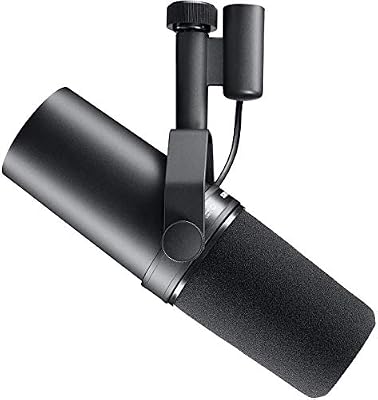
| Shure SM7B | Dynamic | Cardioid | XLR | Does not require phantom power | Dedicated XLR studio setups |
| RØDE NT-USB+ | Condenser | Cardioid | USB-C | USB bus power, listed as 5V at 500mA | USB-only recording in a quiet room |
The Picks
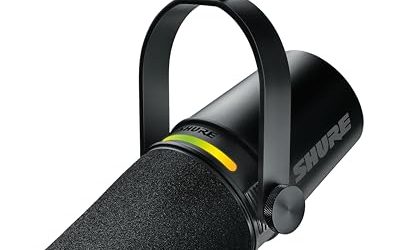
1. Shure MV7+ — Hybrid Flexibility for Growing Setups
The Shure MV7+ is a dynamic podcast microphone with both USB-C and XLR outputs, listed by Amazon with a cardioid polar pattern and a frequency range of 50 Hz to 16 kHz. That hybrid output is its central appeal. Over USB-C, it plugs directly into a computer for a simple solo setup. Over XLR, the same microphone can run into an audio interface or mixer as a studio grows, without replacing the microphone itself.
Shure describes Auto Level Mode as adjusting gain in real time based on voice and position, with processing through the MOTIV Mix application. This bundle listing notes a foam windscreen, a USB-C cable, and an adjustable desktop stand. In XLR mode you will instead need an XLR cable and an interface or mixer.
Best for: Solo podcasters who want to start on USB and keep a clear XLR upgrade path, especially in rooms that are not fully treated.
2. RØDE PodMic USB — Broadcast-Style Dynamic With Two Outputs
View the RØDE PodMic USB on Amazon
The RØDE PodMic USB is described on its Amazon listing as a versatile dynamic broadcast microphone with XLR and USB connectivity for podcasting, streaming, gaming, music-making, and content creation. Like the MV7+, it covers two stages of a setup: direct USB connection for straightforward computer recording, and XLR connection for use with an interface or mixer.
As a dynamic microphone, it follows the close-speaking approach that suits spoken word: work near the front, keep your distance consistent, and use a mount that holds that position. Power follows the connection: over USB it draws power from the host device; over XLR, an interface or mixer is required. Check the listing for the mount and cable supplied.
Best for: Podcasters who prefer a broadcast-style dynamic microphone and want USB convenience or an XLR studio chain from a single purchase.
3. Audio-Technica AT2020 — XLR Condenser for a Quiet Home Studio
View the Audio-Technica AT2020 on Amazon
The Audio-Technica AT2020 is a side-address cardioid condenser studio microphone with an XLR output. Amazon describes it as ideal for project and home studio applications, notes high sound pressure level handling and wide dynamic range, and lists a frequency response of 20 to 20,000 Hz. Audio-Technica also describes a custom-engineered low-mass diaphragm intended to provide extended frequency response and transient response.
That condenser sensitivity is a strength and a warning. In a quiet, treated room, the AT2020 can capture a detailed voice; in a hard, echoing room, it will also capture more of that room. It requires an audio interface or mixer, phantom power through that chain, and an XLR cable. The listing notes a pivoting, threaded stand mount. A shock mount and pop filter are optional accessories worth budgeting for.
Best for: Podcasters who already own, or are ready to buy, an interface with phantom power, and who record in a quiet space.
4. Shure SM7B — XLR Dynamic for a Dedicated Studio Chain
The Shure SM7B is a dynamic studio microphone with XLR connectivity, a unidirectional polar pattern, and a listed frequency range of 50 Hz to 20 kHz. Amazon describes it for podcasting, recording, broadcasting, streaming, and gaming, with a detachable windscreen and a rugged build. Its listed built-in media include a close-talk windscreen, a foam windscreen, and a locking yoke mount.
Shure states on the Amazon listing that the SM7B does not require phantom power and is not affected if phantom power is present on its mixer input. The same listing recommends at least 60 dB of gain, so check whether your interface or mixer can provide enough clean gain, or whether you need an additional preamp stage. You will also need an XLR cable and a sturdy stand or boom arm.
Best for: Experienced podcasters and multi-person studios with a strong XLR interface chain who record in a fixed position.
5. RØDE NT-USB+ — USB Condenser With Stand and Pop Filter Included
View the RØDE NT-USB+ on Amazon
The RØDE NT-USB+ is a professional USB condenser microphone. Its Amazon listing describes it as a professional USB microphone suited to applications including podcasting and streaming, with a unidirectional polar pattern and USB Type-C connection. Manufacturer specifications list a cardioid pattern, a frequency range of 20 Hz to 20 kHz, 24-bit depth, a 48 kHz sample rate, and power requirements of 5V at 500 mA from USB bus power.
There is no separate interface or phantom power supply to buy: connect over USB-C to a computer or compatible mobile device and record. The listing notes a desk stand, a detachable pop filter, a ring mount, and a USB-C cable, plus a headphone output with volume and mix controls. As a condenser, it suits a quieter space better than a lively room with hard walls. The ring mount leaves open the option of a boom arm later.
Best for: Solo podcasters who want a complete USB-only setup with no interface, and who record in a relatively quiet room.
Selection Criteria: How to Choose
Start with your room
An untreated, echoing room will be heard more clearly by a sensitive condenser. A close-used dynamic is usually more forgiving there. A quiet, treated room opens up both categories.
Decide USB, XLR, or hybrid first
USB is the shortest chain: microphone, cable, computer, software. XLR is a system: microphone, cable, interface or mixer, then computer. Hybrids such as the MV7+ and PodMic USB let you start with USB and move to XLR later.
Check power and gain
An XLR condenser such as the AT2020 needs phantom power. An XLR dynamic such as the SM7B does not, but its listing recommends substantial gain. USB models draw power over USB, with the NT-USB+ specification listing 5V at 500 mA.
Plan the mount and monitoring
Budget for a stand or boom arm that holds a steady, close position, a pop filter or windscreen, and monitoring headphones. For multi-host shows, plan one microphone and one interface input per person.
FAQ
Do podcasters need a condenser or a dynamic microphone?
Neither is automatically better. Condensers are more sensitive and suit quiet, treated rooms. Dynamics are less sensitive, are used closer to the mouth, and are more forgiving in untreated rooms.
Can a USB microphone be used without an audio interface?
Yes. The NT-USB+ connects directly over USB-C and draws USB bus power, as can the hybrid MV7+ and PodMic USB. An interface is required only for XLR-only microphones, or when a hybrid is switched to XLR.
What does phantom power mean for a podcast setup?
Phantom power is supplied by an interface or mixer through the XLR cable to a microphone that needs it, such as the AT2020 condenser. Dynamics such as the SM7B do not require it.
Why use a cardioid microphone for a solo podcast?
Cardioid focuses on sound in front and rejects more from the sides and rear, keeping the voice as the main source and reducing off-axis room sound — provided you speak into the front at a consistent distance.
What accessories should be budgeted for with an XLR microphone?
At minimum, an XLR cable, an interface or mixer, and a stand or boom arm. You may also need phantom power for a condenser, enough gain for a dynamic such as the SM7B, and a pop filter or shock mount if not included.
Conclusion
For the simplest upgrade path, a hybrid dynamic model such as the Shure MV7+ or the RØDE PodMic USB lets a podcaster begin on USB and move to XLR without changing microphones. For a complete USB-only condenser setup in a quiet room, the RØDE NT-USB+ includes the stand and pop filter needed to start. For an interface-based studio, the AT2020 covers the condenser route with phantom power, while the SM7B suits a dedicated XLR chain that can supply the gain its listing recommends.
Choose by room, chain, and power first, and you will have a setup you can record with reliably.