Racing games played with a wheel and pedals put a chair through something no other genre does: repeated, hard braking force pushed through your legs while your hands work against force feedback. An ordinary desk chair fails that job in predictable ways. Its casters roll backwards every time you stamp on a load-cell brake, a free tilt mechanism rocks when you want it locked, and loose pedals wander across the floor. This guide covers the two honest answers to that problem — desk chairs whose recline and tilt genuinely lock, and sim cockpits that bolt the seat, wheel and pedals into one frame — and says plainly what each one can and cannot do.


Disclosure: As an Amazon Associate we earn from qualifying purchases.
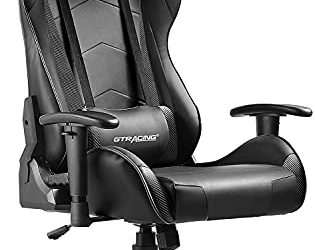
One distinction before the picks: a racing-style chair is a desk chair shaped like a car seat, bought for looks and general gaming comfort. If that is what you are after, our roundup of the best racing gaming chair styles covers it. This article is narrower: seats judged on how they behave when you are actually driving, with a wheel in your hands and pedals under your feet.
What actually matters for racing games
Recline that locks, not just reclines. A deep recline range is only useful if the backrest stays where you set it under leg pressure. Lever-lock recline mechanisms (the car-seat style lever) hold a fixed angle. Tilt mechanisms vary: some lock, some only offer tension adjustment, and a free-rocking chair will move every time you brake hard. For pedal work, a locked backrest at a slightly open angle — roughly 100 to 115 degrees for GT-style driving — is the working position.
Lateral support. Bucket-seat bolsters earn their keep here. In fast direction changes and long banked corners you brace against the seat sides, and pronounced bolsters on the seat base and backrest keep your hips and shoulders centred without you tensing to stay in place. Flat office-style seats offer nothing to brace against.
Base stability under braking force. This is where the two families split. On a desk chair, braking force travels through your body into a five-point base on casters — the weakest link in the whole setup. Locking casters, caster cups, or swapping casters for glides all help, and the pedals themselves need a stop behind them. In a cockpit, the seat and pedal plate are one structure, so braking force closes inside the frame instead of pushing you across the room.
Seat height and pedal angle. Your thighs should be close to level and your heels supported, so brake pressure comes from the leg, not the ankle alone. Desk-chair seat height ranges and cockpit pedal-plate adjustment are the figures to compare against your desk and screen position.
The picks
1. Playseat Evolution ActiFit — the foldable cockpit
The Playseat Evolution is the long-running answer for drivers who want a real cockpit that still stores away. The seat, steering plate and pedal plate are one foldable steel frame, so the geometry between your hands, feet and hips stays fixed session after session — the single biggest upgrade over any desk setup. Playseat’s patented fold-down system collapses it for storage, and both the steering plate and pedal plate adjust to fit drivers from 120 to 220 cm in the maker’s figures.
What it can do: hold gear- and belt-driven wheels and their pedals exactly where you bolt them, with pre-drilled mounting for the mainstream Logitech, Thrustmaster and Fanatec ecosystems, and take braking force through the frame instead of through rolling casters. What it cannot do: double as a desk chair — it is a single-purpose racing seat. Its centre-post wheel mount is also the flex point of the design, so drivers running high-torque direct-drive bases and stiff load-cell pedals at full force are the ones who will find its limits first; a rigid profile rig is the step beyond it. A gearshift holder is a separate Playseat accessory, not part of the base frame.
Specs
- Type: Foldable sim racing cockpit with integrated seat
- Frame: Steel, foldable (patented Playseat fold-down system)
- Adjustment: Steering plate and pedal plate adjustable; seat folds for storage
- Driver fit (maker figures): 120–220 cm length, up to 122 kg / 270 lbs weight
- Compatibility: Logitech, Thrustmaster and Fanatec wheels and pedals; PC and console
- Model: Playseat Evolution ActiFit (REM00004)
2. OpenWheeler GEN3 — the modular cockpit with a car-style seat
The OpenWheeler GEN3 takes a different route to the same job: a fully welded steel-tube chassis carrying a full-size racing seat that reclines and slides on rails, adjusted with oversize quick-release knobs rather than tools. The wheel and pedal plates mount to the same chassis, so — as with the Playseat — braking force stays inside the structure. OpenWheeler fits rolling wheels to the frame and the cockpit breaks down into pieces, which makes it the easier of the two cockpits here to move between rooms.
What it can do: give you a reclining, sliding car-style seat with quick adjustment between drivers of different sizes, plus a modular platform — the maker sells flight-sim add-ons and a shifter bracket for the same frame. What it cannot do: work as everyday desk seating, and — honestly — match a heavy aluminium-profile rig for absolute rigidity under the strongest direct-drive bases. Note that on the standard GEN3 listing the gear shifter mount is an optional add-on rather than a standard inclusion, and OpenWheeler does not publish a driver weight figure in the listing, so heavier drivers should confirm fit with the maker before ordering.
Specs
- Type: Sim racing cockpit with integrated reclining seat
- Frame: Fully welded steel tubing, powder coated
- Seat: Full-size racing seat with recliner and sliding rails
- Adjustment: Quick-release knobs; wheel and pedal positions adjustable independently
- Compatibility: Logitech, Thrustmaster and Fanatec wheels and pedals; PC, PlayStation and Xbox
- Storage: Rolling wheels fitted; breaks down into pieces for storage
3. noblechairs EPIC — the desk chair whose recline locks like a car seat
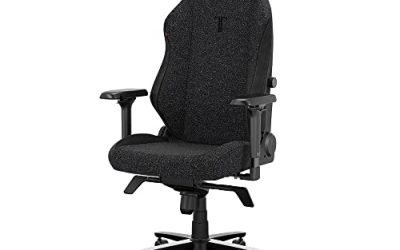
If the wheel clamps to a desk you also work at, the EPIC is the desk-chair pick, because its recline mechanism is the one that behaves most like a racing seat’s: a side lever sets the backrest anywhere in its 90–135° range and locks it there, rather than relying on tilt tension to hold you. The separate rocking mechanism also locks out. Under braking, that fixed backrest is what stops the slow backwards creep that unlocked chairs suffer from. Its cold-foam bucket shape and pronounced bolsters supply the lateral support, and the 4D armrests swing down and out of the way of a wheel rim.
What it can do: serve as a proper everyday chair that also holds a driving position at a desk-clamped wheel, with an aluminium five-point base and a steel frame behind it. What it cannot do: anchor your pedals or stop its own casters rolling. Pair it with locking casters or caster cups and a firm stop behind the pedal set, and treat stiff load-cell pedals as the point where a cockpit starts to make more sense.
Specs
- Type: Racing-style desk chair
- Recline: 90–135°, lever-operated, locks at the set angle
- Tilt: Rocking mechanism with lock
- Armrests: 4D adjustable
- Frame and base: Steel frame; machined aluminium five-point base
- Upholstery: PU faux leather over cold-cure foam
- Maker fit figure: Maximum recommended weight 120 kg / 265 lbs
4. DXRacer Drifting L — deep bolsters and a wide recline for desk drivers

The Drifting L is the second desk-chair route: a winged, cold-cure foam seat with deep side bolsters, a 90–135° recline, and a 15° rocking tilt on top. For gamepad racing and desk-clamped wheels in arcade and rally titles — where you move around in the seat more and brake loads are lighter than a load-cell setup — the bolsters give real lateral support and the wide recline range lets you open the driving position up for longer, lower-intensity sessions. The Class 4 gas lift and aluminium base are the heavy-duty grades in this class, and the listing’s maximum weight recommendation is 275 lbs.
What it can do: hold a smaller-to-average driver centred through fast corners at a desk, with 3D armrests that adjust to clear a wheel. What it cannot do: change the physics of casters under braking — the same locking-caster and pedal-stop advice applies — and its rocking tilt is a comfort feature to manage, not a lock to brake against. Drivers who move to load-cell pedals will outgrow any desk chair, this one included.
Specs
- Type: Racing-style desk chair
- Recline: 90–135° backrest; 15° rocking tilt
- Armrests: 3D adjustable
- Lift and base: Class 4 gas lift; aluminium base
- Seat: Cold-cure foam, winged bolsters; cooling-gel headrest and memory-foam lumbar pillow included
- Maker fit figure: Maximum weight recommendation 275 lbs (listing)
- Model: GC/LDC23FBC/G (Drifting L, water-resistant fabric)
Setup configurations by need
Desk, entry wheel, standard pedals. Either desk chair works. Lock the recline at a slightly open angle, lock out the tilt, put the casters in cups or fit locking casters, and brace the pedal set against a wall, a board or a pedal stop so it cannot walk forward.
Desk, load-cell pedals. The chair becomes the weak link. Caster glides instead of wheels, the firmest pedal stop you can arrange, and a lever-lock recline (the EPIC pattern) are the minimum. If the chair still moves, the honest fix is a cockpit, not a better chair.
Shared room, wheel used a few times a week. The Playseat Evolution folds down and the OpenWheeler GEN3 rolls and breaks apart — both give you fixed wheel-to-seat geometry without a permanent rig in the room.
Dedicated corner, strong direct-drive base. Start with the cockpits here for mainstream bases; for the highest-torque bases and heaviest load-cell pedals, treat these as the step before an aluminium-profile rig, which is a different product class entirely.
Verdict
For racing games played with a wheel, fixed geometry beats comfort features: the Playseat Evolution ActiFit and OpenWheeler GEN3 hold your seat, wheel and pedals in one structure, and that is what hard braking demands. If the same seat has to earn its place at a working desk, the noblechairs EPIC’s lever-locked recline makes it the desk chair that fights back least against your legs, with the DXRacer Drifting L as the bolstered alternative for lighter pedal loads. Whichever family you choose, budget the small fixes too — locking casters and a pedal stop for a desk setup, a shifter mount for a cockpit — because they are part of what makes the seat work.