Disclosure: As an Amazon Associate we earn from qualifying purchases.
Professional sports bodies are defined by four published numbers: how fast the sensor reads out, how many frames per second the body sustains with autofocus active, how deep the buffer runs before it slows, and how quickly the card slots clear that buffer. All five bodies below use stacked or global-shutter full-frame sensors, because that sensor architecture is what removes rolling-shutter distortion and viewfinder blackout at full speed. Every figure in this guide is a maker-published specification as printed on the maker’s product pages and the Amazon listings, not a measured result.
Two buying notes apply to the whole list. First, these are camera bodies: four of the five Amazon listings below are body-only, and the Canon listing is a dealer bundle built around the body. None of them includes a lens, and sports work demands fast telephoto glass — a 70-200mm f/2.8 and a long prime or 100-500mm-class zoom are separate purchases on top of any body here. Second, if your sideline work is at school or club level rather than professional level, the bodies in our broader guide to the best mirrorless cameras for sports photography cover that ground; this page is only about the professional full-frame tier.
1. Sony a9 III — the global-shutter speed specialist

The a9 III is built around the world’s first full-frame global shutter sensor, per Sony: every pixel on the 24.6MP Exmor RS stacked CMOS sensor reads out simultaneously, so fast pans and spinning balls keep their shape and flash can sync at any shutter speed. Sony publishes blackout-free continuous shooting at up to 120 fps with AF/AE tracking, a pre-capture function that records frames from before the shutter button is fully pressed, and a maximum shutter speed of 1/80,000 sec. Its AI processing unit drives Real-time Recognition AF across people, animals, birds and vehicles. The trade-off is resolution: at 24.6MP it gives up the cropping room the 45MP-class bodies below offer.
Specs
- ASIN: B0CMV98DP2
- Model: ILCE-9M3 (body only)
- Sensor: 24.6MP full-frame Exmor RS stacked CMOS with global shutter
- Burst: up to 120 fps, blackout-free, with AF/AE; pre-capture included
- Buffer: published figures run to roughly 180 frames at 120 fps on CFexpress media, format-dependent
- Card slots: dual CFexpress Type A / SD UHS-II (combo slots)
- Autofocus: Real-time Recognition AF with AI processing unit
- Viewfinder: 9.44M-dot OLED, blackout-free
- Stabilisation: in-body, up to 8.0 stops per Sony’s published figure
- Battery: NP-FZ100
- Weight: 702 g with battery and card
- Build: dust- and moisture-resistant design
Suits: professionals shooting indoor arena sports, motorsport and any venue with flickering LED lighting, where the global shutter’s distortion-free frames and all-speed flash sync matter more than megapixels.
2. Canon EOS R1 — Canon’s flagship for RF shooters
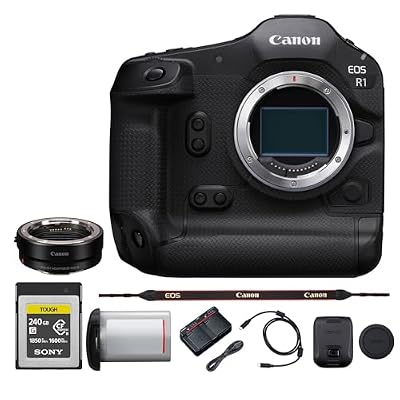
The R1 is Canon’s first 1-series flagship in the RF system: a 24.2MP back-illuminated stacked CMOS sensor driven by DIGIC X plus a DIGIC Accelerator chip. Canon publishes 40 fps electronic-shutter shooting (12 fps mechanical), Pre-Continuous Shooting that buffers frames before the full press, and Dual Pixel CMOS AF II with cross-type AF at the sensor, Action Priority subject modes and Eye Control AF that moves the focus point to where you look. Both card slots take CFexpress Type B. Note the listing format: the Amazon listing used here is a dealer bundle that pairs the body with a 240GB CFexpress Type B card and Canon’s EF-EOS R mount adapter — the camera itself is body-only, with no lens included.
Specs
- ASIN: B0FKCWWZ93
- Model: 6577C002 (dealer bundle: body, 240GB CFexpress Type B card, EF-EOS R adapter)
- Sensor: 24.2MP full-frame back-illuminated stacked CMOS
- Burst: up to 40 fps electronic / 12 fps mechanical, with AF/AE; Pre-Continuous Shooting
- Buffer: published figures run to roughly 230 RAW frames at 40 fps, card-dependent
- Card slots: dual CFexpress Type B
- Autofocus: Dual Pixel CMOS AF II, cross-type AF, Action Priority, Eye Control AF
- Viewfinder: 9.44M-dot OLED, 0.9x magnification
- Stabilisation: in-body, up to 8.5 stops per Canon’s published figure
- Battery: LP-E19 (2,700 mAh)
- Weight: 920 g body only; 1,115 g with battery and card
- Build: integrated vertical grip, weather sealing
Suits: Canon professionals already invested in RF or adapted EF glass who want the deepest Canon buffer and the Action Priority AF modes for team sports.
3. Nikon Z9 — resolution and stamina in an integrated grip

The Z9 pairs a 45.7MP stacked CMOS sensor with the EXPEED 7 processor, so it holds roughly double the a9 III’s and R1’s resolution while still publishing 20 fps in RAW, 30 fps in full-resolution JPEG and 120 fps at a reduced 11MP. Nikon removed the mechanical shutter entirely — the Z9 is electronic-shutter only, protected by a sensor shield. Its 493-point AF system uses deep-learning subject detection across people, animals, birds and vehicles, and the integrated-grip body runs Nikon’s high-capacity EN-EL18d battery. Published buffer figures exceed 1,000 high-efficiency RAW frames at 20 fps with a fast CFexpress Type B card, the deepest in this group.
Specs
- ASIN: B09KHC4XCT
- Model: 1669 (body only, Nikon USA model)
- Sensor: 45.7MP full-frame stacked CMOS, EXPEED 7
- Burst: 20 fps RAW / 30 fps JPEG / 120 fps at 11MP; electronic shutter only
- Buffer: published figures exceed 1,000 high-efficiency RAW frames at 20 fps, card-dependent
- Card slots: dual CFexpress Type B / XQD
- Autofocus: 493-point AF with deep-learning subject detection
- Viewfinder: 3.69M-dot OLED, blackout-free dual-stream
- Battery: EN-EL18d
- Weight: approx. 1,340 g with battery and card
- Build: magnesium alloy, integrated vertical grip, dust- and drip-resistant
Suits: Nikon professionals who shoot long events and need high resolution for cropping distant action, plus the battery and buffer stamina to work a full match without swapping cards or packs.
4. Sony a1 II — 50MP resolution at 30 fps

The a1 II is Sony’s resolution flagship: a 50.1MP Exmor RS stacked sensor that still sustains 30 fps with AF/AE tracking, so it crops like a 45MP-class body while outrunning the Z9 and Z8 in RAW burst speed. It carries the same AI processing unit as the a9 III for Real-time Recognition AF, adds pre-capture of up to one second, and records 8K 30p and 4K 120p video for hybrid shooters. Sony publishes a CIPA battery figure of roughly 520 shots per charge on the NP-FZ100 — plan on spare packs for a full day of action. At 743 g with battery and card it is the lightest body in this group by a wide margin.
Specs
- ASIN: B0DNLVHJ74
- Model: ILCE-1M2 (body only)
- Sensor: 50.1MP full-frame Exmor RS stacked CMOS
- Burst: up to 30 fps with AF/AE; pre-capture up to 1 second
- Buffer: published figures run to roughly 240 compressed RAW frames at 30 fps, card-dependent
- Card slots: dual CFexpress Type A / SD UHS-II (combo slots)
- Autofocus: Real-time Recognition AF with AI processing unit
- Viewfinder: 9.44M-dot OLED
- Stabilisation: in-body, up to 8.5 stops per Sony’s published figure
- Battery: NP-FZ100 (CIPA figure approx. 520 shots)
- Weight: 743 g with battery and card
- Build: dust- and moisture-resistant design
Suits: professionals who crop hard — wildlife and field sports at distance — and want one body that also covers high-resolution commercial and video work.
5. Nikon Z8 — the Z9’s engine in a smaller body
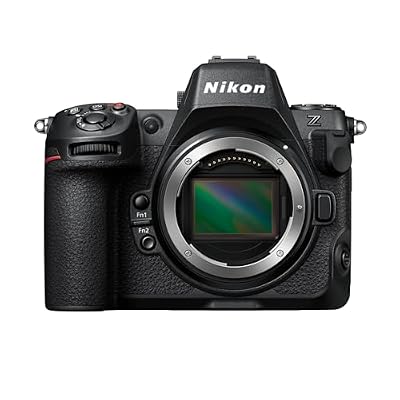
The Z8 runs the same 45.7MP stacked sensor and EXPEED 7 processor as the Z9, with the same published burst set — 20 fps RAW, 30 fps full-resolution JPEG, 120 fps at 11MP — and the same subject-detection autofocus family, in a conventional body without the integrated grip. The compromises are in the supporting hardware: one CFexpress Type B slot paired with one SD UHS-II slot instead of dual CFexpress, and the smaller EN-EL15c battery, which returns a lower shots-per-charge figure than the Z9’s EN-EL18d. In return the body is far more compact, which matters for travel and for working in mixed stills-and-gimbal video kits.
Specs
- ASIN: B0C4Q71JBY
- Model: Z 8 (body only, Nikon USA model)
- Sensor: 45.7MP full-frame stacked CMOS, EXPEED 7
- Burst: 20 fps RAW / 30 fps JPEG / 120 fps at 11MP; electronic shutter only
- Card slots: 1x CFexpress Type B / XQD plus 1x SD UHS-II
- Autofocus: 493-point AF with subject detection (people, animals, birds, vehicles)
- Battery: EN-EL15c
- Build: dust- and drip-resistant; no integrated vertical grip (optional grip available separately)
- Video: 8.3K 60p RAW internal recording per Nikon’s published spec
Suits: professionals who want Z9 image quality and burst performance in a body that packs smaller, and who can live with one fast card slot and shorter battery runs.
How to choose
Speed or resolution first. The 24MP bodies (a9 III, R1) are built for maximum burst speed and clean high-ISO files under arena light; the 45-50MP bodies (Z9, a1 II, Z8) trade some burst rate for heavy cropping room. Decide by your typical subject distance: the further the action, the more resolution earns its keep.
Check the card format before the body. Every body here needs CFexpress media to reach its published buffer figures, but the formats split: Canon and Nikon use Type B, Sony uses the smaller Type A in combo slots that also accept SD UHS-II. If you already own one format, staying with it keeps your card wallet and readers unchanged.
Match the battery to the assignment. The integrated-grip bodies (Z9, R1) run high-capacity packs sized for full events. The a1 II and Z8 use smaller batteries with lower published shots-per-charge figures — budget for spares and a dual charger as part of the system, not an afterthought.
Sealing is a system property. All five bodies publish dust- and moisture-resistant construction, but that protection only holds with a sealed lens mounted and port covers closed. Rain work also means a rain cover for the lens, which no body spec replaces.
The mount is the real commitment. Bodies cycle every few years; the lens mount decides your telephoto options for a decade. Choose the system whose fast telephoto range you can actually build out, then pick the body inside it.