Affiliate disclosure: As an Amazon Associate we earn from qualifying purchases. This post contains affiliate links — if you buy through them we may earn a small commission at no extra cost to you. This never affects our recommendations.
A Mini ITX gaming PC delivers full-size gaming performance in a case that fits on a bookshelf, travels to LAN events, and looks premium on any desk without dominating the space. Mini ITX motherboards (170×170mm) support the same CPUs and GPUs as full ATX builds — the tradeoff is typically one or two M.2 slots, one PCIe slot for the GPU, and more constrained thermal management that requires careful component selection. These are the best Mini ITX gaming PC builds in 2026.
As an Amazon Associate we earn from qualifying purchases at no extra cost to you.


In a hurry? See the top-rated Mini ITX Gaming PC Build deals available right now:
🛒 Check Mini Itx Gaming Pc Build Prices on Amazon →Quick answer: the best mini ITX gaming PC build for most people in 2026 pairs an AM5 mini-ITX board like the ASUS ROG Strix B850-I Gaming WiFi with a Ryzen 7 9700X, a compact RTX 5070-class graphics card, an SFX power supply and a case such as the Cooler Master NR200P V3 or Lian Li A4-H2O. If you would rather skip the build, the Cooler Master NR2 Pro is a ready-made mini ITX gaming PC.
Updated November 2026 – this guide now includes a parts-by-parts mini ITX build list and sample builds. We did not assemble these systems; the figures come from maker listings and published specifications, and component prices move quickly, so we give tiers instead of fixed prices.
🛒 Best Price Today on Amazon
Prime members get fast, free shipping on everything above, plus member-only deals. New members get a 30-day free trial — cancel anytime.
Start 30-Day Prime Free Trial →See Today’s Amazon DealsBest Budget ITX Build: Compact 1080p/1440p Gaming
Case: NZXT H1 V2, which bundles an SFX-L power supply and an AIO cooler, so it is the simplest ITX path. CPU: Ryzen 5 7600 (mid-tier). Motherboard: an AM5 mini-ITX board such as the ASUS ROG Strix B650E-I WiFi. RAM: 32GB DDR5-6000 in standard desktop DIMMs. GPU: an RTX 4070-class card, after checking its length and thickness against the case’s stated limit. Storage: 1TB NVMe. Because the case bundles the PSU and cooler, this is the best-value way into ITX, but total cost depends on current GPU and memory pricing, so add up live prices before ordering. Expect strong 1440p performance and high-refresh 1080p in most titles. Best budget ITX build for desk-space-conscious gamers.
Best Premium ITX Build: Full-Power Compact
Case: Lian Li A4-H2O, a compact SFX-layout case. CPU: Ryzen 7 7700 (65W) or similar, since 65W parts are easier to cool in a small case than 105W chips. Motherboard: an AM5 mini-ITX board such as the ASUS ROG Strix B650E-I Gaming WiFi. Cooler: a low-profile air cooler or AIO that the case listing states it supports. RAM: 32GB DDR5-6000. GPU: an RTX 4080 Super-class card, after verifying length and thickness against the case. Storage: 2TB NVMe. PSU: Corsair SF850L (SFX-L). This is a premium-tier build whose total depends on GPU pricing and typically lands well above the budget build. Performance targets are 4K at 60+ FPS and high-refresh 1440p. Best premium ITX build for maximum-performance portable gaming.
Best Mini ITX Gaming PC Build Parts List for 2026
Every mini ITX gaming PC build starts with the case, because the case sets the limits for graphics card length, cooler height and power supply type. Choose it first, then pick parts that fit its stated clearances. The components below are on-intent examples that work together on an AM5 platform.
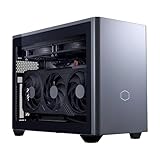
Cooler Master NR200P V3 – Best Mini ITX Case for Beginners
The Cooler Master NR200P V3 is a roomy, airflow-focused mini-ITX case and a common first choice for builders new to small form factor systems.
- 361.5mm graphics card support.
- 280mm AIO radiator support.
- SFX power supply support.
- Vertical GPU mount and PCIe 5.0 riser.
- Mesh panels for intake.
Pros: large GPU clearance, easy to build in, strong airflow. Cons: larger than the tightest SFF cases.
Skip it if you want the smallest possible footprint or a backpack-friendly shell.
Lian Li A4-H2O – Best Compact Mini ITX Case
The Lian Li A4-H2O is a small aluminum and steel mini-ITX case for builders who want a tiny desk footprint.
- Mini-ITX with PCIe 4.0 riser.
- Supports SFX and SFX-L power supplies.
- Easy AIO installation per the listing.
- Aluminum exterior, SPCC steel interior.
Pros: very small, premium finish, easy cooling setup. Cons: tighter GPU limits than the NR200P V3; check card thickness.
Skip it if you want a large-card, easy first build.
ASUS ROG Strix B850-I Gaming WiFi – Best Mini ITX Motherboard

This AM5 B850 mini-ITX board covers everything a gaming build needs in a 170mm square.
- AM5 socket with DDR5 memory.
- 10+2+1 power stages.
- 2.5G LAN and WiFi 7.
- Two M.2 slots.
Pros: strong power delivery, two M.2 slots, current networking. Cons: premium board price tier.
Skip it if you want a cheaper board and can live with fewer extras.
AMD Ryzen 7 9700X – Best CPU for Small Cases

The Ryzen 7 9700X is an eight-core, 16-thread desktop processor with a 3.8-5.5GHz range per its listing. Its lower power draw compared with 105W Ryzen parts makes it easier to cool in a small case.
- 8 cores, 16 threads, AM5 socket.
- Unlocked for tuning.
- Works with a low-profile air cooler or compact AIO.
Pros: efficient, strong gaming and productivity balance. Cons: not the top gaming chip; X3D models game faster.
Skip it if you want maximum frame rates and will pay for an X3D processor.
Noctua NH-L9a-AM5 – Best Low-Profile Cooler

The Noctua NH-L9a-AM5 is a quiet low-profile cooler for small form factor builds.
- Only 37mm tall.
- Designed for AM5 sockets.
- Made for ITX and SFF cases with low clearance.
Pros: fits cases with little cooler height, quiet. Cons: limited cooling for hot CPUs; pair it with an efficient chip and good case airflow.
Skip it if your case has room for a 240mm or 280mm AIO.
PNY GeForce RTX 5070 OC Triple-Fan – Best Compact RTX 5070 Pick

The PNY RTX 5070 OC is marketed as SFF-ready, which matters because many triple-fan cards are too long or thick for ITX cases.
- 12GB GDDR7, 192-bit memory.
- Boost speed listed at 2587 MHz.
- Triple-fan cooler marked SFF-Ready.
Pros: strong 1440p card with a compact design. Cons: always check the exact length and slot thickness against your case limit.
Skip it if your case allows only dual-slot or very short cards.
Lian Li SP850 V2 – Best SFX Power Supply Pick
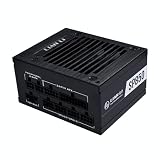
The Lian Li SP850 V2 is an 850W SFX power supply that is ATX 3.1 ready with a native 12V-2×6 cable.
- 850W, 80 Plus Gold.
- SFX form factor.
- Native 12V-2×6 connector for modern graphics cards.
Pros: room for a high-end card, no adapter cable. Cons: SFX units cost more than ATX units of equal wattage.
Skip it if your case uses a full ATX power supply.
Mini ITX Gaming PC Build Compatibility Checklist
Most mini ITX build problems come from clearance, not performance. Work through these checks before buying:
- Graphics card length and thickness: compare the card to the case limit, such as 361.5mm of GPU support in the NR200P V3. A two-slot case rejects a 3-slot card even if it is short enough.
- CPU cooler height: low-profile air coolers like the 37mm Noctua NH-L9a-AM5 fit tight cases; taller coolers need more room.
- Power supply type: SFX and SFX-L units are standard; confirm which the case supports.
- Memory: mini-ITX desktop boards use standard DDR5 DIMMs, not laptop SO-DIMMs.
- Radiator size: only choose an AIO if the case lists radiator support, such as 280mm for the NR200P V3.
- Storage slots: boards like the ROG Strix B850-I list two M.2 slots, but cases may limit 2.5-inch drives.
Mini ITX Gaming PC Build Tiers
| Tier | Core parts | Target |
|---|---|---|
| Budget | NZXT H1 V2 · Ryzen 5 7600 · RTX 4070-class GPU | 1440p high settings |
| Mainstream | NR200P V3 · Ryzen 7 9700X · RTX 5070 · SFX 850W | 1440p high refresh |
| Premium | Lian Li A4-H2O · Ryzen 7 7700 · RTX 4080 Super-class GPU | 4K 60 and high-refresh 1440p |
| Prebuilt | Cooler Master NR2 Pro | Ready-made 1440p to 4K |
Mini ITX vs Micro ATX Gaming PC
A mini ITX gaming PC is built for the smallest footprint and portability. A micro ATX build costs less, runs cooler and offers more slots and case choice. Pick mini ITX when desk space or portability is a real requirement, and micro ATX when it is not.
Should You Buy a Prebuilt Mini ITX Gaming PC?
A prebuilt such as the Cooler Master NR2 Pro avoids compatibility work and ships ready to run with its listed parts, such as a 280mm AIO and 32GB DDR5 in the Ultra 7 configurations. Building usually gives better value per part and the freedom to choose a quieter cooler or a different case, but it costs time and needs care in a tight shell. If it is your first small build, a case with generous clearance like the NR200P V3 reduces the risk.
ITX-Specific Component Considerations
GPU Length Restrictions
ITX cases have strict GPU length limits, from roughly 300mm in the smallest sandwich-style cases to about 361mm in the Cooler Master NR200P V3 (per its listing). Verify GPU physical dimensions before purchase — manufacturers list GPU length on product pages. Most single-fan and dual-fan GPU models fit within 280–300mm (MSI Gaming X Slim, Gigabyte Aero). Triple-fan flagship GPUs (ROG Strix, AORUS Master) often exceed 340mm — incompatible with most ITX cases.
SFX vs ATX PSU in ITX Cases
Most ITX cases use SFX or SFX-L form factor PSUs — smaller than standard ATX PSUs. Corsair SF series, Seasonic Focus SGX, and Lian Li SP series are the recommended SFX PSU options. SFX PSUs usually cost more than equivalent ATX wattage because of their denser components. For ITX builds requiring 750W+, budget for SFX premium alongside other component costs.
Mini ITX Gaming PC Build Examples Explained
Mainstream 1440p mini ITX build
This is the build most readers should start from. The Cooler Master NR200P V3 gives generous GPU clearance and 280mm of AIO support, the ASUS ROG Strix B850-I Gaming WiFi supplies an AM5 platform with two M.2 slots, and the Ryzen 7 9700X keeps heat manageable. Add an RTX 5070-class card, 32GB of DDR5-6000 and an 850W SFX power supply such as the Lian Li SP850 V2. The result targets 1440p at high settings and high refresh rates without exotic cooling.
Memory prices have swung widely, so consider starting with 16GB and adding a second kit later if the price is high at purchase time. Pick EXPO-rated DDR5 for AM5 so the memory profile enables with one BIOS setting.
Ultra-compact mini ITX build
If desk space matters more than easy assembly, move to the Lian Li A4-H2O. Pair it with the Noctua NH-L9a-AM5 or an AIO that the case lists as supported, keep the CPU at 65W-class, and choose a graphics card whose length and thickness fit the stated limits. Expect more careful cable routing and a louder system under load than in a roomy case. This route rewards patience and a measured parts list.
Ready-made mini ITX gaming PC
The Cooler Master NR2 Pro is sold as a complete mini ITX gaming PC in several configurations, including Intel Core Ultra 7 265F systems with an RTX 5070 or RTX 5060 Ti, 32GB DDR5-6000, a 2TB M.2 SSD and a 280mm AIO per the listings. It suits buyers who want an SFF PC without sourcing parts, and it avoids clearance mistakes because the maker already matched the components.
Mini ITX Gaming PC Cooling and Noise Tips
Small cases trap heat, so airflow planning matters more than raw part quality. Keep intake unobstructed, route cables flat against the case walls, and choose a cooler that suits the case: a low-profile air cooler for the smallest shells, a 240mm or 280mm AIO where the case lists support. A 65W-class CPU such as the Ryzen 7 9700X is easier to cool than a 105W chip, and many boards let you cap power in the BIOS. Undervolting the graphics card often cuts a few degrees and noise for little performance loss. Finally, set fan curves to ramp gradually; sudden jumps are what make small builds sound loud.
Common Mini ITX Build Mistakes
- Buying a triple-slot graphics card for a two-slot case.
- Ordering laptop SO-DIMM memory for a desktop mini-ITX board.
- Choosing an ATX power supply for an SFX-only case.
- Skipping the cooler height check on a low-profile case.
- Assuming a prebuilt’s price tier will stay fixed when memory and GPU prices move.
Which Graphics Cards Fit a Mini ITX Gaming PC?
Graphics card choice is the biggest decision in a mini ITX gaming PC build because card size varies far more than card performance. Three numbers matter: length, thickness in slots, and the power connector position. A card that is 2 slots thick and under about 300mm fits most ITX cases; a 3-slot, 340mm flagship fits only a few. Cards labelled SFF-ready, such as the PNY RTX 5070 OC, are designed to be shorter and easier to fit, but the exact figure still has to be checked against the case.
Use this order when choosing: first list the case’s stated GPU length and thickness limits, then shortlist cards below both numbers with a few millimeters of margin for the power cable bend, then choose the card with the best performance at that size. Blower-style or dual-fan cards run hotter in tiny cases but are easier to fit, while triple-fan cards cool better in roomy cases like the Cooler Master NR200P V3.
How much power does a mini ITX gaming PC need?
A mainstream build with a Ryzen 7 9700X and an RTX 5070-class card is comfortable on 750W to 850W. Because SFX units cost more per watt, avoid overbuying; however, a native 12V-2×6 cable like the one on the Lian Li SP850 V2 avoids bulky adapter cables, which matters in a tight case.
Mini ITX motherboard features that matter
Look for two M.2 slots, built-in WiFi, a rear USB-C port and enough fan headers for a small case with several fans. Mini-ITX boards have just two memory slots, so buy a two-stick kit and plan capacity up front. The ASUS ROG Strix B850-I Gaming WiFi covers these needs, and its listing also adds 2.5G LAN and WiFi 7.
Mini ITX storage and expansion
With one PCIe slot used by the graphics card, expansion comes from the motherboard’s M.2 slots and USB ports. A 1TB or 2TB NVMe drive covers most game libraries. If the case has room for 2.5-inch drives, a cheap SATA SSD can hold older games. External drives over USB-C cover anything else without eating into internal space.
Is a mini ITX gaming PC worth it in 2026?
It is worth it when size or portability matters: a small desk, a living-room setup or LAN trips. You pay for that with higher part prices, more careful assembly and tighter thermals. If none of those apply, a micro ATX build usually gives more performance per dollar. For a smaller desk footprint without the assembly work, a ready-made system like the Cooler Master NR2 Pro is the easiest route.
ITX Thermal Management
Cooling Strategy for SFF Builds
SFF cases have reduced airflow compared to ATX towers — component selection and case fan configuration matter more. Recommended approach: CPU — 240mm or 280mm AIO wherever case supports it; 92mm-120mm tower cooler otherwise. GPU — ensure adequate intake airflow; GPU exhausts into the case in many ITX layouts (GPU blower coolers are optimal in enclosed ITX cases but run louder). Ambient temperature matters more in SFF: hot summer ambient increases SFF temperatures more dramatically than ATX tower cases with greater thermal mass.
What is the best mini ITX gaming PC build for 1440p?
An AM5 build with a Ryzen 7 9700X and an RTX 5070-class card handles 1440p at high refresh rates. Put it in a case with enough GPU clearance, such as the Cooler Master NR200P V3.
What PSU do I need for a mini ITX gaming PC?
Most mini ITX cases need an SFX or SFX-L unit. 750W to 850W covers an RTX 5070-class card, and the Lian Li SP850 V2 is one 850W SFX option with a native 12V-2×6 cable.
Is a Ryzen 7 9700X good for a small form factor build?
Yes. It is an efficient eight-core chip that is easier to cool in a small case than 105W Ryzen parts, which suits a low-profile cooler or compact AIO.
Frequently Asked Questions
Is Mini ITX worth the premium over Micro-ATX?
Mini ITX costs more (smaller-run motherboards, SFX PSU, complex case engineering) and provides fewer features (typically one or two M.2 slots, limited USB headers) than Micro-ATX. The payoff is minimum physical footprint — if desk space or portability is a genuine priority, ITX is worth the premium. If portability isn’t critical, Micro-ATX provides better value: more expansion slots, cheaper boards, standard PSU compatibility, more case choices.
Can Mini ITX gaming PCs run full-size GPUs?
Yes — full-size consumer GPUs (RTX 4090, RX 7900 XTX) fit in appropriately sized ITX cases. Check each case’s stated GPU length and thickness limits first; the Cooler Master NR200P V3, for example, lists 361.5mm of GPU support. Thermal performance of full-size GPUs in ITX cases typically runs warmer than in an ATX tower — within safe operating range for high-quality GPU coolers but may trigger thermal throttling on poorly cooled budget GPU variants.
Is building Mini ITX more difficult than ATX?
Yes — cable management in constrained ITX cases requires patience and planning. Short GPU power cables, SFX PSU cable routing, and fitting an AIO into compact space require more careful assembly sequencing than spacious ATX mid-towers. First-time builders should attempt ATX builds before ITX — the reduced complexity of ATX builds provides confidence and skills that transfer to ITX assembly. ITX builds reward experienced builders who can plan component routing before assembly.
Related Articles
Looking for more on this topic? Browse the hand-picked guides below — each one covers a related build or component.