Affiliate disclosure: As an Amazon Associate we earn from qualifying purchases. This post contains affiliate links — if you buy through them we may earn a small commission at no extra cost to you. This never affects our recommendations.
As an Amazon Associate we earn from qualifying purchases at no extra cost to you.
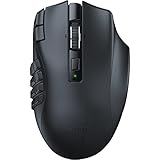
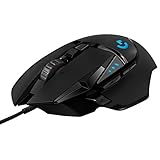


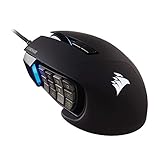
If you have ever found yourself alt-tabbing mid-raid, scrambling for a keybind during a ranked match, or losing precious milliseconds reaching across your keyboard for a macro, a gaming mouse with programmable side buttons is the upgrade that changes everything. In 2026, the field has matured significantly — sensors are near-flawless, wireless latency is no longer a liability, and software ecosystems have grown powerful enough to map virtually any action to your thumb. The question is no longer whether a multi-button mouse is worth it; it is which one belongs on your desk.
We compared over a dozen options across MMOs, FPS titles, and productivity workflows. Below are the five best gaming mice with side buttons available right now, ranked from best overall down to the top budget pick.
In a hurry? See the top-rated Gaming Mouse with Side Buttons deals available right now:
🛒 Check Gaming Mouse With Side Buttons Prices on Amazon →🛒 Best Price Today on Amazon
Prime members get fast, free shipping on everything above, plus member-only deals. New members get a 30-day free trial — cancel anytime.
Start 30-Day Prime Free Trial →See Today’s Amazon DealsQuick Comparison Table
| Mouse | Side Buttons | Sensor | Connectivity |
|---|---|---|---|
| Logitech G604 LIGHTSPEED | 15 programmable | HERO 25K | Wireless (2.4GHz + BT) |
| Razer Naga X | 16 programmable | Focus+ Optical | Wired |
| SteelSeries Aerox 5 | 9 programmable | TrueMove Air | Wireless (2.4GHz + BT) |
| Corsair Scimitar Elite Wireless | 17 programmable | Marksman 26K | Wireless (SLIPSTREAM) |
| Redragon M908 Impact | 12 side buttons | 12,400 DPI | Wired |
Our Top Picks
Each pick below was evaluated on build quality, button accessibility, sensor performance, software depth, and real-world gaming comfort over extended sessions. Here is what rose to the top.
1. [Best Overall] Logitech G604 LIGHTSPEED
The Logitech G604 LIGHTSPEED is the most well-rounded gaming mouse with side buttons you can buy in 2026. It packs 15 fully programmable buttons — six of which sit comfortably under the thumb — driven by Logitech’s HERO 25K sensor, which tracks at up to 25,600 DPI with exceptional accuracy and near-zero smoothing. The dual wireless modes (2.4 GHz LIGHTSPEED and Bluetooth) give you elite-tier gaming responsiveness on PC and the flexibility to pair with a tablet or secondary device without a dongle. Battery life is class-leading at up to 240 hours in Bluetooth mode, making this a pick-up-and-play mouse that rarely needs charging.
Pros:
- HERO 25K sensor with zero hardware acceleration
- 15 programmable buttons, all reachable without repositioning grip
- Dual wireless: 2.4 GHz LIGHTSPEED + Bluetooth 5
- Up to 240-hour battery life (AA battery)
- G HUB software is mature and supports per-profile macros
Cons:
- Heavier than dedicated lightweight mice (~135g)
- Right-hand only design
- No RGB lighting

2. [Best Wired] Razer Naga X
The Razer Naga X is built for players who live inside complex ability rotations — MMO healers, MOBA supports, RTS commanders. Its 16-button mechanical thumb grid is the highest button count in a wired form factor at this price, and Razer’s Focus+ optical sensor delivers 20,000 DPI performance with 99.6% resolution accuracy. At just 85 grams, the Naga X is remarkably light for a mouse this feature-dense, reducing fatigue during long sessions. The wired connection via a flexible Speedflex cable means zero input lag and no battery management — plug it in and forget about it.
Pros:
- 16-button thumb grid — most per-inch density of any mouse here
- Only 85g — exceptional for a high-button-count mouse
- Focus+ optical sensor with true 20K DPI
- Flexible Speedflex cable eliminates drag
- Razer Synapse 3 supports complex macro chains and hypershift layers
Cons:
- Wired only — no wireless option
- Thumb grid takes time to memorize without looking
- Software requires a Razer account for cloud profiles
3. [Best Wireless Lightweight] SteelSeries Aerox 5
The SteelSeries Aerox 5 is the answer to a question many gamers have asked: can a mouse with multiple side buttons still feel like a featherweight? The honeycomb shell brings the weight down to 74 grams without sacrificing structural rigidity, and the nine programmable buttons — including two forward-facing thumb buttons and a row of three — cover most macro needs without turning your thumb into a mapmaker. The TrueMove Air sensor was tuned for wireless performance specifically and holds up at up to 18,000 DPI. Dual wireless support (2.4 GHz and Bluetooth 5.0) and a 180-hour battery life round out an impressive package for wireless-first gamers.
Pros:
- 74g with honeycomb design — lightest pick on this list
- 9 programmable buttons in intuitive positions
- TrueMove Air optical sensor, optimized for wireless
- 2.4 GHz + Bluetooth 5.0 dual wireless
- IP54 water and dust resistance
- 180-hour battery (2.4 GHz mode)
Cons:
- Fewer buttons than Naga X or Scimitar — not ideal for heavy MMO play
- Honeycomb shell collects debris over time
- SteelSeries GG software less powerful than Logitech G HUB for deep macro work

4. [Best for MMO] Corsair Scimitar Elite Wireless
The Corsair Scimitar Elite Wireless is purpose-built for MMO players who need a button for everything. Its 17-button mechanical side panel is the largest on this list, and the buttons can be physically slid forward or backward along a 8mm key slider to match your exact thumb anatomy — a feature that makes a genuine difference during 4-hour raid sessions. The Marksman 26,000 DPI optical sensor is among the fastest available in 2026, and Corsair’s SLIPSTREAM wireless technology delivers sub-1ms response time, matching the feel of a wired connection. If your game demands maximum programmability and you play wired or wireless, this is the MMO throne.
Pros:
- 17 programmable buttons — most on this list
- Physical 8mm key slider adjusts thumb panel position
- Marksman 26K DPI sensor with sub-1ms SLIPSTREAM wireless
- iCUE software supports per-slot lighting, complex macros, and ability timers
- 100-hour battery life with RGB enabled
Cons:
- Heaviest mouse on this list (~122g)
- iCUE software is resource-intensive
- Premium price point
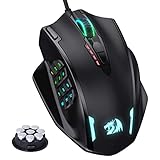
5. [Best Budget] Redragon M908 Impact
Not every gamer needs to spend $80–$110 to get a mouse with meaningful thumb programmability. The Redragon M908 Impact delivers 12 side buttons, an onboard 12,400 DPI sensor, and five programmable DPI stages for under $40. The build quality is solid for the price — rubberized side grips keep your thumb anchored, and the braided cable adds durability. Software-defined macros, adjustable RGB lighting across 16.8 million colors, and 1000 Hz polling rate make this feel like a much more expensive mouse. If you are new to multi-button mice or building a budget gaming setup, the M908 is the easiest entry point on the market.
Pros:
- 12 side buttons at under $40 — exceptional value
- 12,400 DPI sensor with 5 DPI stages
- 1000 Hz polling rate
- On-board memory stores up to 5 profiles
- Aggressive, comfortable ergonomic shape
Cons:
- Wired only
- Sensor accuracy lags behind premium options
- Software interface is dated and clunky
- Heavier than expected at ~130g

How to Choose the Right Mouse with Side Buttons
With five strong options on the table, the right pick comes down to four criteria. Answer these honestly and the decision becomes obvious.
Button Count vs. Button Accessibility
More buttons is not always better. A 17-button panel sounds impressive, but if you can only reliably reach 6 of them without moving your grip, the other 11 add noise, not value. Consider how many commands you actually need under your thumb. MMO players with deep rotation requirements benefit from 12–17 buttons. MOBA and ARPG players typically find 6–9 buttons sufficient. FPS players rarely need more than 2–4. Match button count to your actual workflow, not theoretical maximum.
Wired vs. Wireless
In 2026, the latency gap between wired and quality wireless mice has essentially closed. Technologies like Logitech LIGHTSPEED and Corsair SLIPSTREAM achieve sub-1ms response times. The real tradeoff is freedom of movement versus zero battery management. If you compete at a high level and want one fewer variable to manage, wired is simpler. If you want a clean desk or frequently move your setup, wireless at this tier is genuinely competitive.
Sensor Quality and DPI Range
For most gaming scenarios, any sensor above 12,000 DPI with proper 1:1 tracking is more than sufficient. The HERO 25K, Focus+, TrueMove Air, and Marksman 26K are all tournament-grade. Unless you are playing on an extreme DPI setting for ultra-wide displays or very specific competitive reasons, sensor differences between the top four picks will not affect your gameplay. Budget sensors like the M908’s 12,400 DPI unit are noticeably less precise at high speeds but perform well at typical gaming sensitivities.
Software Ecosystem
Hardware is only half the equation. The software determines how deeply you can program your buttons. Logitech G HUB and Razer Synapse 3 lead the field with per-profile layering, application-triggered profile switching, and macro recording that handles complex multi-key sequences. Corsair iCUE is feature-rich but resource-heavy. SteelSeries GG is clean and fast but less powerful for complex macro chains. Redragon’s software gets the job done for basic remapping. If your workflow involves conditional macros, timed sequences, or game-state triggers, prioritize the software ecosystem, not just the hardware.
Final Verdict
The Logitech G604 LIGHTSPEED earns the best overall title in 2026 because it balances button count, sensor quality, wireless freedom, and software depth better than anything else at its price point. The Razer Naga X is the right call if you want maximum buttons in a wired, lightweight form factor. SteelSeries Aerox 5 wins for gamers who refuse to sacrifice portability. Corsair Scimitar Elite Wireless is the undisputed MMO choice for players who need every slot filled. And the Redragon M908 Impact proves that thumb programmability does not have to break your budget — it delivers genuine value at under $40 that outperforms its price in almost every measurable way.
Whatever your genre, session length, or sensitivity preference, a mouse with well-placed side buttons will make you faster, more comfortable, and more consistent. Pick the one that matches how you actually play.
Frequently Asked Questions
Q: How many side buttons do I actually need on a gaming mouse?
A: It depends entirely on your genre. FPS players typically need 2–4 extra buttons for push-to-talk, reload macros, or grenade binds. MOBA players benefit from 4–8 buttons covering abilities, ward shortcuts, and item actives. MMO and ARPG players get the most value from 12–17 buttons to cover full ability bars, consumables, and UI toggles. Start with what your most-played game demands and scale from there.
Q: Are wireless gaming mice with side buttons reliable for competitive play?
A: Yes — at the level represented by the Logitech G604 and Corsair Scimitar Elite Wireless, wireless latency is effectively imperceptible. Both use dedicated 2.4 GHz receivers with polling rates of 1000 Hz or higher. Professional players use wireless mice in tournaments regularly. The only scenario where wired maintains a hard advantage is if you are playing in an environment with significant 2.4 GHz interference from multiple devices.
Q: Can I use a gaming mouse with side buttons for productivity and not just gaming?
A: Absolutely, and many users find the value-per-dollar ratio actually higher in productivity contexts. Side buttons map naturally to browser back/forward, copy/paste, undo/redo, application switching, and custom shortcuts in tools like Photoshop, Premiere Pro, or Excel. Logitech G HUB and Razer Synapse both support application-aware profiles that automatically switch bindings when you change the active window — meaning your buttons behave differently in your browser versus your DAW versus your game, with zero manual switching required.
Related Articles
Looking for more on this topic? Browse the hand-picked guides below — each one applies the same scoring rubric used in this review.