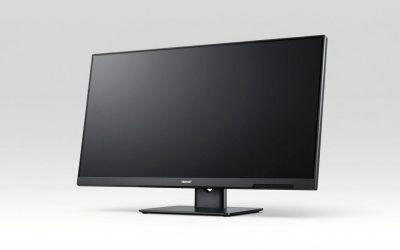
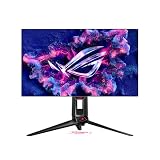
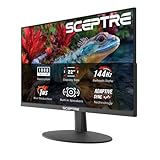
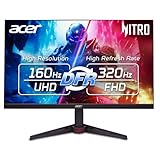
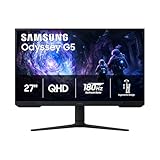
- Top Pick: Dell 27 240Hz Gaming Monitor – SE2726HG – 27-inch FHD (1920×1080) 240Hz Display, in-Plane Switching (IPS) Technology, AMD FreeSync Premium, TÜV 3-Star, 2X HDMI, DisplayPort 1.4, Tilt
- Best Value: Samsung 27" Odyssey G5 (G51F) Series QHD (1440P) Gaming Monitor
- Premium Choice: Sceptre New 22-Inch Gaming Monitor, FHD 1080p, Up to 144Hz, HDMI, DisplayPort, Built-in Speakers, Machine Black (E225W-FW144 Series, 2026)
Affiliate disclosure: As an Amazon Associate we earn from qualifying purchases. This post contains affiliate links — if you buy through them we may earn a small commission at no extra cost to you. This never affects our recommendations.
Choosing the right gaming monitor in 2026 comes down to matching the panel to your GPU, game library, and budget. A 1080p 144Hz screen is still the sweet spot for competitive players on mid-range hardware, while 1440p IPS monitors have become the mainstream choice for most PC gamers. OLED and Mini-LED panels are maturing fast, making premium purchases more justifiable than ever.
In a hurry? See the top-rated Gaming Monitors deals available right now:
🛒 Check Gaming Monitors Prices on Amazon →🛒 Best Price Today on Amazon
Prime members get fast, free shipping on everything above, plus member-only deals. New members get a 30-day free trial — cancel anytime.
Start 30-Day Prime Free Trial →See Today’s Amazon DealsTop Picks at a Glance
| Product | Best For |
|---|---|
| LG 27GP850-B | Best overall 1440p |
| Samsung Odyssey G7 | Curved 1440p premium |
| ASUS ROG Swift PG279QM | High-refresh esports 1440p |
| Dell G2724D | Budget 1440p value |
| Gigabyte M27Q | KVM productivity + gaming |
As an Amazon Associate we earn from qualifying purchases at no extra cost to you.






LG 27GP850-B — Best Overall Gaming Monitor
- Panel: 27-inch IPS, 2560×1440, 180Hz (overclocked), 1ms GtG
- HDR: VESA DisplayHDR 400
- Connectivity: 2x HDMI 2.0, 1x DisplayPort 1.4, USB hub
- Pros: Excellent color accuracy out of the box; wide viewing angles typical of IPS; anti-glare coating handles bright rooms well; G-Sync Compatible and FreeSync Premium certified
- Cons: HDR 400 certification is modest — blacks are not deep enough for HDR to shine; stand lacks height adjustment travel
Samsung Odyssey G7 — Best Curved 1440p Monitor
- Panel: 32-inch VA curved (1000R), 2560×1440, 240Hz, 1ms MPRT
- HDR: VESA DisplayHDR 600 with local dimming
- Connectivity: 2x HDMI 2.0, 1x DisplayPort 1.4
- Pros: 240Hz refresh rate is a genuine advantage in fast-paced shooters; HDR 600 with local dimming delivers noticeably better contrast than flat IPS panels; immersive 1000R curve works well in gaming and movie watching
- Cons: VA panel shows motion blur in fast transitions that IPS avoids; aggressive curve can cause geometric distortion at close range; 2x HDMI 2.0 limits bandwidth for next-gen consoles
ASUS ROG Swift PG279QM — Best High-Refresh Esports Monitor
- Panel: 27-inch IPS, 2560×1440, 240Hz (overclocked to 270Hz), 1ms GtG
- HDR: VESA DisplayHDR 400, G-Sync module
- Connectivity: 1x HDMI 2.0, 1x DisplayPort 1.4, USB 3.0 hub
- Pros: 240Hz+ IPS is the sharpest and smoothest 1440p experience available; native G-Sync module is preferred by NVIDIA GPU owners for tear-free performance; ASUS ELMB-Sync reduces motion blur without sacrificing variable refresh
- Cons: Expensive for 1440p; G-Sync module adds cost that AMD GPU owners cannot fully utilize; stand is bulky
Dell G2724D — Best Budget 1440p Gaming Monitor
- Panel: 27-inch IPS, 2560×1440, 165Hz, 1ms GtG
- HDR: DisplayHDR 400
- Connectivity: 2x HDMI 1.4, 1x DisplayPort 1.2, USB hub
- Pros: Excellent color accuracy and brightness for the price; slim bezel design looks modern; reliable Dell build quality with a 3-year warranty that competitors at this price rarely match
- Cons: HDMI 1.4 ports limit console compatibility (DisplayPort required for full 1440p 165Hz on PC); HDR implementation is minimal; no USB-C input
Gigabyte M27Q — Best Dual-Purpose Gaming and Productivity Monitor
- Panel: 27-inch IPS, 2560×1440, 170Hz, 0.5ms MPRT
- HDR: DisplayHDR 400
- Connectivity: 2x HDMI 2.0, 1x DisplayPort 1.2, 1x USB-C (with KVM), USB hub
- Pros: Built-in KVM switch lets you control two computers with one keyboard and mouse — genuinely useful for work-from-home setups; USB-C video input adds laptop compatibility; accurate factory calibration
- Cons: KVM setup requires some initial configuration; OSD navigation via joystick is not the most intuitive; stand has limited pivot range
Buying Guide: Choosing the Right Gaming Monitor
Resolution: 1080p vs. 1440p vs. 4K
At 27 inches, 1440p is the sweet spot for pixel density and GPU demand. 1080p at 27 inches starts to look noticeably soft; reserve 1080p for 24-inch screens where it remains sharp. 4K gaming demands a high-end GPU (RTX 4080 or above) to run modern titles at high settings above 60fps — not a practical choice for most gamers with mid-range hardware. 1440p gives a significant visual upgrade over 1080p at a GPU cost that most RTX 3060 and above cards can handle comfortably.
Refresh Rate: 60Hz vs. 144Hz vs. 240Hz
Going from 60Hz to 144Hz is the single most impactful upgrade in gaming monitors — the difference is immediately visible to any player. The jump from 144Hz to 240Hz is real but subtler, and mainly benefits competitive FPS players who can sustain high frame rates consistently. For RPGs, strategy games, and casual play, 144Hz or 165Hz is more than sufficient and lets you spend your budget on panel quality instead.
Panel Technology: IPS vs. VA vs. OLED
IPS panels offer the best color accuracy and widest viewing angles — they are the most versatile choice for mixed gaming and creative work. VA panels deliver superior contrast ratios (typically 3000:1 vs. 1000:1 for IPS) which makes dark scenes look richer, but faster motion can cause slight blurring. OLED panels offer perfect blacks and near-instantaneous pixel response, but come at a significantly higher price point and require burn-in awareness for static HUD elements.
Variable Refresh Rate: G-Sync vs. FreeSync
G-Sync Compatible and AMD FreeSync Premium monitors now outnumber proprietary G-Sync module screens. Most NVIDIA GPUs work fine with FreeSync displays via G-Sync Compatible mode — you rarely need to pay the premium for a native G-Sync module unless you are a competitive player who notices even minor frame pacing irregularities. Check the NVIDIA G-Sync Compatible list before purchasing any FreeSync display.

FAQ
Q: What resolution is best for a 27-inch gaming monitor?
A: 1440p (2560×1440) is the ideal resolution for 27-inch gaming monitors in 2026. It offers noticeably sharper visuals than 1080p at that screen size, while being more GPU-friendly than 4K. Most mid-to-high-range graphics cards can drive 1440p at 144Hz or higher in current titles.
Q: Is a curved monitor worth it for gaming?
A: Curved monitors enhance immersion in racing games, RPGs, and open-world titles. The benefit is most apparent on 32-inch and larger screens. At 27 inches, the curvature effect is subtle — a flat IPS at 27 inches is often the better all-around choice for mixed use including productivity and video watching.
Q: Does HDR make a noticeable difference in gaming?
A: Only if the monitor meets at least DisplayHDR 600 with local dimming. HDR 400 certification — which most monitors carry — adds minimal visible benefit. True HDR impact requires 600 nits brightness with local dimming zones (like the Samsung Odyssey G7) or OLED panels with per-pixel dimming.

Q: What ports do I need on a gaming monitor?
A: For PC gaming, DisplayPort 1.4 is the preferred connection — it supports 4K 144Hz and 1440p 240Hz. HDMI 2.1 is essential for PS5 and Xbox Series X at 4K 120Hz. HDMI 2.0 handles 1440p at up to 144Hz, which is sufficient for most builds. USB-C is a useful bonus for laptop users.
Q: How much should I spend on a gaming monitor?
A: For most PC gamers, a $200–$350 budget covers an excellent 1440p 144Hz+ IPS panel. Spending beyond $500 typically gets you higher refresh rates (240Hz+), better HDR implementation, or OLED technology. The budget under $250 still delivers strong 1440p options like the Dell G2724D for gamers with tighter spending limits.
Final Verdict
The LG 27GP850-B remains the monitor we recommend most often — it delivers 1440p at 180Hz on an accurate IPS panel at a competitive price, and it works equally well for competitive gaming, creative work, and everyday use. If you want the curved cinematic experience with better HDR, the Samsung Odyssey G7 is worth the premium. For the tightest budget, the Dell G2724D is reliable, accurate, and backed by Dell’s three-year warranty — a combination that is hard to beat under $230.
Related Articles
Looking for more on this topic? Browse the hand-picked guides below — each one applies the same scoring rubric used in this review.
Frequently Asked Questions
What matters more, refresh rate or resolution?
It depends on what you play. Competitive shooters benefit most from high refresh, so 1080p or 1440p at 240Hz beats 4K at 60Hz for that use. Single-player and visually driven games reward resolution and contrast. If you split your time, 1440p at 144-180Hz is the most balanced compromise available today.
What size monitor suits my desk distance?
At a typical 60-70cm viewing distance, 24 inches suits 1080p, 27 inches suits 1440p and 32 inches suits 4K. Going larger without adding resolution makes pixels visible and text soft. Ultrawide 34-inch panels sit roughly between 27 and 32 inches in vertical height while adding significant horizontal field of view.
Is response time or input lag the number I should watch?
Manufacturer response time figures are best-case grey-to-grey numbers under aggressive overdrive and are largely marketing. What you actually feel is total system latency, which combines panel response, signal processing and refresh rate. Independent review measurements of real response times and processing lag are far more useful than the spec sheet.
Do curved monitors help in games?
On wide panels of 34 inches and above, curvature keeps the edges roughly equidistant from your eyes, which reduces distortion and eye travel. On a standard 27-inch 16:9 screen the benefit is minimal and largely a matter of taste. Curved panels are a poor choice for design work where straight-line accuracy matters.
How many monitors can my graphics card drive?
Most current NVIDIA and AMD cards support four displays simultaneously, limited by the physical ports on the card. Total bandwidth matters more than count: three 4K 144Hz panels will exhaust the available DisplayPort bandwidth long before you hit the display limit. Check port versions before planning a multi-monitor high-refresh setup.