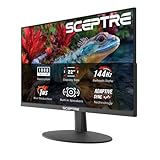
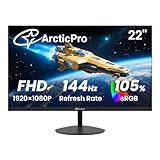
- Top Pick: Sceptre New 22-Inch Gaming Monitor, FHD 1080p, Up to 144Hz, HDMI, DisplayPort, Built-in Speakers, Machine Black (E225W-FW144 Series, 2026)
- Best Value: LG 24G411A-B 24-inch Ultragear Full HD (1920 x 1080) IPS Gaming Monitor, 144Hz (O/C), 1ms MBR, NVIDIA G-Sync Compatible, AMD FreeSync, HDR10, HDMI, DisplayPort, Slim Stand, Black
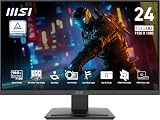
- Premium Choice: msi PRO MP243L E14 24-inch IPS 1920 x 1080 (FHD) Gaming Office Monitor, 144Hz, Free-Synch, HDR Ready, HDMI, VGA Port,VESA Mountable, Tilt, 4-Side Slim Bezel,1ms, Black
Affiliate disclosure: As an Amazon Associate we earn from qualifying purchases. This post contains affiliate links — if you buy through them we may earn a small commission at no extra cost to you. This never affects our recommendations.
144Hz was the magic number that separated competitive gaming monitors from office displays, and in 2026 that threshold has become the entry point rather than the ceiling. Today’s 144Hz monitors deliver IPS color accuracy, sub-1ms response, and G-Sync/FreeSync compatibility that would have required flagship spending three years ago. We compared five of the best to find the right 144Hz panel for every resolution, budget, and game type.
In a hurry? See the top-rated 144Hz Gaming Monitors deals available right now:
🛒 Check 144Hz Gaming Monitors Prices on Amazon →🛒 Best Price Today on Amazon
Prime members get fast, free shipping on everything above, plus member-only deals. New members get a 30-day free trial — cancel anytime.
Start 30-Day Prime Free Trial →See Today’s Amazon DealsTop Picks at a Glance
| Monitor | Resolution | Panel | Max Hz | Best For | Price Range |
|---|---|---|---|---|---|
| LG 27GP850-B | 1440p | Nano IPS | 165Hz | Best overall | $$$ |
| ASUS VG279QM | 1080p | IPS | 280Hz | Competitive 1080p | $$ |
| MSI G274QPF-QD | 1440p | Rapid IPS | 170Hz | 1440p value | $$ |
| Gigabyte M27Q | 1440p | IPS | 170Hz | Budget 1440p | $$ |
| Acer Nitro XV272U | 1440p | IPS | 170Hz | All-rounder 1440p | $$ |
As an Amazon Associate we earn from qualifying purchases at no extra cost to you.




1. LG 27GP850-B — Best 144Hz Gaming Monitor Overall
- Specs: 27-inch Nano IPS, 2560×1440, 165Hz (OC), 1ms GtG, HDR400, 98% DCI-P3, G-Sync Compatible + FreeSync Premium Pro, DisplayPort 1.4 + 2x HDMI 2.0
- Nano IPS Advantage: Nano IPS coating expands color volume beyond standard IPS — games with HDR content and vibrant palettes look genuinely stunning at 98% DCI-P3
- Response Time: 1ms GtG at 165Hz with Overdrive enabled — effectively eliminates ghosting on fast-moving objects without inverse ghosting artifacts
- Pros: Near-perfect color accuracy out of box, excellent viewing angles, G-Sync and FreeSync support for any GPU, height/tilt/pivot/swivel stand
- Cons: HDR400 certification is functional but not transformative; HDMI 2.0 limits consoles to 1440p/120Hz (not 4K)
2. ASUS VG279QM — Best 1080p Competitive Gaming Monitor
- Specs: 27-inch Fast IPS, 1920×1080, 280Hz max, 1ms GtG, G-Sync Compatible + FreeSync Premium, ELMB Sync, DisplayPort 1.2 + 2x HDMI 1.4
- 280Hz at 1080p: If your GPU pushes 200+ FPS in competitive titles (CS2, Valorant, Apex Legends), the 280Hz ceiling gives you every frame your hardware generates
- ELMB Sync: ASUS’s Extreme Low Motion Blur Sync combines strobing backlight with VRR — one of few monitors that runs both simultaneously without conflict
- Pros: Excellent fast IPS response, G-Sync Compatible verified, sRGB 99% coverage for accurate color at 1080p, solid 5-way OSD joystick
- Cons: 1080p on a 27-inch panel shows pixel density limitations for productivity use; HDMI 1.4 limits to 1080p/144Hz on console
3. MSI G274QPF-QD — Best 1440p Mid-Range Monitor
- Specs: 27-inch Rapid IPS with Quantum Dot, 2560×1440, 170Hz, 1ms GtG, HDR400, 99% DCI-P3, G-Sync Compatible + FreeSync Premium Pro, DisplayPort 1.4 + 2x HDMI 2.0
- Quantum Dot IPS: QD layer boosts color saturation to 99% DCI-P3 — rivaling LG’s Nano IPS at a lower typical street price
- Rapid IPS: MSI’s Rapid IPS panel achieves true 1ms GtG through a faster liquid crystal layer — identical to LG’s Fast IPS approach but with QD enhancement
- Pros: Outstanding color volume for the price, FreeSync Premium Pro with LFC for low frame rate compensation, USB hub (2x USB-A downstream)
- Cons: Stand adjustment range is more limited than LG’s, OSD software is basic, light bleed can appear near corners
4. Gigabyte M27Q — Best Budget 1440p Gaming Monitor
- Specs: 27-inch IPS, 2560×1440 (non-standard pixel layout), 170Hz, 0.5ms MPRT, HDR400, 92% DCI-P3, FreeSync Premium, DisplayPort 1.4 + 2x HDMI 2.0, USB-C 18W PD
- Value Proposition: 27-inch 1440p 170Hz IPS with USB-C power delivery and a built-in KVM switch at a price that undercuts most 1440p competitors
- KVM Switch: The M27Q’s built-in KVM lets you control two computers with one keyboard and mouse through the monitor’s USB hub — ideal for dual-PC desk setups
- Pros: USB-C with 18W PD charges laptops, KVM switch for productivity users, solid IPS colors, excellent price-to-spec ratio
- Cons: BGR subpixel layout causes text fringing with Windows ClearType — enable ClearType tuning or use FreeSync; not G-Sync Compatible certified (works but uncertified)
5. Acer Nitro XV272U — Best All-Round 1440p Monitor
- Specs: 27-inch IPS, 2560×1440, 170Hz, 1ms VRB, HDR400, 95% DCI-P3, G-Sync Compatible + FreeSync Premium, DisplayPort 1.2 + 2x HDMI 2.0, 4x USB-A hub
- Versatility: The XV272U is the pick for users who game, work, and create — its accurate 95% DCI-P3 and adjustable stand make it as capable in Photoshop as in Valorant
- USB Hub: Four downstream USB-A ports make the Nitro XV272U a practical desk hub — connects keyboard, mouse, headset, and webcam without a separate hub
- Pros: G-Sync Compatible verified, strong color accuracy for creative work, 4-port USB hub, excellent adjustability, zero-frame display design
- Cons: DisplayPort 1.2 limits future HDR bandwidth; 1ms figure is VRB (strobing) not GtG — GtG response is closer to 4ms
Buying Guide
IPS vs. VA vs. TN Panels in 2026
TN (Twisted Nematic) panels are nearly extinct at quality monitor tiers — their poor color and narrow viewing angles have no place in modern gaming setups. VA (Vertical Alignment) panels offer the best contrast ratio (3000:1 vs. IPS’s 1000:1) and inky blacks — excellent for dark game environments and single-player RPGs — but suffer from slower response times and “smearing” on fast motion. IPS panels deliver superior color accuracy, wide viewing angles, and fast response times, making them the preferred choice for competitive gaming and color work. Fast IPS (Rapid IPS, Nano IPS) variants have closed the response gap to virtually nothing. All five picks here use IPS variants for this reason.
1080p vs. 1440p: Choosing Your Resolution
1080p at 144Hz+ is the competitive gamer’s choice — lower resolution means higher frame rates from the same GPU, and frame rate wins gunfights. 1440p at 144Hz is the sweet spot for gamers who play both competitive titles and story-driven games — sharp enough for immersive single-player, fast enough for competitive play. The crossover point: if you’re primarily playing battle royales and hero shooters, 1080p at 280Hz (VG279QM) maximizes your GPU’s advantage. If your library is varied, 1440p at 165–170Hz is the better all-round investment.
G-Sync vs. FreeSync: Which Do You Need?
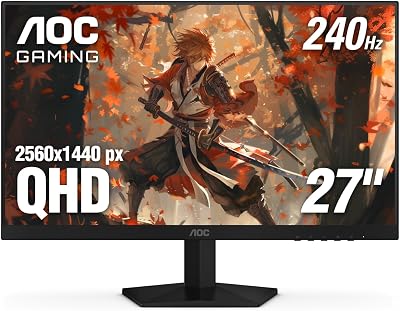
Variable refresh rate (VRR) synchronizes the monitor’s refresh rate to the GPU’s frame output, eliminating screen tearing and reducing stuttering. NVIDIA cards work best with G-Sync certified monitors (hardware module) or G-Sync Compatible monitors (FreeSync certified by NVIDIA). AMD cards use FreeSync natively. In 2026, most premium monitors carry both certifications — all five picks here are G-Sync Compatible and FreeSync enabled. If you have an NVIDIA GPU, G-Sync Compatible is all you need; the hardware G-Sync module adds cost without meaningful benefit at 1440p.
What GPU Do You Need to Drive These Monitors?
For 1080p 144Hz minimum (competitive games): RTX 3060 or RX 6600 gets the job done in most titles. For 1080p 280Hz: RTX 4070 or RX 7800 XT to consistently approach the ceiling in competitive titles. For 1440p 165Hz: RTX 4070 Super or RX 7900 GRE for high-quality settings in demanding games. For 1440p 170Hz in competitive titles with low settings: RTX 3080 / RX 6800 XT. Be realistic about your GPU before investing in a 170Hz panel — running 90 FPS on a 165Hz display still looks better than 60Hz, but you’re not getting your money’s worth without the frame rate to match.
FAQ
- Is there a visible difference between 144Hz and 165Hz or 170Hz?
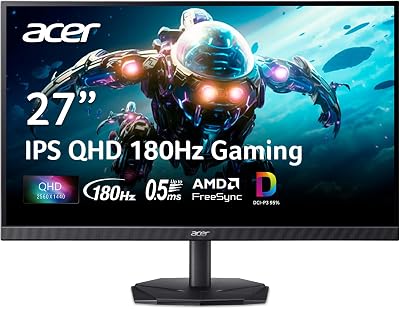
- At 144Hz vs. 165Hz, the difference is subtle — most users can’t distinguish it in blind tests. 144Hz vs. 240Hz is more noticeable. All monitors here run at 144Hz as a baseline and overclock higher — you get the best of both.
- Can I use a 144Hz gaming monitor for photo/video editing?
- Yes, with caveats. The LG 27GP850-B and MSI G274QPF-QD cover 98–99% DCI-P3, making them genuinely capable for creative work. The ASUS VG279QM’s 1080p resolution limits Lightroom and Premiere productivity. For dual-purpose work and gaming, 1440p IPS picks are the correct choice.
- Does 144Hz help with console gaming in 2026?
- Yes — PS5 and Xbox Series X output 1080p/120Hz and 1440p/120Hz on supported monitors. All five picks here support 120Hz on consoles, giving you smooth gameplay even if the full 144Hz+ ceiling isn’t reached. Check HDMI 2.1 support if your primary use is console at 4K/120Hz — none of these monitors have HDMI 2.1.
- What response time spec should I look for?
- Look for GtG (Gray-to-Gray) response time, not MPRT (Moving Picture Response Time) — MPRT uses backlight strobing and is a different measurement. For competitive gaming, target 1ms GtG. For general gaming, 4ms GtG is imperceptible. All five picks here achieve 1ms GtG with overdrive enabled.
- Is HDR worth it on a gaming monitor?
- At HDR400 (the standard on these monitors), the improvement is modest — it requires HDR600 or HDR1000 with local dimming to produce a genuinely transformative difference. HDR on these monitors is a bonus, not a selling point. True HDR gaming requires an OLED or mini-LED monitor with 1000+ nits peak brightness and full array local dimming.
Final Verdict
The LG 27GP850-B earns the top recommendation for 2026 — Nano IPS color coverage, 165Hz, proven 1ms response, and dual adaptive sync make it the complete package for gamers who want both visual quality and competitive performance at 1440p. Competitive 1080p players who prioritize frame rate above all else should choose the ASUS VG279QM and enjoy 280Hz ceiling on titles where frame rates climb high. Budget-conscious 1440p shoppers will find the Gigabyte M27Q and Acer Nitro XV272U both offer outstanding value, with the M27Q’s KVM and USB-C edge suiting productivity-heavy setups. At any budget, all five monitors on this list represent a dramatic upgrade over 60Hz displays — and once you experience 144Hz gaming, returning to 60Hz becomes genuinely difficult.
Related Gaming Guides
- Best Gaming Monitors Under $300 in 2026 — 1080p and 1440p Options
- Best 1080p Gaming Monitors in 2026 — Fast, Sharp, and Budget-Friendly
- Best 240Hz Gaming Monitors 2026 — Ultra-Smooth 1080p & 1440p Picks
- Best 1440p Monitors 2026: 144Hz, 165Hz, G-SYNC, HDR Picks
- Best 1440p 240Hz Gaming Monitors in 2026: 7 Top Picks Tested
Related Articles
Looking for more on this topic? Browse the hand-picked guides below — each one applies the same scoring rubric used in this review.
Frequently Asked Questions
Will I actually notice the jump from 60Hz to 144Hz?
Yes, immediately. The difference shows up in ordinary mouse movement and window dragging before you even launch a game. In fast shooters, the extra frames reduce motion blur and shorten the delay between your input and what appears on screen, making tracking targets measurably easier. It is the single most noticeable monitor upgrade most people make.
What GPU do I need to drive 144Hz?
At 1080p, competitive esports titles such as CS2, Valorant and Rocket League will exceed 144fps on almost any current mid-range card. Demanding single-player games need more muscle. At 1440p and 144Hz, plan on something around an RTX 4060 Ti or RX 7700 XT class card, using upscaling where available.
Should I choose 1080p or 1440p at 144Hz?
Choose 1080p if you play competitively, have a modest GPU, or sit close to a 24-inch panel. Choose 1440p for a 27-inch screen, where 1080p starts looking soft due to the low pixel density. 1440p roughly doubles the pixels the GPU must render, so budget accordingly.
Is IPS, VA or TN best for a 144Hz monitor?
IPS gives the best colour accuracy and viewing angles and now hits response times fast enough for competitive play, which is why most recommendations land there. VA offers much deeper blacks for dark games and movies but can smear in fast dark transitions. TN is the cheapest and fastest but has weak colours and narrow viewing angles.
Do I need G-Sync or is FreeSync enough?
FreeSync is enough for the vast majority of buyers. Almost every FreeSync monitor sold today also works with NVIDIA cards through G-Sync Compatible mode, and adaptive sync eliminates tearing without the input lag of V-Sync. Dedicated G-Sync hardware modules add cost and are worth it only for specific variable-overdrive benefits.
Ready to decide? Our #1 pick for 2026 is the LG 27GP850-B.
Live price & availability on Amazon.