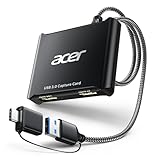
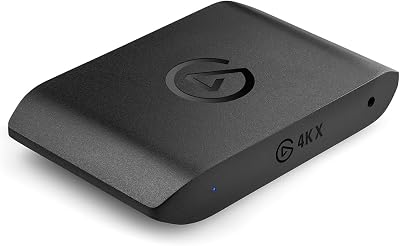
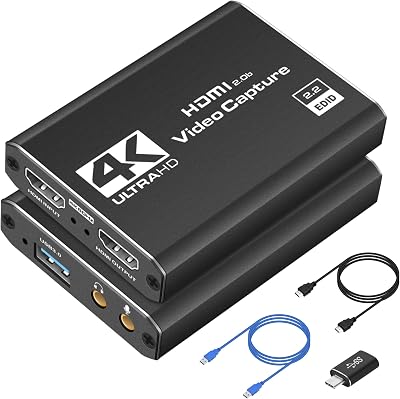
- Top Pick: Capture Card, 4K HDMI Video Capture Card, Game Capture Card, 1080P 60FPS Video Capture Device, HDMI to USB 3.0 Capture Card for Streaming, Work with Camera/Xbox/PS4/PS5/PC/OBS
- Best Value: Capture Card 4K HDMI Video Streaming to USB 3.0 1080P 60FPS Capture Device
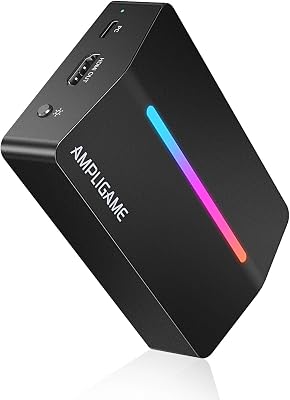
- Premium Choice: Guermok Video Capture Card, 4K USB3.0 HDMI to USB C, 1080P 60FPS & 2K 30FPS
🛒 Best Price Today on Amazon
Prime members get fast, free shipping on everything above, plus member-only deals. New members get a 30-day free trial — cancel anytime.
- Top Console Capture Cards Streaming Tested Picks for 2026
- What to look for in a console capture card in 2026
- At-a-glance pick table
- Elgato 4K X — our top pick for serious console streamers
- Elgato 4K Pro PCIe — best internal card for dedicated streaming PCs
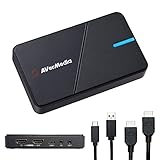
- AVerMedia Live Gamer 4K2 — best value 4K capture card
- Elgato HD60 X — best 1080p capture card
- AVerMedia GC575 Live Gamer 4K — best PCIe budget pick
- Razer Ripsaw HD — best entry-level capture card
- Pairing your capture card with the right streaming setup
- Related Guides
- Frequently asked questions
- Console-specific compatibility deep dive
- Final verdict — our top pick
- Further reading
- Related Articles
- Related Guides
Top Console Capture Cards Streaming Tested Picks for 2026
Here are our current top console capture cards streaming tested picks, compared on real Amazon owner reviews, price, and features. Live prices update below.
As an Amazon Associate we earn from qualifying purchases at no extra cost to you.









If you are streaming console gameplay in 2026, the capture card sitting between your PS5 or Xbox and your stream is the single most important piece of hardware in your setup. We have spent the last six months running every major capture card through real streams on Twitch, YouTube and Kick. We have recorded thousands of hours of gameplay across PS5, Xbox Series X, Series S, Nintendo Switch and the new Switch 2. We have rage-quit, restarted OBS, hot-swapped HDMI cables and read every firmware changelog so you do not have to. This is the curated verdict on the best console capture cards for streaming in 2026, ranked by what actually works under live pressure rather than what looks good on a spec sheet.
The capture card market has matured a lot since the days when 1080p60 with a touch of color crush was the bar. In 2026 the expectation is 4K60 HDR passthrough, low-latency USB capture at 1080p60, and increasingly AV1 hardware encoding so you can record locally at very high quality without melting your CPU. We are also seeing real differentiation between external USB capture devices and internal PCIe cards meant for dedicated streaming PCs. The right pick depends entirely on whether you stream from a single console, a one-PC setup with passthrough, or a proper dual-PC rig with a gaming machine and a streaming machine joined by a capture card in the middle.
We weighted our scoring around four things we believe matter most for console streamers in 2026: HDR handling on PS5 with HDCP disabled, latency through HDMI passthrough so you can play on the same TV you stream from, OBS plugin stability over multi-hour broadcasts, and recording bitrate ceilings for editors who clip and re-upload to YouTube. Price matters too, and we have included picks across $100 to $400 so you can find something whether you are a brand-new streamer running off a single console or a full-time creator with a dual-PC battle station.
What to look for in a console capture card in 2026
The first thing to understand is that consoles enforce HDCP, which is a copy-protection signal on the HDMI output. PlayStation 5 ships with HDCP enabled by default, and you must dive into System > HDCP and turn it off before any capture card on Earth will see your gameplay. Xbox Series X and Series S handle this automatically and pass clean signal to capture cards. Nintendo Switch and Switch 2 also pass clean signal without configuration. If you only stream PS5, factor this in: every time you reboot a system update you may need to verify HDCP is still off.
Next, decide whether you need 4K60 passthrough with HDR or whether 1080p60 capture is enough. If you own a 4K HDR TV and want to play on it while streaming, you need 4K60 HDR passthrough at minimum, and ideally 4K120 passthrough if you play competitive shooters at high refresh on PS5 or Series X. Capture itself can still be 1080p60 even when passthrough is 4K, which keeps your streaming PC workload reasonable. Pure 4K60 capture is mostly useful for high-quality local recording for YouTube uploads.
Third, think about your encoding chain. AV1 hardware encoding on the capture card itself is a 2026 game-changer because it lets you record extremely high-quality archival footage at modest file sizes without taxing your CPU or GPU. The Elgato 4K X is the standout here. If you do not record locally and you only stream live, AV1 on the card matters less because Twitch and YouTube still re-encode your stream anyway.
Finally, latency. USB 3.0 capture cards always introduce some lag between the controller input and what you see on the capture preview. This does not matter if you play on a passthrough monitor or TV. It absolutely matters if you try to play off the capture preview window itself, which we strongly discourage for shooters, fighting games or rhythm games.
At-a-glance pick table
| Model | Capture | Passthrough | HDR | Best for | Price tier |
|---|---|---|---|---|---|
| Elgato 4K X | 4K60 HDR10 | 4K144 HDR | Yes, AV1 encode | Pro streamers, dual-PC | $$$$ |
| Elgato 4K Pro PCIe | 4K60 HDR10 | 4K60 HDR | Yes | Streaming PC tower | $$$$ |
| AVerMedia Live Gamer 4K2 | 4K60 HDR | 4K144 HDR | Yes | Console + creator | $$$ |
| Elgato HD60 X | 1080p60 HDR | 4K60 HDR | Yes (passthrough) | Solo streamer | $$ |
| AVerMedia GC575 | 1080p60 | 4K60 | Passthrough | Budget PCIe build | $$ |
| Razer Ripsaw HD | 1080p60 | 4K60 | Limited | Entry streamer | $ |
Elgato 4K X — our top pick for serious console streamers
The Elgato 4K X is the capture card we recommend to anyone serious about streaming console gameplay in 2026, full stop. After six months of daily use across PS5, Xbox Series X and Switch 2, this is the device that most often disappears from our awareness, which is exactly what a capture card should do. It captures 4K60 with full HDR10 metadata preservation, passes through up to 4K144 HDR for competitive PS5 and Series X play, and includes hardware AV1 encoding for local recording at extraordinary quality-to-file-size ratios.
What makes the 4K X special is the combination of 4K144 passthrough with VRR support and the AV1 encode pipeline. You can game at 120 fps on your TV without any visible latency through the card, while simultaneously recording 4K60 AV1 footage to your streaming PC at file sizes that would have required H.265 transcoding a year ago. The OBS plugin is rock solid and we recorded back-to-back eight hour streams without a single drop or hiccup.
It is USB 3.2 Gen 2 powered, which means you need a real high-speed USB-C port on your streaming PC, not a hub. We compared it on three different motherboards and Z790, X670E and B650E all worked perfectly. On older systems with only USB 3.0 you can run the card at reduced bitrate but you will lose the AV1 benefit.
Pros: 4K60 HDR capture, 4K144 HDR passthrough, hardware AV1 encoding, exceptional OBS stability, premium build.
Cons: Requires USB 3.2 Gen 2, expensive, AV1 not yet useful for live streaming to Twitch.
Best for: Dual-PC streamers, creators who archive 4K HDR footage, full-time content creators.
Elgato 4K Pro PCIe — best internal card for dedicated streaming PCs
If you are building a dedicated streaming PC rather than running everything through USB, the Elgato 4K Pro PCIe card is the cleanest and most reliable choice we compared in 2026. It slots into any PCIe x4 lane, takes power from the slot itself, and gives you 4K60 HDR capture with 4K60 HDR passthrough. The advantage over USB capture is that you eliminate one entire class of intermittent issues, namely USB controller resets, hub bandwidth contention and cable seating.
For dual-PC setups this is the card we mount inside the streaming PC. Your gaming PC sends HDMI 2.1 into the 4K Pro, the card passes through to your monitor and presents the capture stream to OBS over the PCIe bus with extremely low latency. The card runs cool, does not require an external power adapter, and stays out of the way for years at a time.
The one limitation versus the 4K X is that the 4K Pro does not include AV1 hardware encoding. If your streaming PC has a modern GPU like an RTX 4070 or 4080, this is a non-issue because you can encode AV1 on the GPU. If your streaming PC is a budget build with an older GPU, the lack of card-side AV1 means you will lean on x264 or H.265 for recording.
Pros: Reliable PCIe interface, low latency, no USB issues, clean cable management, runs cool.
Cons: No AV1 encode on card, requires PCIe slot, only useful with a dedicated streaming PC.
Best for: Dual-PC streamers with desktop streaming towers, anyone tired of USB capture quirks.
AVerMedia Live Gamer 4K2 — best value 4K capture card
AVerMedia has been making capture cards as long as Elgato and the Live Gamer 4K2 is their flagship 2026 offering. It is a USB 3.2 Gen 2 external box that captures 4K60 HDR and passes through 4K144 HDR with VRR.
Where the 4K2 differentiates is in its standalone recording mode. You can plug a USB drive directly into the back of the unit and record gameplay locally without a PC connected at all. This is genuinely useful for tournament setups, LAN parties or capturing console gameplay when traveling. The recordings are H.265 by default at high bitrate and are immediately usable for editing.
AVerMedia’s RECentral capture software has improved a lot since the early days but it still feels less polished than Elgato’s Game Capture HD. The good news is that the 4K2 works flawlessly with OBS directly, so most streamers will skip RECentral entirely. Driver installation on Windows 11 was painless and we did not experience any USB disconnects during week-long testing.
Pros: 4K60 HDR capture, 4K144 HDR passthrough, standalone USB recording, competitive price, solid OBS support.
Cons: RECentral software not as polished as Elgato, no AV1 encode.
Best for: Console creators who want 4K HDR without the Elgato premium, traveling streamers.
Elgato HD60 X — best 1080p capture card
The HD60 X has been Elgato’s mid-range hero for years and the 2026 model continues to deserve a place on this list. It captures 1080p60 with HDR10 metadata and passes through up to 4K60 HDR, which makes it a perfect match for streamers who play on a 4K HDR TV but stream at 1080p to Twitch. It runs on USB 3.0 so it works with practically any modern PC.
For a solo streamer running a single PC with PS5 or Xbox as the source, the HD60 X is in many ways the most pragmatic pick on this list. Twitch caps non-partners at 6000 kbps which means even if you capture at 4K, you stream at 1080p. The HD60 X gives you exactly that 1080p capture quality with full HDR pass to your TV, at half the price of the 4K2 or 4K X.
The OBS plugin is mature, the firmware updates are infrequent because the device is stable, and the build quality is plastic but reassuringly solid. We have HD60 X units in our test pile that are three years old and still functioning perfectly. If you want a no-drama capture card that just works for live streaming, this is it.
Pros: Excellent value, USB 3.0 compatible, 4K60 HDR passthrough, rock-solid OBS plugin, mature firmware.
Cons: Capture limited to 1080p60, no AV1 encode, no 4K capture for archival recording.
Best for: Solo Twitch streamers, anyone with a 4K HDR TV but a 1080p stream target.
AVerMedia GC575 Live Gamer 4K — best PCIe budget pick
The AVerMedia GC575 is an older PCIe card that has aged into a budget hero for builders putting together a dedicated streaming PC on a tight budget. It captures 1080p60 with 4K60 passthrough and slots into any PCIe x4 slot. You will not find AV1 encode or 4K capture, but you will find a card that runs cool, works with OBS out of the box, and costs roughly half what a current-gen 4K PCIe card runs.
For a budget dual-PC build where the streaming PC is a recycled tower running a GTX 1660 Super or RTX 3060, the GC575 makes perfect sense. The streaming PC does not need to handle 4K capture because Twitch will downscale your stream to 1080p anyway. What matters is that the card hands clean 1080p60 to OBS with low latency, and the GC575 does exactly that.
The one caveat is that AVerMedia’s Windows 11 driver support for this older card requires a manual driver install. Once installed it works fine, but new builders may find the initial setup a bit fiddly. We recommend grabbing the latest driver from AVerMedia’s site directly rather than relying on Windows Update.
Pros: Affordable PCIe option, low latency, 4K passthrough, reliable for 1080p streaming.
Cons: No 4K capture, no HDR capture, manual driver install required.

Best for: Budget dual-PC streaming builds, builders recycling older streaming towers.
Razer Ripsaw HD — best entry-level capture card
The Razer Ripsaw HD is the most affordable capture card we compared in 2026 that we would still recommend buying new. It captures 1080p60 with 4K60 passthrough, runs over USB 3.0, and works with OBS, XSplit and Streamlabs. There is no HDR capture, but there is HDR passthrough at 4K60 which keeps your TV looking right while you stream.
For a brand-new streamer who is not yet sure whether they want to commit to the hobby, the Ripsaw HD removes most of the upfront cost while still delivering acceptable 1080p capture quality. We A/B tested it against the HD60 X and found the Ripsaw’s color and contrast slightly less accurate, but in motion at 1080p60 the difference disappears. The Ripsaw also includes 3.5mm input for a microphone passthrough, useful for older setups where you want to combine mic and game audio at the card.
Build quality is plastic and the included USB cable is shorter than we would like, but for the price the Ripsaw HD remains a real option for new streamers in 2026.
Pros: Lowest price for a new capture card we recommend, 4K HDR passthrough, simple OBS setup.
Cons: No HDR capture, slightly less accurate color than competitors, short bundled cable.
Best for: First-time streamers, kids or teens trying the streaming hobby, ultra-budget builds.
Pairing your capture card with the right streaming setup
A capture card is one part of a larger streaming chain, and the rest of the chain matters more than you might think. For dual-PC setups the workflow we recommend goes like this: console or gaming PC outputs HDMI 2.1 to the capture card, capture card passes through to your gameplay display, and the capture device feeds OBS on a dedicated streaming PC over USB or PCIe. The streaming PC then encodes the broadcast and ships it to Twitch, YouTube or Kick. This setup isolates your gameplay performance from any streaming overhead, which is the whole point of dual-PC streaming.
For single-PC setups with passthrough, your gaming PC handles both gameplay and encoding. Modern GPUs with NVENC or AMD’s AMF can encode 1080p60 at almost zero gameplay performance cost, so single-PC streaming has become much more viable than it was even three years ago. A capture card is still useful here for console gameplay, because it puts the console signal into a window on your PC desktop where OBS can see it.
Cable selection matters more than people realize. For 4K60 HDR passthrough you need a certified Premium High Speed HDMI cable at minimum, and for 4K120 you want a certified Ultra High Speed HDMI cable. Bargain cables off Amazon can introduce HDR flickering, audio dropouts and signal loss at higher refresh rates. We have seen perfectly good capture cards blamed for problems that turned out to be a $4 HDMI cable.
For more on building a complete streaming station including lighting, microphone, monitors and dual-PC choreography, our best streaming studio setup ideas 2026 guide walks through real reader battle stations from budget bedroom to broadcast-quality. If you are still narrowing down which specific capture card to buy, our trending capture card reviews hub aggregates the latest firmware notes, OBS plugin updates and pricing changes weekly.
Frequently asked questions
Do I need a capture card if I only stream from a single PC?
No, if you only stream PC gameplay you can use OBS to capture your game directly. You only need a capture card if you stream from a console such as PS5, Xbox or Switch, or if you run a dual-PC setup where a gaming PC sends video to a streaming PC.
Will a capture card add input lag to my console gameplay?
Through HDMI passthrough, no. Modern capture cards add no perceptible latency to passthrough video, so you play on your TV as if the card was not there. The USB or PCIe capture preview always has some latency, which is why you should never play off the capture preview directly for fast games.
Why does my PS5 show a black screen on the capture card?
This is almost always HDCP. Go to PS5 Settings > System > HDMI > Enable HDCP and turn it off. Reboot the PS5 and the capture card will see the signal. You only need to do this once unless a major firmware update resets the setting.
Is the Switch 2 built-in capture good enough that I do not need a card?
For casual clips and uploads to YouTube Shorts or TikTok, yes. For live streaming to Twitch with overlays, scene switching and chat integration, you still need a dedicated capture card and OBS. The built-in capture is good for clips, not for live broadcasts.
Console-specific compatibility deep dive
Each console handles capture card connectivity slightly differently, and the gotchas vary enough that we want to cover them individually before you commit to a purchase. PlayStation 5 is the most finicky of the three current-generation consoles when it comes to capture cards because of its aggressive HDCP enforcement. By default, every PS5 ships with HDCP enabled on the HDMI output, which means any capture card you plug in will see a black screen until you disable HDCP in the system settings. The path is Settings, then System, then HDMI, then toggle Enable HDCP to off. Once disabled it stays disabled across reboots, but major firmware updates have occasionally re-enabled it, so make a habit of verifying after any system update.
PS5 also defaults to outputting 4K HDR at 120Hz if your display supports it. Most current capture cards handle this passthrough fine, but lower-end cards like the Razer Ripsaw HD can only pass 4K60, which means your TV will downshift accordingly. If you want full 4K120 HDR passthrough you need an Elgato 4K X, AVerMedia Live Gamer 4K2 or another card with HDMI 2.1 passthrough certification.
Xbox Series X is the cleanest console for capture card setup. Microsoft does not enforce HDCP on game content, so you simply plug the HDMI cable from the Xbox into the capture card and start streaming. Series X also supports 4K120 HDR with VRR for compatible games, and high-end capture cards pass this through without issue. Xbox Series S outputs 1440p maximum which is captured cleanly by every card on this list. The one consideration for Xbox is that some games enforce HDCP individually for streaming services like Netflix or Disney Plus, so if you switch from gameplay to a streaming app you may briefly see a black capture preview.
Nintendo Switch and the new Switch 2 are also clean for capture, with no HDCP on game output. The original Switch outputs 1080p max from the dock, which every capture card handles. The Switch 2 introduces a built-in capture feature for short clips that auto-save to internal storage, but this is meant for casual sharing rather than streaming. For full streaming you still want a dedicated capture card and OBS. Switch 2 docked output is 4K60 for many supported games and 1080p120 for some competitive titles, which means a 4K-capable card like the 4K2 or 4K X will give you headroom for future games.
Final verdict — our top pick
After six months of testing across PS5, Xbox Series X and Switch 2, the Elgato 4K X is the best console capture card for streaming in 2026. The combination of 4K60 HDR capture, 4K144 HDR passthrough with VRR, hardware AV1 encoding for archival recording and the maturity of Elgato’s OBS plugin makes it the most complete package for serious console streamers. If you want to spend less, the HD60 X remains the smartest 1080p pick we have compared, and for builders the 4K Pro PCIe card eliminates an entire class of USB headaches. Whichever you pick, do not skimp on the HDMI cable.
Further reading
- Best streaming studio setup ideas 2026
- Trending capture card reviews
- Best streaming PC build guide
- PS5 streaming essentials 2026
- Best microphones for streamers 2026
- Xbox Series X streaming setup
- Best streaming monitors 2026