As an Amazon Associate we earn from qualifying purchases
A professional podcast lives or dies on the voice recording. Listeners rarely stay with a show that sounds thin, noisy, or tiring. A condenser microphone captures the detail that makes a spoken voice sound close and clear, and an audio interface supplies the preamp gain, phantom power, and headphone monitoring that a condenser needs. Buying separately works, but it raises compatibility questions: enough gain, phantom power, cables, and software.
A bundle removes that guesswork. Microphone, interface, cable, and usually headphones and software arrive in one box, chosen to work together. The five bundles here follow a strict rule: every pick includes both a condenser microphone and an audio interface in the same package, as stated on its listing. They range from a single-input setup for one voice, through two-input bundles for interviews, to a larger package with monitor speakers.
If you are still deciding between a standalone condenser and a bundled kit, our guide to the best gaming microphone condenser options covers the microphone side of the decision in more depth.
How to Choose a Bundle for Podcasting
Count the microphone inputs first
A single-input interface suits a solo show: one host, one microphone, one clean track. A two-input interface opens up in-person interviews, co-hosted shows, and a spare channel for a second microphone, and is usually the safer choice if guests record in the room. If guests join remotely, one input may be enough, because the remote voice arrives through the computer.
Phantom power is not optional
Condenser microphones need phantom power, normally +48V from the interface. Every bundle here pairs its condenser with an interface that provides it. Check how it is switched: on some interfaces it applies to both inputs at once, which is fine for two condensers but needs care with certain other microphone types.
Monitoring keeps performances consistent
Closed-back headphones let you hear yourself without sound leaking back into the microphone, and low-latency monitoring lets you speak without a distracting echo. All of these bundles include headphones, and the larger PreSonus package adds speakers for editing and playback. Comfort matters: you may wear them for an interview, an edit, and a mix check in one day.
Software and accessories
If you are building a workflow from scratch, an included workstation such as Studio One Artist, Pro Tools Intro+, or Ableton Live Lite gives you a place to record, edit, and export. Check what the listing names, because packages differ. Pop filters, shock mounts, stands, and cables also vary: a pop filter softens plosives, a shock mount reduces desk vibration, and a stand keeps the microphone at a consistent distance. No bundle fixes a reflective room, so record close and add soft furnishings.
The Five Bundles
Focusrite Scarlett 2i2 Studio 4th Gen

The Scarlett 2i2 Studio is the natural starting point for a two-person podcast recorded in the same room. Its interface provides two microphone connections, so a host and a guest can each use a condenser, with the included CM25 MkIII covering the first voice from the box. The listing describes two ultra-low-noise microphone preamps, studio-grade converters with a 120dB dynamic range, and features called Auto Gain and Clip Safe, aimed at setting levels quickly and protecting a take from overload. Air mode is also present.
For podcasting, the appeal is balance: a condenser for the main voice, a second input ready for a guest, SH-450 headphones, and an XLR cable and pop filter. The listed software — Pro Tools Intro+, Ableton Live Lite, and Hitmaker Expansion — covers recording plus tools for music beds and intros. This is the most flexible all-round setup here.
Specs
- Bundle contents: Scarlett 2i2 Studio 4th Gen interface, CM25 MkIII condenser microphone, SH-450 headphones, XLR cable and pop filter as described on the listing
- Interface: 2-in / 2-out, USB-C connection, two microphone preamps with 69dB of analogue gain as stated in the product description
- Phantom power: +48V phantom power provided by the interface for the included condenser microphone
- Monitoring: one headphone output, SH-450 closed-back headphones included
- Included software: Pro Tools Intro+, Ableton Live Lite and Hitmaker Expansion as named on the listing
- Other features named on the listing: Air mode, Auto Gain, Clip Safe and loopback
PreSonus AudioBox USB 96 Studio 25th Anniversary Edition
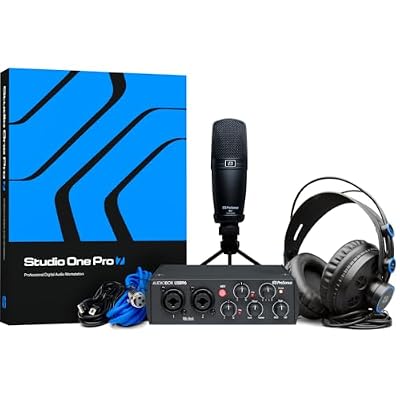
The AudioBox USB 96 Studio takes a traditional, podcast-first approach. PreSonus describes the package as a way to produce professional podcasts and music, and the included components are clear: the AudioBox USB 96 audio and MIDI interface, the M7 large-diaphragm condenser microphone with cable and desktop stand, HD7 studio monitoring headphones, and Studio One Artist software. That desktop stand matters for podcasters who record at a desk and do not yet own a boom arm.
The interface provides two channels, two class-A preamps and combo jacks, plus MIDI that most podcast interfaces leave out. MIDI will not matter to a speech-only show, but it helps if the studio also handles theme music. The listing gives a maximum sample rate of 96 kHz and Windows and macOS compatibility. Alongside Studio One Artist, the description names the Studio Magic Suite and Ableton Live Lite. For a complete, clearly itemised package with a stand included, this is a straightforward choice.
Specs
- Bundle contents: AudioBox USB 96 interface with cable, M7 condenser microphone with cable and desktop stand, HD7 headphones, as listed in the included components
- Interface: two channels, USB connection, two class-A microphone preamps with combo input jacks, maximum sample rate 96 kHz as stated on the listing
- Phantom power: +48V phantom power provided by the interface for the included condenser microphone
- Monitoring: HD7 studio monitoring headphones included for tracking and mixing
- Included software: Studio One Artist, plus Studio Magic Suite and Ableton Live Lite as named in the product description
- Extra connectivity: MIDI, as stated for the AudioBox USB 96 interface in the listing
Focusrite Scarlett Solo Studio 4th Gen

The Scarlett Solo Studio is the focused option for a single voice. Its interface provides one microphone connection and one instrument or line connection, which maps neatly onto a solo podcast: the CM25 MkIII condenser handles the host, and the second input remains available for a guitar or another line source. The listing describes a detailed ultra-low-noise microphone preamp, studio-grade converters with a 120dB dynamic range, and Air mode, so the solo format does not mean a stripped-down recording chain.
You still get the same pairing as the larger Scarlett bundle: CM25 MkIII with pop filter and XLR cable, and SH-450 headphones, plus Pro Tools Intro+, Ableton Live Lite, and Hitmaker Expansion. The trade-off is plain: if you later move to in-person interviews, you will need a different interface. For a solo, voice-led podcast, it fits the job very well.
Specs
- Bundle contents: Scarlett Solo Studio 4th Gen interface, CM25 MkIII condenser microphone, SH-450 headphones, XLR cable and pop filter as described on the listing
- Interface: 2-in / 2-out, USB-C connection, one microphone connection and one instrument or line connection as shown in the listing comparison
- Phantom power: +48V phantom power provided by the interface for the included condenser microphone
- Monitoring: one headphone output, SH-450 closed-back headphones included
- Included software: Pro Tools Intro+, Ableton Live Lite and Hitmaker Expansion as named on the listing
- Other features named on the listing: Air mode and loopback
PreSonus AudioBox 96 Full Studio Bundle with ATOM and Eris 3.5 Monitors

This larger PreSonus package builds on the AudioBox 96 Studio foundation and turns it into a small podcast production desk. The product description confirms the core pairing — the bus-powered AudioBox USB 96 audio and MIDI interface and the M7 large-diaphragm condenser microphone — and the box contents add a pair of Eris 3.5 monitors, the ATOM MIDI and production pad controller, HD7 headphones, a microphone boom arm stand with pop filter, a studio microphone with XLR cable and shock mount, and instrument and stereo cables.
For podcasters, the boom arm and monitors are the meaningful additions. A boom arm keeps the condenser at a repeatable distance and frees desk space, while monitors give a second way to judge an edit after headphone work. The ATOM controller is aimed at music production, so treat it as a bonus for theme music. This is the biggest, least portable option here, suited to a fixed studio corner — and the most complete box in this guide.
Specs
- Bundle contents: AudioBox 96 interface, studio microphone with XLR cable and shock mount, HD7 headphones, Eris 3.5 monitors, ATOM controller, boom arm stand with pop filter, and cables, as listed in the box contents
- Interface: AudioBox USB 96 audio/MIDI interface, bus-powered, as described in the product description
- Microphone: M7 large-diaphragm condenser microphone, as named in the product description
- Phantom power: +48V phantom power provided by the interface for the included condenser microphone
- Monitoring: HD7 headphones and a pair of Eris 3.5 monitors included
- Included software: Studio One Artist download, with Studio Magic Suite and MVP Loop content as named in the description
Behringer U-Phoria Studio

The Behringer U-Phoria Studio is the simplest bundle in this guide, built around the compact U-Phoria UM2 interface and the C-1 studio condenser microphone. The listing describes it as a complete recording and podcasting bundle, and names the UM2 USB audio interface, the C-1 condenser microphone, HPS5000 studio headphones, and the cables needed to connect them. For a podcaster setting up a first dedicated recording desk, that short parts list is the point: microphone, interface, headphones, cables, and nothing that complicates the first session.
The UM2 provides two channels, a XENYX preamp, and a separate instrument input, so you can add a guitar or keyboard for a theme. The C-1 is described on the listing as a professional-quality condenser designed for realism, sensitivity, and accuracy, with a cardioid pattern. Choose this bundle if you value simplicity over an extensive software suite: it covers the essential chain — condenser, powered interface, headphones — in one box.
Specs
- Bundle contents: U-Phoria UM2 USB audio interface, C-1 studio condenser microphone, HPS5000 studio headphones and cables, as described on the listing
- Interface: UM2, two-channel USB audio interface with a XENYX microphone preamp and an instrument input
- Phantom power: +48V phantom power provided by the UM2 for the included condenser microphone, as stated for the UM2 interface
- Monitoring: HPS5000 studio headphones included
- Included accessories: cables needed to connect the bundle, as stated on the listing; C-1 swivel mount and case are named for the microphone in bundle descriptions
- Included software: downloadable recording, editing and podcasting software and plug-ins as described for the UM2 on its listing
Frequently Asked Questions
Do I need two interface inputs for a podcast with guests?
Only if guests record in the same room. Two inputs let you record each voice on its own track, which makes editing easier. If guests join remotely, their audio arrives through the computer, and a single-input bundle such as the Scarlett Solo Studio can handle the host side.
Why does a condenser microphone need an interface at all?
A condenser microphone outputs a low-level analogue signal and needs phantom power to operate. An audio interface supplies that +48V power, amplifies the signal with a microphone preamp, converts it to digital audio for your computer, and provides a headphone output for monitoring. The microphone and the interface are two halves of one recording chain, not interchangeable accessories.
Can I edit and publish a podcast with the included software?
Yes. Each bundle names a recording program suitable for speech. Studio One Artist, Pro Tools Intro+, and Ableton Live Lite can all record, cut, and export an episode. You may later prefer a dedicated podcast editor, but the bundled software is enough to finish an episode.
Will a condenser bundle make a noisy room sound quiet?
No. A condenser microphone is sensitive, and it will capture room reflections, computer fans, and household noise along with your voice. A bundle helps through accessories such as a pop filter, shock mount, stand, or boom arm, and through close microphone placement, which raises your voice relative to the room. Treat the room first, keep the microphone close and consistent, and set a moderate gain level.
Conclusion
The choice comes down to how many voices record in the room. The Scarlett 2i2 Studio suits host-and-guest recording, while the Scarlett Solo Studio trims the same pairing down for a solo show. The AudioBox USB 96 Studio offers a stand-included package with MIDI and Studio One Artist, and its Full Studio Bundle adds monitors, a boom arm, and a controller. The Behringer U-Phoria Studio keeps the formula simplest.
Before you order, check four things: enough microphone inputs for your format, phantom power for the condenser, headphones that suit long sessions, and software that fits how you work. Get those right, and a bundle gives you a coherent, repeatable podcast sound from the first episode onward.