Diagnostic software doesn’t fix anything by itself, but it tells you what’s actually wrong instead of what you’re guessing is wrong. The gap between those two things is usually a few hours of unnecessary parts-swapping. If you’re building, repairing, or doing bench work regularly, the right toolkit pays for itself the first time it catches a failing stick of RAM before you blame the motherboard.
What a diagnostic toolkit actually needs to cover
Most technician workflows break down into five jobs: stress-testing stability, monitoring temps and voltages in real time, checking storage health, verifying RAM integrity, and reading POST codes or boot failures on dead or unstable systems. No single app does all five well, so you end up running three or four tools depending on the symptom. That’s normal. The mistake is relying on one all-in-one suite and assuming it caught everything.
Stress-testing CPU and GPU stability
For CPU stability, Prime95 (specifically the small FFTs or blended test) is still the standard for finding instability under sustained load, and OCCT has become the better all-rounder because it tests CPU, GPU, and memory with built-in error detection instead of just loading the chip and hoping it crashes. For GPU work, FurMark remains the quickest way to check for thermal throttling or power delivery issues, though it runs hotter than most real workloads so don’t treat a FurMark pass/fail as the whole story. If a customer’s rig is unstable only under gaming loads, a synthetic 100% stress test can actually pass clean while the real problem is a transient VRM dip. In that case Afterburner or HWInfo logging during an actual game session catches what synthetic tools miss.
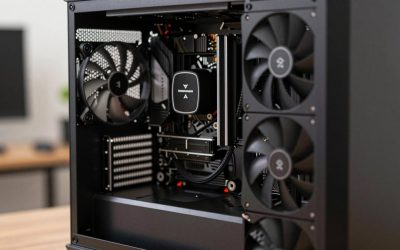
A decent AIO or air cooler buys you margin here. If a system fails Prime95 within two minutes at stock clocks, that’s rarely a cooling problem, but if it fails only after 20-30 minutes once case temps climb, check airflow and paste before touching settings. Anyone doing this kind of bench work regularly should keep a spare liquid CPU cooler on hand to rule out thermal issues on client machines without committing their actual cooler to a test.
Real-time monitoring
HWInfo64 is the one piece of software I’d call close to mandatory. It logs voltages, clocks, temps, fan speeds, and power draw per-component, and the sensor log is the single most useful artifact when diagnosing intermittent crashes, because you can hand a customer a CSV instead of a guess. HWMonitor and Core Temp are fine lighter alternatives if you just need a quick temp check, but they don’t log with the same granularity.
Watch for VRM temps on budget motherboards specifically, since that’s a common silent failure point that generic “it’s fine” temp readouts from CPU-only tools will miss entirely.
Memory and storage diagnostics
MemTest86 (the free version, booted from USB) is still the right tool for RAM. Run at least 2 full passes; one pass can miss errors that only show up after the memory controller warms up. If a system is randomly blue-screening with different error codes each time, suspect RAM before anything else, that symptom pattern is close to a fingerprint for bad or mismatched DIMMs.
For storage, CrystalDiskInfo gives you SMART data and a plain health percentage, which is enough for 90% of cases. If a drive shows reallocated sectors or pending sectors climbing over time, that drive is dying, full stop, regardless of what the benchmark numbers still show. Manufacturer tools (Samsung Magician, WD Dashboard, Crucial Storage Executive) are worth running too since they expose firmware updates and NVMe-specific health metrics that generic tools sometimes don’t surface.
Quick comparison
| Tool | Best for | Cost | Limitation |
|---|---|---|---|
| HWInfo64 | Real-time monitoring & logging | Free | No stress-test function, read-only |
| OCCT | Combined CPU/GPU/RAM stress test | Free / paid tier | Paid version needed for full error detection history |
| MemTest86 | RAM fault detection | Free (paid for advanced features) | Needs a boot USB, takes 30-60+ min per pass |
| CrystalDiskInfo | Drive health/SMART data | Free | Doesn’t predict failure, just reports current state |
| FurMark | GPU thermal/power stress | Free | Unrealistically harsh load vs real games |
When software can’t tell you anything
Software diagnostics assume the system POSTs and boots into an OS. A lot of bench work doesn’t get that far. For dead-on-arrival boards, a POST code diagnostic card or a simple debug LED readout (most mid-range and higher boards have these built in now) is faster than any software. If you’re doing enough repair or build work that you’re regularly troubleshooting boards that won’t POST, a basic motherboard diagnostic card saves real time over swapping components blind. Pair that with a cheap PSU tester, since a borderline failing power supply causes a disproportionate number of “random instability” tickets that no stress-testing software will ever catch, because the PSU only fails under load spikes software can’t simulate on a bench.
What’s actually worth paying for
Almost everything above has a free tier that’s genuinely sufficient for day-to-day technician work. The paid upgrades (OCCT Pro, MemTest86 Pro) mainly add scripting, remote logging, and report generation, which matter if you’re running a shop and need to hand customers formal reports, but they don’t diagnose anything the free versions can’t. Don’t pay for a “universal PC diagnostic suite” bundle promising to replace all of this in one package; those tend to be shallow on every individual test compared to the dedicated free tools, and you lose the granular logs that actually explain a failure instead of just flagging one.
The only hardware purchase worth prioritizing before more software is a reliable USB flash drive dedicated to bootable diagnostic images (MemTest86, a Linux live environment, manufacturer SSD tools). Half the time lost on dead systems is spent re-flashing a USB drive you already use for something else.