- Top Pick: Anker 737 Power Bank, 140W 24,000mAh 3-Port Laptop Charger, Smart Display
- Best Value: Anker Nano USB C Cable, 240W 1 ft Flexible Multi-Color Braided Cord 737 Power Bank, 24,000mAh 3-Port Laptop Portable Charger with 140W Output
- Premium Choice: Anker 737 Power Bank, 24,000mAh 3-Port Laptop Portable Charger with 140W Output Prime Power Bank, 9,600mAh Battery Pack with 65W Output, Built-in AC Plug
The Anker 737 140W 24,000mAh Power Bank was the product that redefined what a portable power bank can do — the first USB-C charger of its size to deliver a full 140W USB Power Delivery output, enough to charge a 16-inch MacBook Pro at the same speed as Apple’s wall charger. With 24,000mAh / 87Wh of capacity and a price around $150, the 737 remains the flagship laptop-class bank in Anker’s lineup. This Anker 737 review covers the capacity, charging speed, build and value.

Anker 737 Power Bank, 140W 24,000mAh 3-Port Laptop Charger, Smart Display | Fast Multi-Device Charging, for iPhone 16 / 15 / 14 Series, Vision Pro, Samsung, MacBook, and More


As an Amazon Associate we earn from qualifying purchases. Product prices and availability are accurate as of the date/time indicated.
🛒 Best Price Today on Amazon
Prime members get fast, free shipping on everything above, plus member-only deals. New members get a 30-day free trial — cancel anytime.
As an Amazon Associate we earn from qualifying purchases.


Anker 737 140W at a Glance
| Component | Specification |
|---|---|
| Capacity | 24,000mAh / 87Wh (3.6V nominal) |
| Maximum output power | 140W USB-C Power Delivery (single port) |
| Input fast-charge | 65W USB-C PD recharge |
| Ports | 2x USB-C (in/out) + 1x USB-A out (3 outputs total) |
| Wireless charging | None |
| Quick-charge protocols | USB PD 3.1, PPS, QC 3.0 |
| Cycle life and warranty | 1,000+ cycles to 80% capacity, 18-month Anker warranty |
| Weight and dimensions | 630g; 155 x 56 x 50 mm |
| Approximate price | around $150 |
Capacity and Recharge Time
The 737’s 24,000mAh / 87Wh of capacity is the high end of what any airline will allow without special approval — at 87Wh it sits below the 100Wh personal-electronics carry-on limit, but only just, and above that line approval is required from each carrier. In practical terms 87Wh is enough for a single full charge of a 16-inch MacBook Pro (the M4 model uses around 70Wh battery), or roughly 5 full charges of a flagship phone, or two full charges of a 13-inch laptop. The 65W USB-C PD input is the second standout — refilling the bank takes around two hours from a 65W wall charger, which is genuinely fast for a 24,000mAh capacity. Anker rates the cells for 1,000 cycles to 80% capacity (double the typical lithium-polymer figure), which makes the 737 sensible to buy for the long term.
Fast Charging and Power Delivery
The 140W headline is the defining feature. USB Power Delivery 3.1 lifted the maximum PD output ceiling from 100W to 240W, and the Anker 737 was the first widely available power bank to ship at the new 140W tier — the same wattage as Apple’s largest USB-C wall charger. That matters because it means the 737 charges a 16-inch MacBook Pro at full speed (around 100W sustained, peaking to 140W), where any 100W bank caps below the laptop’s maximum draw. PPS support means the second USB-C port also fast-charges modern Samsung phones at 25-45W. Total combined output across the three connectors is capped at 140W, which is shared between ports — plug a laptop and a phone in at once and the laptop drops to around 100W while the phone gets up to 30W. For a single primary user who wants full laptop charging speed, the 737 remains unrivalled in this size class. For more about the laptops it pairs with, see best RTX 5070 gaming laptops.
Wireless and Magnetic Features
The 737 is a wired-only bank, and that is the right choice for a 140W charger — wireless charging is inefficient even at lower wattages, and there is no production magnetic wireless standard that approaches 140W. Anker positions the 737 firmly as the laptop bank in its lineup, with the MagGo line covering the magnetic wireless category. Buyers who want both should pair the 737 (in a backpack for laptop charging) with a smaller Anker MagGo Qi2 or 633 Magnetic (in a pocket for phone wireless).
Build Quality and Portability
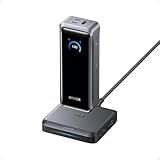
At 630g the 737 is the heaviest bank in this lineup — it is a backpack charger, not a pocket charger. The 155 x 56 x 50 mm chassis is a chunky brick by any standard, with a brushed-metal finish that feels genuinely premium. The standout feature is the bright colour LCD on one face, which shows percentage-precise charge level, real-time wattage in and out per port, time-to-full-charge estimate when the bank itself is charging, and temperature. That LCD is more useful in daily use than it sounds — knowing the laptop is pulling 95W rather than ‘lots of watts’ helps with travel power-budgeting. Build quality is exemplary, and the 1,000-cycle rating gives the 737 a longer lifespan than most rivals.
Best For: Laptop Charging?
The 737 is squarely a laptop bank. For phone-only use it is overkill — a 5,000mAh MagGo or a 10,000mAh INIU would weigh a fraction. For light laptop top-up a 65W bank works. The 737’s natural buyer is the road-warrior creator carrying a 14- or 16-inch USB-C laptop who needs a full second charge on a long flight, in a coffee shop with no available outlet, or at a film/photo shoot location. The Anker 25,000mAh Triple 100W is the close competitor at higher capacity but with lower per-port wattage — for fastest single-laptop charging the 737 wins; for multi-device travel the 25,000mAh is the alternative. For laptop pairing context see best RTX 5070 gaming laptops; for tablet-class use see best gaming tablets.
Verdict: Is the Anker 737 Worth Around $150?
Yes, for the buyer who genuinely needs 140W charging on the move. At around $150 the Anker 737 140W remains the benchmark laptop-class power bank — full 140W USB-C PD output, 87Wh of carry-on-legal capacity, a uniquely useful LCD that reports real wattage, and a 1,000-cycle cell rating that signals it is built to last. Weight and price are the trade-offs, but no rival at this writing matches the combination for full-speed MacBook Pro charging. For the mobile creator or travelling professional, it earns a strong recommendation.
Pros: First production 140W USB-C PD power bank; charges a 16-inch MacBook Pro at full Apple wall-charger speed; 87Wh capacity is carry-on-legal at the very top of the airline limit; bright colour LCD reports real-time wattage and percentage capacity; 1,000-cycle cell rating doubles the typical longevity; full PD 3.1 with PPS implementation.
Cons: At 630g it is a backpack charger, not a pocket one; $150 is premium pricing; no wireless or magnetic surface; combined output across all ports caps at 140W, so multi-device charging splits the wattage.
Frequently Asked Questions
Will the Anker 737 charge a 16-inch MacBook Pro at full speed?
Yes. The 140W USB-C Power Delivery output matches Apple’s largest USB-C wall charger, so the 16-inch MacBook Pro charges at its full sustained speed of around 100W with 140W peak.
Is the Anker 737 allowed on planes?
Yes. At 87Wh it sits below the 100Wh personal-electronics carry-on limit set by the FAA and most international carriers, so it travels in carry-on with no special approval — checked baggage is not permitted.
What is USB PD 3.1 and why does it matter?
USB Power Delivery 3.1 raised the maximum PD output ceiling from 100W to 240W, and added 28V/36V/48V voltage levels. The Anker 737 uses PD 3.1 to deliver 140W on a single port, the same wattage as Apple’s largest USB-C wall charger.
How many laptop charges does the Anker 737 deliver?
Roughly one full charge of a 16-inch MacBook Pro (which uses an 86Wh battery, very close to the bank’s 87Wh capacity), or two full charges of a 13-inch USB-C laptop, before the bank itself runs flat.
More Power Bank Reviews
- UGREEN 10,000mAh Magnetic Wireless 20W PD Power Bank Review
- Anker 622 MagGo 5,000mAh Foldable Magnetic Review
- Anker Nano 5,000mAh Built-in USB-C Connector Review
- Anker 633 Magnetic 10,000mAh 20W USB-C PD Review
- Jackery Explorer 300 Review: 292Wh Portable Power Station
- Anker Nano 10,000mAh 30W Built-in USB-C Cable Review
- Anker Laptop Power Bank 25,000mAh Triple 100W Review
- Anker MagGo Qi2 15W MagSafe-Compatible Power Bank Review
Affiliate Disclosure: As an Amazon Associate, we earn from qualifying purchases. If you click a link and make a purchase, we may earn a small commission at no extra cost to you. Prices and availability are accurate as of publication and may change.