The Jackery Explorer 300 Portable Power Station is a different class of product from the pocket-class banks in this lineup — it is a 292Wh portable power station with a pure sine wave 300W AC wall outlet, multiple DC outputs and a familiar grab-handle form factor for camping, photography and short-duration home backup. At its typical mid-$200s price it is the entry point to the portable power station category. This Jackery Explorer 300 review covers the capacity, output options, build and value.
- Jackery Explorer 300 at a Glance
- Capacity and Recharge Time
- Fast Charging and Power Delivery
- Wireless and Magnetic Features
- Build Quality and Portability
- Best For: Camping, Photography or Home Backup?
- Verdict: Is the Jackery Explorer 300 Worth Around $250?
- Frequently Asked Questions
- More Power Bank Reviews
- Related Articles

Jackery Explorer 300 Portable Power Station,292Wh | Backup LiFePO4 Battery, Solar Generator for Outdoors, Camping, Travel, Hunting, Blackout (Solar Panel Optional)




As an Amazon Associate we earn from qualifying purchases. Product prices and availability are accurate as of the date/time indicated.
🛒 Best Price Today on Amazon
Prime members get fast, free shipping on everything above, plus member-only deals. New members get a 30-day free trial — cancel anytime.
As an Amazon Associate we earn from qualifying purchases.


Jackery Explorer 300 at a Glance
| Component | Specification |
|---|---|
| Capacity | 78,000mAh / 292Wh (lithium-ion 3.65V nominal) |
| Maximum output power | 300W continuous / 500W peak AC pure sine wave |
| Input fast-charge | 60W AC wall recharge / 60W USB-C PD recharge / 100W solar via DC barrel |
| Ports | 2x AC 110V outlets + 1x USB-C PD + 2x USB-A + 1x 12V car port + 1x DC barrel (7 outputs) |
| Wireless charging | None |
| Quick-charge protocols | USB PD 3.0, QC 3.0, USB-A |
| Cycle life and warranty | 500 cycles to 80% capacity, 2-year Jackery warranty |
| Weight and dimensions | 3.1kg; 230 x 133 x 167 mm |
| Approximate price | around $250 |
Capacity and Recharge Time
The Jackery’s 292Wh of capacity is roughly four times that of the largest pocket bank in this lineup (the 87Wh Anker 737) and around 16 times that of a 5,000mAh phone bank. That step-up in scale is what makes the Explorer 300 a different category of product — it is a tabletop power station, not a pocket charger. Critically, at 292Wh the Jackery is over the 100Wh airline carry-on limit and is therefore not allowed on commercial flights — neither in carry-on nor in checked baggage. It is built for car, camping, RV and home backup use, not aviation. Recharge takes around 2 hours from a wall outlet, or around 4 hours from a Jackery 100W solar panel (sold separately). The 500-cycle rating is standard for this class.
The solar input is one of the Explorer 300’s most useful features for genuine off-grid use — a 100W folding solar panel placed in direct sunlight delivers around 80-90W of real charging power in good conditions, which translates to around 4 hours for a full recharge from empty. That makes the Explorer 300 a sustainable power source for multi-day camping trips or van life where mains power is unavailable. The unit also supports simultaneous charging and discharging, so it can run a CPAP machine or laptop overnight while solar-charging during the day — a closed-loop power solution that no pocket bank can offer.
Fast Charging and Power Delivery
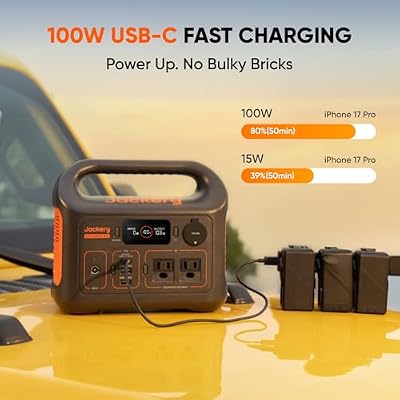
The Explorer 300’s defining feature is the two AC pure sine wave 110V outlets at 300W continuous (500W peak) — the same kind of mains outlet a small kitchen appliance or laptop charger plugs into. That means the Jackery runs almost any household device under 300W: laptop chargers (including the largest 140W MacBook Pro charger), CPAP machines, small fans, projectors, camera battery chargers, kitchen blenders for short bursts, even a small electric blanket. The USB-C PD output runs at 60W, enough to charge a 13- or 14-inch USB-C laptop directly. Combined output across all ports is bounded by the 300W inverter rating. The Explorer 300 is not a phone-and-tablet bank, though it can certainly charge those — it is built for the higher-wattage device categories that pocket banks cannot touch.
Wireless and Magnetic Features
The Explorer 300 is wired-only — no Qi pad and no magnetic surface. For its target use cases (camping, photography, RV, home backup) wireless charging would be a curious distraction; users plug devices in. For pure wireless phone top-up the Anker MagGo line is the right tool, and for full magnetic plus AC outlet the right combination is a pocket MagGo bank plus a power station like the Explorer 300, used for their respective roles.
Build Quality and Portability
At 3.1kg the Explorer 300 has the heft of a small wine bottle — properly portable for a power station, with a moulded grab handle on top, but not pocketable or even bag-pocketable. The chassis is a robust grey plastic with rubber-feet stability, and the front panel groups the AC outlets, USB ports and DC outputs cleanly with backlit labels. The small LCD shows real-time input watts, output watts and remaining capacity percentage. Build is well above the import-tier power stations, and Jackery’s two-year warranty plus established North American service support are real reasons to pick the brand. Cooling is by quiet fan, which kicks in only at higher loads.
Best For: Camping, Photography or Home Backup?
The Explorer 300 is built for car-and-camp use rather than air travel. Its 292Wh runs a CPAP overnight, a film/photo shoot’s worth of camera batteries, or a couple of laptops for a day in a coffee shop or van. For shorter power outages it runs the routers, modems and a few LED lights — not whole-house backup, but enough to keep communications and light running for an evening. For travel power that flies, the Anker 737 140W or 25,000mAh Triple 100W are the right tools, since both come in under the 100Wh airline carry-on limit. Critically: the Jackery cannot fly. For laptop pairing context see best RTX 5070 gaming laptops.
Verdict: Is the Jackery Explorer 300 Worth Around $250?
Yes, for the camping/RV/photography buyer who needs household-class AC power away from the wall. At around $250 the Jackery Explorer 300 delivers two real AC pure sine wave outlets at 300W, 292Wh of usable capacity, full USB-C PD output, and the established Jackery brand and two-year warranty. The honest limit is airline carry-on: at 292Wh the Explorer 300 is over the 100Wh limit and cannot fly. For ground-based portable AC power, it remains one of the most sensible entries in the portable power station category.
Pros: Two real AC pure sine wave 110V outlets at 300W continuous and 500W peak; full USB-C PD at 60W for direct laptop charging; solar input via DC barrel; established Jackery brand with two-year warranty and North American service; clear front-panel LCD; moulded grab handle for genuine portability.
Cons: At 292Wh it cannot fly on commercial aircraft (exceeds the 100Wh airline carry-on limit); 3.1kg is too heavy for bag-portable use; not a phone-pocket alternative; the 300W inverter ceiling rules out higher-draw appliances like microwaves or heaters; the cooling fan is audible under sustained load.
Frequently Asked Questions
Can the Jackery Explorer 300 fly on a plane?
No. At 292Wh the Explorer 300 is over the 100Wh personal-electronics carry-on limit set by the FAA and most international carriers. It is not allowed in either carry-on or checked baggage on commercial flights — it is built for ground use.
What can a 300W AC outlet run?
Devices that draw 300W continuous or less: laptop chargers (including 140W USB-C bricks), CPAP machines, small fans, projectors, camera battery chargers, small blenders for short bursts, LED lighting and similar. It will not run heating elements, microwaves or other high-draw appliances.
Is the Jackery Explorer 300 a power bank or a power station?
A power station. The defining difference is the AC pure sine wave outlets, which standard pocket-class power banks do not include. The Explorer 300 is built for camping, RV, photography and home-backup use rather than for pocket travel.
How long does the Jackery Explorer 300 run a laptop?
Roughly three to four full charges of a 13-inch USB-C laptop, or about one full charge of a 16-inch MacBook Pro plus two flagship phone charges, depending on the laptop’s battery size and the inverter efficiency at the device’s wattage.
More Power Bank Reviews
- Anker Nano 10,000mAh 30W Built-in USB-C Cable Review
- Anker Laptop Power Bank 25,000mAh Triple 100W Review
- Anker MagGo Qi2 15W MagSafe-Compatible Power Bank Review
- INIU 45W 10,000mAh Detachable Cable Power Bank Review
- Anker Zolo 20,000mAh 30W Power Bank Review (2026)
- Anker 621 MagGo Magnetic Wireless 5,000mAh Review
- Anker 737 140W 24,000mAh Laptop Power Bank Review
- UGREEN 10,000mAh Magnetic Wireless 20W PD Power Bank Review
Affiliate Disclosure: As an Amazon Associate, we earn from qualifying purchases. If you click a link and make a purchase, we may earn a small commission at no extra cost to you. Prices and availability are accurate as of publication and may change.