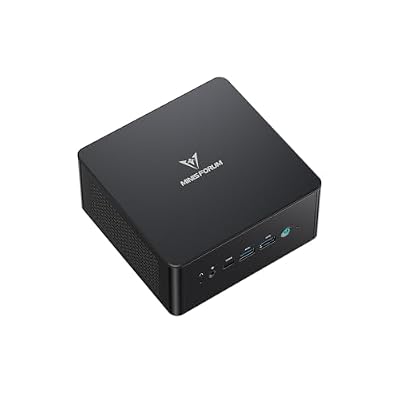
- Top Pick: MINISFORUM UM890 Pro Mini PC, AMD Ryzen 9 8945HS (up to 5.2GHz) Mini Computers, 32GB DDR5 5600MHz RAM&1TB PCIe 4.0 SSD, Mini Desktop Quad Display HDMI/DP1.4/USB-C, AMD Radeon 780M/Dual LAN 2.5G
- Best Value: GMKtec Mini PC G10, AMD Ryzen 5 3500U (Beats 4300U) 16GB DDR4 256GB SSD
- Premium Choice: Beelink SER8 Mini PC, AMD Ryzen 7 8745HS (8C/16T up to 4.9GHz), 16GB DDR5 512GB SSD, AMD Radeon 780M Graphics/Triple 4K Display (HDMI 2.1+DP+USB4)/2.5G LAN/WiFi 6/BT5.2 Performance Desktop Computer
Affiliate disclosure: GamingPCGuru is reader-supported. When you buy through links on our site, we may earn an affiliate commission at no extra cost to you. This does not influence our independent reviews.
As an Amazon Associate we earn from qualifying purchases at no extra cost to you.


🛒 Best Price Today on Amazon
Prime members get fast, free shipping on everything above, plus member-only deals. New members get a 30-day free trial — cancel anytime.
How to Pick a Mini Gaming PC in 2026: SFF Finally Stopped Compromising
Quick Answer (TLDR)
Small form factor (SFF) gaming PCs in 2026 are no longer the thermal-and-noise nightmare they were five years ago. Cases like the Fractal Terra, Lian Li A4-H2O, NZXT H1 V2, and SSUPD Meshlicious now fit RTX 5080-class GPUs and 165W CPUs into 13-20 liter footprints with thermals only 3-5C worse than mid-tower equivalents. The catch: SFF builds cost 15-25% more than equivalent mid-tower builds because of premium PSUs (SFX-L), low-profile coolers, and case prices. They also demand more careful component selection — not every motherboard, GPU, and cooler fits. For desk-constrained, dorm-bound, or living-room buyers who genuinely benefit from the small footprint, SFF is now a legitimate primary build. For everyone else who just thinks small looks cool, you’re paying a premium for size you don’t need. Decide based on actual physical constraint, not aesthetic preference.
The Five Criteria That Matter
1. Case volume and GPU clearance. SFF cases range from 4L (NUC-class, integrated graphics only) to 25L (technically SFF, fits anything). For full-spec gaming with discrete GPU, the 13-20L sweet spot fits cards up to ~330mm length and 3-slot height. Verify your specific GPU fits — RTX 5080/5090 partner cards vary from 320mm to 360mm length, and not all fit common SFF cases.
2. SFX/SFX-L PSU requirements. Most SFF cases require SFX or SFX-L PSUs, not standard ATX. SFX-L 1000W units exist (Corsair SF1000L, SilverStone SX1000) but cost $50-100 more than equivalent ATX. Budget accordingly and verify PSU compatibility with your specific case.
3. Cooling constraints — air vs AIO. Many SFF cases support only low-profile air coolers (Noctua NH-L12S, Thermalright AXP-90) or compact AIOs (240mm or smaller). High-end air coolers like the NH-D15 don’t fit. Verify CPU cooler height clearance before selecting CPU; some flagship CPUs need at least 240mm AIO to handle sustained load.
4. Cable management in tight spaces. SFF builds require shorter custom cables for clean routing. Aftermarket SFF cable kits cost $50-150 from CableMod or Pslate Customs. Stock PSU cables are often 60cm+ — way too long for a 14L case. Budget for custom cables or expect a messy interior.
5. Thermal performance under sustained load. SFF case airflow is constrained by surface area. Even great designs trail mid-tower cases by 3-8C on GPU and 2-5C on CPU under sustained load. This translates to slightly louder fans and modestly lower sustained boost clocks. Acceptable for most buyers; problematic if you push overclocks or run 8+ hour gaming sessions.
Buying Checklist
- Confirm physical desk or shelf space requires SFF (otherwise mid-tower is cheaper)
- Choose case based on GPU clearance for your specific card
- Verify PSU form factor (SFX/SFX-L) and wattage support for chosen GPU
- Check CPU cooler height clearance and select compatible cooler
- Confirm motherboard form factor (ITX for smallest, mATX for some 18-25L cases)
- Plan storage layout — most ITX boards have only 2-3 M.2 slots, no SATA bays
- Budget for custom-length cables ($50-150 additional)
- Verify front I/O includes USB-C 3.2 Gen 2 for modern peripherals
- Check airflow path — intakes and exhausts should not be blocked by desk furniture
- Plan for slightly higher fan noise versus mid-tower equivalent
Spec Primer: What the Numbers Actually Mean
SFF size categories. Sub-5L = NUC/console-class, integrated graphics only. 5-10L = limited GPU support, typically 2-slot cards under 220mm. 10-15L = supports most consumer GPUs, the SFF sweet spot. 15-20L = fits anything, easier thermals. 20-25L = technically SFF but barely smaller than compact mid-tower.
SFX vs SFX-L vs ATX PSU. SFX is 125x100x63.5mm — smaller capacity. SFX-L is 125x125x63.5mm — typically 850-1000W range. ATX is standard 150x86x140mm. Most SFF cases under 15L require SFX or SFX-L; only larger SFF cases accept ATX.
Low-profile vs tower CPU coolers. Low-profile coolers (under 70mm height) handle CPUs up to 125W TDP well. Tower coolers (80-160mm) handle higher TDP but require taller cases. Pre-purchase, verify your case lists maximum cooler height and your selected cooler fits that limit.
GPU clearance — length, height, thickness. Length is most common limiter. Height (slot count) matters in cases with limited vertical clearance. Thickness (mm of card depth) matters in cases where the GPU sits parallel to motherboard. Verify all three for your chosen card.
Cable length requirements. Standard PSU cables are 600-700mm. SFF cases need 300-450mm. Custom cable kits from CableMod or Pslate are nearly mandatory for clean SFF builds. The OEM-included cables often won’t even fit because they’re too long to route in tight space.
Common Buyer Mistakes
Choosing case before component compatibility. Falling in love with a specific case aesthetic, then trying to fit components — common SFF mistake. Pick components first, then choose a case that fits them, not the reverse. Otherwise you end up with thermally-throttled hardware in a beautiful case.
Underestimating PSU cost difference. An equivalent SFX-L 1000W PSU costs $70-120 more than an ATX 1000W. Many SFF builders only realize this after committing to the case. Factor PSU premium into total SFF cost calculation.
Buying the wrong GPU height. 3-slot or 4-slot GPUs don’t fit many compact SFF cases. The RTX 5080 partner cards are mostly 3-slot. Verify your case supports the slot height of your selected GPU.
Skipping the cable budget. SFF builds without custom cables look terrible inside and often have airflow blocked by tangled cables. Custom cable kits add $50-150 to the build but are essentially required.
Ignoring user-serviceability. Some SFF cases require complete disassembly to swap components. If you anticipate upgrades, choose a case with easier internal access — Fractal Terra and Lian Li A4-H2O are user-friendly; some console-style SFF cases are not.
FAQ
Can SFF really fit an RTX 5090? The smaller RTX 5090 SKUs (Founders Edition reference, smaller partner cards) fit some SFF cases. The massive 4-slot partner cards do not. Verify exact dimensions before committing — Gigabyte AORUS Master 5090 doesn’t fit cases that accept ASUS TUF 5090.
Is the Mac Mini M5 a viable gaming option? For casual gaming and emulation, yes — Apple Silicon GPU performance is roughly RTX 4060 level for native macOS games. For AAA Windows gaming, no — macOS game library is too limited and Windows-via-Parallels has too much overhead. Mac Mini fills a different niche than SFF gaming PCs.
Should I get a console-form SFF case? Cases like the Streacom DA2 and HDPLEX H5 fit under a TV like a console. Excellent for living-room gaming with HDMI to TV. Generally accept 2-slot GPUs up to 280mm — fits RTX 5070, struggles with 5080+. Niche but well-served for HTPC-meets-gaming use cases.
Are SFF builds louder than mid-tower? Typically 2-5dB louder under sustained load, depending on case airflow design. Modern SFF cases with mesh side panels (Fractal Terra, Meshlicious) come close to mid-tower noise levels. Solid-panel “console-style” SFF cases run noticeably louder.
The Console-Killer Comparison
A 13-15L SFF gaming PC at $1,400-1,800 sits about console-sized while delivering 2-3x the raw gaming performance of PS5 Pro. For living-room or limited-space gaming, this is genuinely compelling — controller support, Steam Big Picture mode, and HDMI 2.1 to OLED TV creates a console-like experience with PC flexibility. The Fractal Terra, Cooler Master NR200P MAX, and SSUPD Meshlicious are popular choices for this living-room SFF use case.
Final Take
Mini gaming PCs in 2026 are finally good enough to be a primary build, not a compromise. The Fractal Terra, Lian Li A4-H2O, SSUPD Meshlicious, and Cooler Master NR200P MAX all build excellent 13-15L gaming systems that match mid-tower performance within 3-5C and 2-5dB. The premium is real (15-25% over equivalent mid-tower), but the size savings are meaningful for genuine desk-constrained or living-room scenarios. Don’t buy SFF because it looks cool — buy it because you actually need the smaller footprint. If your desk has space for a mid-tower, save the SFF premium and put it toward a better GPU.
Frequently Asked Questions
What size categories should I be comparing?
Small form factor covers a wide range. Sub-10 litre cases such as the Velka or Dan A4 need custom loops or low-profile coolers and short GPUs, 12 to 20 litre ITX cases like the NR200 or FormD T1 accept most triple-slot cards, and 20 to 30 litre micro-ATX builds behave almost like normal towers.
Will a full-size graphics card fit?
Check three numbers on the case spec sheet before anything else: maximum GPU length in millimetres, maximum slot thickness, and maximum CPU cooler height. Many current 4080 and 5080 class cards run 320mm or longer and three slots thick, which immediately rules out a large slice of the compact case market.
How do I keep thermals and noise under control?
Prioritise mesh side and front panels over tempered glass, since restricted intake is the main cause of small-build throttling. Undervolting both the CPU and GPU typically cuts 20 to 30 percent of heat output for a couple of percent performance loss, which is the single most effective tuning step in a compact chassis.
Do I need an SFX power supply?
In most cases under 20 litres, yes. Look for an SFX or SFX-L unit with 80 Plus Gold efficiency or better, and check whether it ships with the 12V-2×6 connector your GPU needs so you avoid bulky adapters. Cable bulk is a genuine airflow problem in small builds, so short custom cables help.
Is a mini gaming PC slower than a full tower?
Only marginally, and mostly under sustained load. With good airflow, the CPU and GPU hit the same boost clocks; the difference shows up as slightly earlier thermal throttling and higher fan noise during long sessions. Component choice and cooling headroom matter far more than chassis volume alone.