The Anker Nano 5,000mAh Built-in USB-C Connector Power Bank takes the cable-free idea further than any rival — it eliminates the cable entirely, replacing it with a fold-out USB-C connector built into the body. Plug the bank directly into the phone or tablet and it charges, with no separate lead at all. At around $30 it is one of the most travel-friendly small banks. This Anker Nano review covers the capacity, charging speed, design and value.
- Anker Nano 5,000mAh at a Glance
- Capacity and Recharge Time
- Fast Charging and Power Delivery
- Wireless and Magnetic Features
- Build Quality and Portability
- Best For: Phone Travel Top-Up?
- Verdict: Is the Anker Nano 5,000mAh Worth Around $30?
- Frequently Asked Questions
- More Power Bank Reviews
- Related Articles
- Related Guides

Anker Nano Power Bank,5,000mAh Portable Charger, Built-in USB-C Connector | 5,000mAh 22.5W Portable Charger for iPhone 17 / 16 / 15 Series, Galaxy S23 / S22 Series, iPad Pro / Air, AirPods, and More



As an Amazon Associate we earn from qualifying purchases. Product prices and availability are accurate as of the date/time indicated.
🛒 Best Price Today on Amazon
Prime members get fast, free shipping on everything above, plus member-only deals. New members get a 30-day free trial — cancel anytime.
As an Amazon Associate we earn from qualifying purchases.




Anker Nano 5,000mAh at a Glance
| Component | Specification |
|---|---|
| Capacity | 5,000mAh / 18.5Wh (3.7V nominal) |
| Maximum output power | 22W USB-C Power Delivery |
| Input fast-charge | 12W USB-C recharge (via same connector) |
| Ports | 1x fold-out built-in USB-C connector (in/out) + 1x USB-C secondary port |
| Wireless charging | None |
| Quick-charge protocols | USB PD 3.0, PPS |
| Cycle life and warranty | 500+ cycles to 80% capacity, 18-month Anker warranty |
| Weight and dimensions | 100g; 81 x 41 x 28 mm |
| Approximate price | around $30 |
Capacity and Recharge Time
The Anker Nano carries 5,000mAh / 18.5Wh — enough for one full charge of a modern flagship phone or about three-quarters of a charge for a small tablet. Capacity is deliberately modest; the Nano is a single-day top-up tool, sized to disappear into a pocket. The 18.5Wh figure is well within airline carry-on limits. Recharging the Nano over the built-in connector or the secondary USB-C port at 12W takes around two hours from empty — slower than the 30W-input mid-tier banks but acceptable for the size. The 500-cycle rating is standard for quality lithium-polymer at this price.
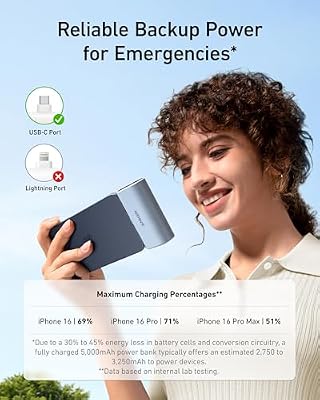
The cable-free direct-charge design has a small efficiency advantage over wired-with-cable banks — there is no cable loss, no connector resistance and no impedance mismatch from a third-party lead, so essentially all the 95% wired efficiency makes it to the phone. In practice this means the Nano delivers a fractionally larger usable charge from the same 18.5Wh of stored energy than a comparable bank used with a generic cable. For a single-charge top-up bank that extra few percentage points can be the difference between reaching home with the phone alive and arriving with a dead phone — a small but meaningful real-world advantage of the eliminated-cable design.
Fast Charging and Power Delivery
The Nano delivers up to 22W of USB-C Power Delivery output through either the built-in connector or the secondary USB-C port. That is enough to fast-charge any current iPhone or Galaxy at their full PD/PPS speed, and to keep a USB-C tablet topped up at a usable rate. The PPS support is the standout — many small banks at this price use only basic PD, which means slower charging on PPS-dependent Samsung phones; the Nano’s full PPS implementation guarantees genuine fast charging on those devices. There is no laptop-class output here; for laptop use the 737 or 25,000mAh Triple 100W are the right choices.
Wireless and Magnetic Features
The Nano is wired-only, with no Qi or MagSafe wireless face and no magnets. The trade-off for cable-free use is the direct connector rather than wireless charging — which is, in important ways, the more efficient design choice (USB-C wired is roughly 95% efficient, where wireless is around 80%). For a buyer who wants magnetic wireless in a similar small format, the Anker 621 MagGo is the right choice; for a buyer who wants the smallest possible direct-charge bank, the Nano leads.
Build Quality and Portability
The Nano is the smallest meaningful charger in this lineup — 100g and 81 x 41 x 28 mm, smaller than many car keys with a fob attached. The fold-out USB-C connector tucks neatly into a slot on the top edge, and the catch holds it firmly closed when stowed. Build is typical Anker quality with no rattle or creak, and the four-LED bar gives sensible charge indication. The eliminated cable is the genuine convenience win — there is no separate lead to forget, no tangle to undo, and no specific iPhone-vs-Android cable hunt; the Nano works with any USB-C device that fits the connector geometry. The 18-month warranty is honest at the price.
The fold-out connector hinge is the part of the Nano that defines its long-term durability, and Anker has engineered it well — the hinge is metal-reinforced and rated for thousands of fold cycles, with a positive detent at both the fully open and fully closed positions. In practice the connector feels closer to a folding USB-C plug on a wall charger than to a fragile flip-out mechanism. The chassis is plastic with a soft-touch finish, in muted colour options that make the bank disappear into a jacket pocket rather than announcing itself. For a bank designed to be carried everywhere, that quiet aesthetic is the right design choice.
Best For: Phone Travel Top-Up?
The Nano is the most travel-friendly bank in this lineup for buyers whose primary use is a single-phone or single-tablet top-up during the day. The eliminated cable saves real bag space — a 10,000mAh bank plus a cable is dramatically larger than a 5,000mAh Nano alone. The honest limits are obvious: 5,000mAh is one charge, not multiple, and there is no wireless option. For users who want both magnetic wireless and a fold-out plug in one device, the cable-free advantage is what to pick on; for higher capacity see the Anker Nano 10,000mAh 30W or the INIU 45W. For pairing context see best gaming tablets.
Verdict: Is the Anker Nano 5,000mAh Worth Around $30?
Yes, for the right user. At around $30 the Anker Nano 5,000mAh Built-in USB-C is the cleverest piece of design in the small-bank category — a fold-out USB-C connector that eliminates the cable, full 22W PD-with-PPS output, and a chassis small enough to forget in a jacket pocket. The 5,000mAh capacity is the obvious trade-off, but for the buyer whose target is one phone top-up per day in a compact form, the Nano is the best small-bank design Anker sells.
Pros: Fold-out USB-C connector eliminates the cable entirely; tiny 100g weight is the smallest meaningful bank in the lineup; full 22W PD-with-PPS for genuine Samsung fast charging; carry-on-legal at 18.5Wh; secondary USB-C port for two-device output; sensible 18-month Anker warranty.
Cons: 5,000mAh capacity is a single phone charge only; no wireless or magnetic surface; the built-in connector may not seat fully in deep-recess phone cases; 12W input recharge is slow versus the 30W rivals at higher capacity.
Frequently Asked Questions
Will the Anker Nano’s built-in USB-C connector fit my phone case?
It fits most thin and mid-thickness phone cases. Very thick rugged cases or cases with a deep recess around the charging port may prevent the bank from seating fully — in that case, use the secondary USB-C port with a standard cable.
Can the Anker Nano charge two devices at once?
Yes. The bank has the built-in USB-C connector plus a secondary USB-C port — both can output simultaneously, though combined wattage is shared and each port drops below the 22W single-port figure.
How many phone charges does 5,000mAh deliver?
About one full charge of a modern flagship phone, which is the intended use case — the Nano is a single-day top-up bank, not a multi-day battery.
Is the Anker Nano allowed on planes?
Yes. At 18.5Wh it is well within all airline carry-on limits — it must travel in carry-on rather than checked baggage, but no special approval is needed.
More Power Bank Reviews
- Anker 633 Magnetic 10,000mAh 20W USB-C PD Review
- Jackery Explorer 300 Review: 292Wh Portable Power Station
- Anker Nano 10,000mAh 30W Built-in USB-C Cable Review
- Anker Laptop Power Bank 25,000mAh Triple 100W Review
- Anker MagGo Qi2 15W MagSafe-Compatible Power Bank Review
- INIU 45W 10,000mAh Detachable Cable Power Bank Review
- Anker Zolo 20,000mAh 30W Power Bank Review (2026)
- Anker 621 MagGo Magnetic Wireless 5,000mAh Review
Affiliate Disclosure: As an Amazon Associate, we earn from qualifying purchases. If you click a link and make a purchase, we may earn a small commission at no extra cost to you. Prices and availability are accurate as of publication and may change.