Flagship GPUs have gotten physically absurd. A triple-fan RTX 4090 or 5090 routinely occupies four expansion slots, not three, and that extra slot height is now a real constraint when you’re picking a case, motherboard, or even a second GPU for a workstation build. This isn’t a marketing footnote. It changes what you can plug into the slot below it, whether your case clears the cooler, and whether a multi-GPU setup is even physically possible.
This article covers what a 4-slot card actually means, why cards have grown this large, and how to plan a build around one without discovering mid-assembly that nothing fits.
What “4-slot” actually means
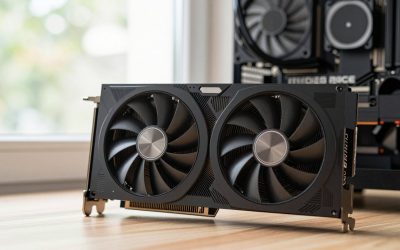
Expansion slot height is measured in increments of about 20mm, based on the spacing between PCIe slot brackets on a motherboard. A single-slot card is roughly 20mm thick. A standard dual-slot card, the historical norm for mid-range and high-end GPUs, is about 40mm. A triple-slot card runs around 60mm, and a 4-slot card is pushing 70-75mm thick, sometimes more once you include the fan shroud lip.
The slot count matters for two practical reasons. First, it tells you how many motherboard slots the card physically blocks, even though it only uses one PCIe connector. A 4-slot card can cover three slots below its own, killing access to M.2 slots hidden under some cards, SATA headers, or additional expansion cards. Second, it’s a rough proxy for cooler size and airflow requirements. Manufacturers aren’t adding slot height for fun, they’re doing it because 450-600W GPUs need more fin surface area and more fan volume to stay quiet under load.
Why cards got this big
Power draw is the real driver. The RTX 4090 and 5090 pull 450W and up at stock, and overclocked or liquid-cooled variants push past that. Dissipating that much heat quietly with air cooling requires either a very large cooler or very fast, loud fans. Board partners chose large coolers, which means thicker shrouds, longer heatsinks, and more fans, hence 3.5 and 4-slot designs becoming common at the top end.
There’s also a practical side effect: thicker coolers can run fans slower for the same cooling capacity, so a 4-slot flagship is often quieter than a 2-slot card trying to cool the same wattage. The trade-off is entirely about space, not performance, since the GPU die and VRAM don’t care how thick the shroud is.
Where this causes real problems
The most common issue is a card that blocks the slot directly below it, which matters if you run a capture card, a sound card, a second GPU for compute, or a Wi-Fi card in a PCIe slot. Many ATX motherboards put the second x16 slot close enough to the first that a 4-slot GPU completely covers it.
Case clearance is the second failure mode. GPU length and width get listed everywhere, but slot height (sometimes called “GPU thickness”) is often buried in the spec sheet or missing entirely from case listings. A case rated for a certain GPU length doesn’t guarantee it has 4 slots worth of width in the shroud or expansion bracket area, especially in SFF builds where the PSU shroud or front panel cabling eats into that space.
Multi-GPU workstation builds are where this becomes a hard blocker rather than an inconvenience. If you’re trying to run two or more GPUs for rendering or AI workloads, a 4-slot card effectively needs its neighbor slots left empty, which usually means you need a motherboard with slots spaced far enough apart, or you move to blower-style or liquid-cooled cards that reclaim slot space specifically for this reason.
Slot height at a glance
| Slot height | Typical thickness | Common on | Multi-GPU friendly? |
|---|---|---|---|
| Single-slot | ~20mm | Low-profile cards, blower workstation cards | Yes, easiest |
| Dual-slot | ~40mm | Mid-range cards, some compact high-end cards | Yes, with spaced slots |
| Triple-slot | ~60mm | Most high-end air-cooled cards | Difficult, needs wide slot spacing |
| Quad-slot (4-slot) | ~70-75mm | Flagship air-cooled cards (4090/5090-class) | Usually impractical in one case |
If you need to run two GPUs in the same tower and keep both cool, the practical answer is often not a 4-slot air cooler at all, but a blower-style card or a liquid-cooled hybrid card that returns the slot footprint to 2 slots. Shopping for blower-style graphics cards is worth it specifically for this use case, since they trade some noise and thermal headroom for a much smaller footprint.
Planning a build around a 4-slot card
Before buying, check three things: the card’s listed thickness in millimeters (not just “4-slot,” since partners round differently), the case manufacturer’s GPU clearance spec, and your motherboard’s slot layout if you plan to use the slot below the GPU for anything. If you’re buying a case specifically to fit a known flagship card, look for cases that explicitly list support for triple-fan RTX 4090/5090-class cards rather than relying on generic “supports GPUs up to Xmm” numbers, since real-world clearance also depends on front panel cable routing and PSU shroud height.
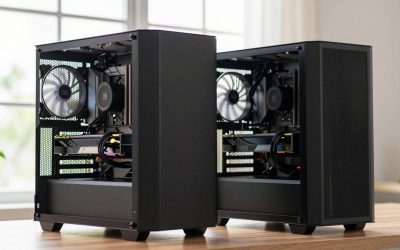
If you’re building new and haven’t bought the GPU yet, picking a full tower case gives the most margin for error, since mid-tower cases are where 4-slot clearance problems show up most often. It’s not that mid-towers can’t fit these cards, most do, but the margin for cable routing and front panel radiator space shrinks fast.
For most people building a single-GPU gaming rig, none of this is a dealbreaker, you buy the case rated for your card’s length and move on. It only becomes a real planning problem when you’re trying to use the slot underneath the GPU, or when you’re assembling a multi-GPU workstation where every slot counts.
FAQ
Does a 4-slot GPU perform better than a 2-slot or 3-slot version of the same card?
Not from the slot count alone. Performance comes from the GPU die, VRAM, and power limit, which are usually identical across slot variants of the same model. The extra slot height buys quieter or cooler operation, not more frames.
Will a 4-slot GPU fit in any ATX case?
Not automatically. Check the case’s specific GPU clearance rating in millimeters, not just whether it’s labeled ATX, since case width and shroud design vary a lot even within the ATX category.
Can I still use the PCIe slot below a 4-slot GPU?
Usually no. Most 4-slot cards physically cover the next one or two slots below them. Check your motherboard’s slot spacing before assuming you can add a second card or expansion card.
Is a 3-slot card a safer buy than a 4-slot one if I’m not sure about clearance?
Often yes, if the performance tier is otherwise similar. A 3-slot cooler leaves more room for error on tight clearances and is more likely to leave a usable slot open below it.