Most people buy a usb thumb drive the same way they buy a phone case: they grab the cheapest thing that fits the pocket, plug it in once, and never think about it again. The problem is that flash storage quietly fails. Corrupted files, dropped transfer speeds, drives that vanish from a computer’s file system after a few months of use — these are not edge cases. They are the most common complaints in owner reviews across every price tier.
What separates a dependable drive from a disposable one comes down to a handful of measurable differences: controller quality, sustained write performance versus burst speed, the type of USB interface, and whether the physical design protects the connector during daily carry. This roundup compares eight drives spanning USB 2.0 to USB 3.2 Gen 1, capacities from 16GB to 128GB, and price points from under ten dollars to just under thirty-six, using published specs and verified owner feedback to identify which products deliver on their stated numbers in 2026.
As an Amazon Associate we earn from qualifying purchases at no extra cost to you.






Quick Picks
| Product | Best for | Price |
|---|---|---|
| Lexar D40E 128GB | Dual-connector convenience | $29.99 |
| SANDISK 128GB Ultra Flair | Best value high-capacity | $24.83 |
| PNY 128GB Turbo Attaché 3 | Backup redundancy | $27.99 |
| 2 Pack 64GB USB 2.0 Swivel | Basic file swaps on a budget | $18.99 |
| SIMMAX 32GB Swivel | Color-coded personal use | $9.99 |
| SamData 32GB 2-Pack LED | Active transfer visibility | $16.99 |
| Enfain 16GB 10-Pack | Corporate events and team kits | $35.99 |
| IMEASON 16GB Keychain | Carry-along file transport | $8.99 |
How We Picked
We evaluated each drive on four criteria: sustained performance relative to its rated interface speed, physical durability of the connector or swivel mechanism, real-world capacity usable after formatting, and the aggregate tone of verified owner reviews regarding longevity and file integrity. Drives with high complaint rates about dead-on-arrival units or premature failure were excluded regardless of price advantage.
The 8 Best Usb Thumb Drive in 2026
Lexar D40E 128GB Dual USB 3.2 Gen 1 Type-C
The D40E solves the recurring annoyance of needing two different ports by integrating a USB-A and a USB-C connector on opposite ends of the same body. At 128GB with a USB 3.2 Gen 1 interface, it handles large media files and project folders with comfortable headroom. The Champagne Silver finish and compact profile make it presentable on a desk without looking like a novelty.
- Dual Type-C and Type-A connectors eliminate the need for adapters on modern laptops and tablets
- 128GB capacity at the 3.2 Gen 1 tier positions it for sustained multi-gigabyte transfers
- Premium price relative to single-connector alternatives offering similar raw capacity
Skip it if you only use one type of port and want the lowest per-gigabyte cost available.
SANDISK 128GB Ultra Flair USB 3.0
SANDISK’s Ultra Flair line has been a default recommendation for years, and this model keeps the formula simple: a metal-cased USB 3.0 drive at 128GB with a keyring loop and no moving parts to fail. At just under twenty-five dollars it undercuts most same-capacity competitors while maintaining brand-name controller reliability that shows up consistently in long-term owner reports.
- Proven controller firmware with broad compatibility across operating systems and older USB 3.0 ports
- Compact metal shell resists flex and heat better than plastic-bodied drives in the same tier
- Single USB-A connector only; no Type-C option for newer devices
Consider a different model if your primary device is a phone or tablet requiring Type-C without an adapter.
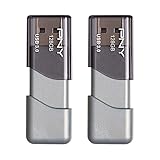
PNY 128GB Turbo Attaché 3 USB 3.0 2-Pack
Two identical 128GB USB 3.0 drives for under twenty-eight dollars makes this the most cost-effective high-capacity option in the roundup. The value proposition centers on redundancy: one drive for daily carry, one kept as a backup copy. Turbo Attaché 3 units are straightforward in build — plastic housing, capless design, keyring hole — prioritizing function over finish.
- Two drives at 128GB each for a combined 256GB of storage at a price competitors match with a single unit
- Capless retractable mechanism means there is no separate cap to lose mid-session
- Plastic body and basic build quality feel budget-tier next to metal-cased alternatives
Skip this if you want a single polished drive rather than a functional pair for distributed backups.
2 Pack 64GB USB 2.0 Swivel Design
At under nineteen dollars for two 64GB drives, this swivel-style pair targets buyers who need bulk storage for occasional file transfers — sharing documents between workstations, moving photos off a camera card temporarily, or keeping software installers in a drawer. The fold-swivel mechanism protects the connector without requiring a cap.
- Twelve dollars per drive for 64GB each is the lowest cost-per-gigabyte in this roundup
- Swivel housing keeps the metal connector covered during pocket carry, reducing dust and bend damage
- USB 2.0 interface caps real-world throughput far below what modern systems expect for large transfers
Pass on this if you regularly move files above a few gigabytes, where the interface limitation becomes a daily frustration.
SIMMAX 32GB Swivel USB 2.0 (Purple)
The SIMMAX is a small, single-purpose drive for people who want a recognizable colored stick in a keychain ring — photos of a kids’ sports game, a personal document folder, a resume copy. Thirty-two gigabytes is sufficient for those tasks, and the purple finish makes it easy to find in a bag. At under ten dollars it is effectively a consumable price point.
- Lowest single-drive price in the roundup with a distinctive color option for quick identification
- Swivel design requires no cap management and survives being thrown into a backpack daily
- USB 2.0 with 32GB capacity limits it to small file sets; not suitable for media libraries
Choose this only for low-volume personal storage; skip it for anything that will need to grow beyond a few gigabytes.
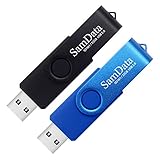
SamData 32GB 2-Pack with LED Light
The integrated LED activity light is a small quality-of-life feature that removes the guesswork of knowing whether a transfer is complete or a file is actively being written. Two 32GB drives in black and blue at seventeen dollars provides color-coding on top of redundancy, which suits households or small teams sharing a single computer.
- LED indicator prevents premature removal during active writes, reducing corruption risk
- Two distinct colors help separate personal data from work or shared files physically
- USB 2.0 throughput means large folders still take noticeable time even on modern hardware
Skip it if you need faster transfers or plan to move multi-gigabyte archives regularly.
Enfain 16GB USB 2.0 10-Pack with Labels
This is a procurement product, not a personal one. Ten 16GB drives in gift-ready packaging with printable labels targets conference organizers, onboarding teams, and corporate gifting scenarios where uniform, identifiable media is distributed to a group. At thirty-six dollars total, the per-unit cost sits just above three dollars, and the included labels eliminate the need for separate marker work.
- Pre-labeled and individually packaged — ready to hand out at an event with zero prep beyond filling files
- Ten-unit consistency means every recipient gets the same experience rather than a random mix
- 16GB per unit is the smallest capacity here; large presentations or video handouts will not fit on one drive
Individual buyers should look elsewhere; this pack only makes sense at organizational scale.
IMEASON 16GB Swivel USB 2.0 Keychain
At nine dollars, the IMEASON is the cheapest single drive in this comparison. Its built-in keychain ring and swivel body make it permanently attached to a set of keys, which suits people who carry a small working file set daily and want zero chance of leaving the drive on a desk. Sixteen gigabytes holds documents, a PDF collection, or a compressed project folder comfortably.
- Integrated keychain loop removes the most common failure mode — losing the drive — by attaching it to an item you always carry
- Lowest absolute price for anyone who only needs a small, always-available file container
- USB 2.0 and 16GB place it in the slowest and smallest category; not appropriate for backups or media
Consider it a convenience item; skip it if you need speed or capacity beyond document-level storage.
Buying Guide
Interface Generation: The Single Biggest Performance Gap
USB 2.0 drives are capped at 480 megabits per second in theory, and real-world sustained writes on budget controllers often land in the 5-15 MB/s range. USB 3.0 and 3.2 Gen 1 drives typically sustain 50-100 MB/s. That difference is not academic: a 10GB file set transfers in under two minutes on a 3.x drive versus ten-plus minutes on a 2.0 unit. If your budget allows a $5-$10 premium for the faster interface, it recoups itself in waiting time within the first year of regular use.
Connector Design: Swivel, Cap, or Dual
Exposed connectors bend and accumulate debris. Swivel mechanisms enclose the plug inside a rotating shell, protecting the metal contacts without adding a cap that can be lost. Dual-connector drives (USB-A on one end, USB-C on the other) add physical length but eliminate adapter dependency. Choose swivel for pocket carry, dual-connector if you switch between a laptop with only USB-C ports and older desktops with USB-A.
Capacity Planning: Real Usable Space After Formatting
A drive sold as 128GB shows roughly 119GB of usable space in a file manager after binary formatting overhead. Thirty-two-gigabyte drives show approximately 29GB. Plan for about seven to eight percent less than the marketed number. If your workflow involves a fixed file set that currently fills a 32GB drive to capacity, the next tier up is not a luxury — it is the minimum required for the next project cycle.
Our Verdict
The top pick is the Lexar D40E 128GB for anyone with mixed-device workflows, because its dual connectors and fast interface cover the widest range of use cases without accessories. The best budget pick is the 2 Pack 64GB USB 2.0 Swivel at $18.99, which delivers the lowest cost-per-gigabyte in this group for users who prioritize volume over speed. The condition under which another product wins outright: if you need two backup copies of a large project and want a single-connector simplicity, the PNY 128GB Turbo Attaché 3 2-Pack beats the Lexar on total capacity for less money.
FAQ
Can I use a USB thumb drive as permanent boot media for an operating system installer?
Yes, most drives support bootable partitions, but sustained read performance and endurance matter. Choose a USB 3.0 or 3.2 Gen 1 drive with at least 32GB and a reputable controller to avoid slow installs or write-cycle degradation over repeated reformatting.
Why does my 64GB drive only show 58GB of free space?
Manufacturers label capacity using decimal (base-10) math while operating systems report in binary (base-2). The difference scales with size, and file system overhead accounts for a small additional reduction. This is normal behavior, not a defect.
How long can data sit unpowered on a flash drive before corruption?
Manufacturer datasheets typically guarantee data retention for at least ten years under storage conditions below 30°C. In practice, drives kept at room temperature retain readable files well beyond that, but critical archives should still be copied to a secondary medium periodically.
Is a swivel drive more durable than a capped drive?
Swivel designs eliminate the loss and stress-point risks associated with small detachable caps. The internal hinge mechanism is the only moving part, and on well-built units it outlasts the flash memory itself. Capped drives fail more often from lost caps or broken clips than from connector wear.