Picking a brand matters more for some components than others. For a CPU or GPU, you’re really choosing between two or three companies with wildly different performance tiers. For PSUs, cases, and cooling, the field is wider and the “best” brand depends on what you’re paying. Here’s how the major hardware makers actually stack up, based on what shows up in real builds and what tends to fail.
CPUs: AMD vs Intel
This is a two-horse race, and it has been for over a decade. AMD’s Ryzen lineup currently has the edge in multi-threaded workloads and power efficiency, especially the X3D chips for gaming, which stack extra cache to cut down on frame-time stutter. Intel’s Core series still competes well on single-threaded speed and tends to be cheaper at the low end, but its high-end chips run hotter and pull more power for similar gaming performance.
The practical failure mode with Intel’s recent 13th/14th-gen desktop chips was voltage-related instability under sustained load, which pushed Intel to issue microcode fixes. AMD’s AM5 platform has had its own early teething issues with memory compatibility, but that’s mostly settled now. Neither company is a bad choice; the deciding factor is usually your motherboard socket roadmap. AM5 is committed through at least 2027, which matters if you plan to upgrade the CPU later without replacing the board.
| Factor | AMD Ryzen | Intel Core |
|---|---|---|
| Gaming (1080p/1440p) | Strong, especially X3D parts | Competitive, slightly behind at same price |
| Multi-core / productivity | Generally ahead per watt | Fast but higher power draw |
| Platform longevity | AM5 socket through ~2027 | New socket roughly every 2 generations |
| Price at entry level | Comparable | Often slightly cheaper |
GPUs: Nvidia, AMD, and Intel
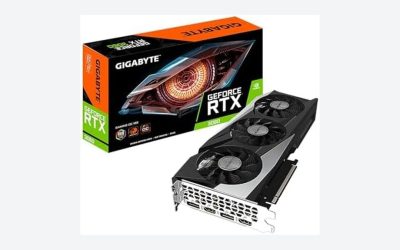
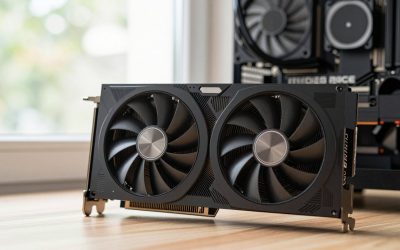
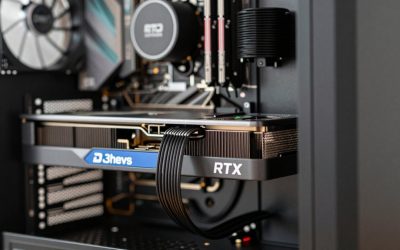
Nvidia dominates mindshare and the high end, and for good reason: better ray tracing performance, DLSS upscaling that’s genuinely better than AMD’s FSR in most titles, and the best driver stability track record. The cost is that Nvidia cards usually run $50-150 more than an AMD equivalent at the same raw performance tier, and VRAM has been stingy on mid-range cards, which shortens their useful life for 4K or heavily modded gaming.
AMD’s Radeon cards are the value play. Raw rasterized performance per dollar is usually better, and FSR has closed the gap with DLSS enough that it’s a non-issue for most people. The trade-off is weaker ray tracing and fewer software extras (no equivalent to Nvidia Broadcast or RTX Video). Intel’s Arc cards are the wildcard: genuinely good value at the budget tier, but driver maturity is still catching up, and you’ll hit occasional game-specific bugs that Nvidia and AMD ironed out years ago.
If you’re shopping, it’s worth comparing current Nvidia graphics cards against AMD Radeon graphics cards at the same price point rather than assuming one brand wins outright. The right pick flips depending on whether ray tracing or raw frame rate matters more to you.
Motherboards and power supplies
Motherboard brands (ASUS, MSI, Gigabyte, ASRock) are closer in quality than people assume once you’re past the bottom-shelf boards. Where they actually differ is VRM quality on high-end chips, BIOS usability, and warranty support. ASUS tends to charge a premium for build quality and support that’s often justified on flagship boards, less so on budget ones. Gigabyte had a rough patch with capacitor failures on some B550 boards years back; that’s resolved now but it’s a reminder that even reputable brands have bad batches.
PSUs are the one component where brand name should outweigh price. A failing PSU can take other components down with it. Corsair, Seasonic, and EVGA (for existing stock, since EVGA exited the GPU business and scaled back PSUs) have the strongest reliability records. Avoid unbranded or bargain-bin PSUs below the 80+ Bronze certification; the money saved isn’t worth the risk to a $1500 build. Look up the specific model on a PSU tier list before buying rather than trusting the brand alone, since even good manufacturers rebadge different internal platforms under the same product line.
Cooling: air vs liquid, and who makes it
Noctua and be quiet! lead air cooling on quality and noise, though you pay for it, often $90-100 for a flagship air cooler. Cooler Master and Deepcool offer nearly as much cooling performance for $40-60 less, and for most CPUs that aren’t pushed to their power limits, that gap in cooling performance won’t matter.
For liquid cooling, Corsair and Arctic dominate the all-in-one (AIO) market. The main failure mode across all AIO brands is pump whine developing after a year or two, and occasional coolant evaporation reducing performance over 3-5 years. A good 240mm or 280mm AIO from a reputable brand will outperform a cheap 360mm from an unknown brand, because radiator size matters less than pump and fan quality. If you’re assembling a parts list, browsing CPU liquid coolers by radiator size and reviewed noise levels will tell you more than the brand name alone.
What actually matters when you’re buying
Brand loyalty makes less sense in PC hardware than in most product categories, because the same company can make a great product one generation and a mediocre one the next. Check current-generation reviews and benchmarks for the specific model, not the brand’s reputation from two years ago. The one place brand consistency genuinely pays off is PSUs, where the cost of being wrong is other components.