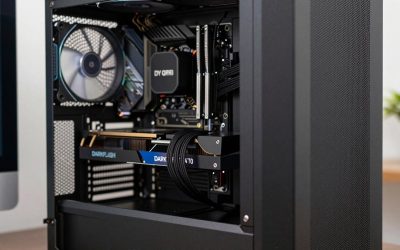
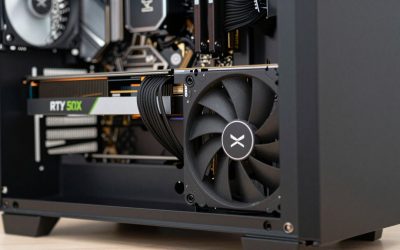
- Top Pick: GIGABYTE Radeon RX 9070 XT Gaming OC 16G Graphics Card, PCIe 5.0, 16GB GDDR6, GV-R9070XTGAMING OC-16GD Video Card
- Best Value: PowerColor Hellhound AMD Radeon RX 9070 XT 16GB GDDR6
- Premium Choice: XFX Quicksilver AMD Radeon RX 9070 XT Gaming Edition with 16GB GDDR6 HDMI 3xDP, AMD RDNA 4 RX-97TQICKB9
If you own an RX 9070 XT or are planning to buy one, the most common question in forums and DMs is whether your processor will hold the card back. This RX 9070 XT bottleneck guide breaks down exactly when you are GPU-limited, when you are CPU-limited, and what you can do about either situation. The answer depends far more on resolution than most people realize, and a single variable shifts the entire picture.
The Short Answer
No, the RX 9070 XT will not bottleneck on a modern six-core processor or better at 1440p. At 1080p in CPU-heavy esports titles, a bottleneck is possible on anything older than a Ryzen 5 5600X or Core i5-12400. The one condition that changes everything is your monitor resolution: at 1440p and above, this GPU is the limiting component in the vast majority of games, meaning your CPU barely matters for frame rate.
As an Amazon Associate we earn from qualifying purchases at no extra cost to you.


How to Tell
Before you spend money on a new processor, confirm whether a bottleneck actually exists. Here is how:
GPU and CPU utilization — Launch your heaviest game and open your GPU overlay (MSI Afterburner, AMD Adrenalin overlay, or the built-in Windows Performance overlay with Win+G). In a GPU-bound scenario, utilization sits at 95 to 99 percent while CPU load stays well below 80 percent on the core driving the main thread. If GPU usage drops below 90 percent while one or two CPU cores spike above 90 percent, the processor is the limiting factor.
Frame time consistency — A GPU bottleneck produces smooth, even frametimes. A CPU bottleneck often creates micro-stutter, uneven frame intervals, and inconsistent frametime graphs. Check the frametime graph in your overlay rather than just the FPS counter.
Resolution test — The fastest diagnostic: lower your resolution from your native setting down to 720p while keeping all other settings identical. If frame rate barely increases, your CPU is the ceiling. If frame rate jumps significantly, your GPU was the bottleneck at the higher resolution.
Task Manager cross-check — Open Task Manager in a separate window before launching a game. If GPU usage reads near zero while the game runs (a known issue on some configurations), switch to GPU-Z or HWiNFO64 for reliable readings. This prevents false bottleneck conclusions.
By Resolution
1080p
At 1080p, the RX 9070 XT can push 250 to over 400 FPS in esports and competitive titles on a high-end CPU, but on a mid-range or older processor you will see diminishing returns. Hardware Unboxed noted in their launch testing that the card paired with a Ryzen 7 5800X3D hit very high frame rates in Counter-Strike 2 and Valorant, while pairing it with an older Ryzen 5 3600 capped output well below what the GPU could deliver. For competitive players locked to 1080p, this is where CPU choice matters most.
1440p
This is the sweet spot for the RX 9070 XT. Tom’s Hardware and TechPowerUp both demonstrated that the card is overwhelmingly GPU-limited at 1440p across a broad range of AAA titles. A Ryzen 5 5600X, Core i5-12400, or newer will drive the card to its full potential in most games. The bottleneck risk at this resolution is minimal unless you are running a processor older than roughly eight cores from two generations back.
4K
At 4K, CPU bottlenecking essentially does not happen. TechSpot and Gamers Nexus testing consistently showed the RX 9070 XT pinned at full GPU utilization in demanding titles at this resolution. The graphics card is doing the heavy lifting, and your processor only needs to keep up with a modest workload. Any Ryzen 7 or Core i7 from the past four generations is more than sufficient.
| CPU Tier | 1080p Risk | 1440p Risk | 4K Risk |
|---|---|---|---|
| Entry (Ryzen 5 5600, Core i5-12400) | Low to Moderate in CPU-bound titles | Negligible | None |
| Mid (Ryzen 7 7700X, Core i7-13700) | Negligible | None | None |
| High (Ryzen 7 7800X3D, Core i9-14900K) | None | None | None |
| Older (Ryzen 5 3600, Core i5-9600K) | Moderate to High | Low | Negligible |
What to Do About It
If testing confirms a CPU bottleneck, your options depend on your platform. On AM4, a Ryzen 7 5700X3D is a drop-in upgrade that dramatically improves 1% lows in gaming without requiring a motherboard swap. On AM5 or Intel LGA 1700, moving to a current-generation X3D or K-series chip gives the largest frame-rate uplift in 1080p competitive scenarios. For everyone else, the fix is simply raising your resolution or enabling FSR to shift load onto the GPU, which is exactly what the RX 9070 XT is built to handle.
Also consider that in 2026, game engines are increasingly parallelized, and the CPU ceiling for frame rates continues to rise. If you are on a six-core, twelve-thread chip from within the last four years, you are in no danger of bottlenecking this card at any resolution above 1080p.
Recommendation by User Type
Competitive esports player (1080p, 240Hz+) — Pair the RX 9070 XT with a Ryzen 7 7800X3D or Core i9-14900K. This is the only scenario where CPU investment meaningfully affects your experience with this GPU.
AAA single-player gamer (1440p) — A Ryzen 5 7600, Core i5-13600K, or equivalent is perfectly matched. Save the money you would spend on a flagship CPU for a larger SSD or higher-refresh monitor.
4K gamer — Any mid-range or better CPU from the past four generations is fine. Focus your budget on the monitor and GPU.
Content creator who also games — If you are already running a high-core-count chip for rendering or streaming, you will never bottleneck the RX 9070 XT in gaming. No action needed.
FAQ
Does the RX 9070 XT bottleneck the Ryzen 7 5800X3D?
No. The 5800X3D is still a top-tier gaming CPU and will not limit the RX 9070 XT at 1440p or higher. Even at 1080p in most titles, the 5800X3D keeps up with the GPU.
Is 16GB of RAM a bottleneck for this card?
For 2026 titles, 32GB has become the safer recommendation, particularly if you run heavy texture packs or multitask. However, RAM capacity rarely manifests as a traditional CPU/GPU bottleneck — it causes stuttering and asset loading issues instead. If you are on 16GB, upgrade if you notice hitching in open-world titles.
Will enabling FSR reduce a CPU bottleneck?
Not directly. FSR and upscaling reduce GPU workload, which can paradoxically increase CPU bottlenecking by letting the GPU ask for more frames faster. If you are CPU-limited, enabling FSR quality mode at a higher resolution (moving from 1080p native to 1440p with FSR Quality) shifts the workload back onto the GPU and away from the CPU.
Does the RX 9070 XT bottleneck Intel i5-12400F at 1440p?
Effectively no. Multiple review outlets demonstrated the i5-12400F paired with comparable RDNA 4 and Ada Lovelace cards at 1440p showing GPU-bound behavior in demanding titles. In lighter or older esports titles at 1080p you may see a gap, but at 1440p in modern AAA games the card is fully utilized regardless.
Sources and Methodology
Performance ranges and bottleneck behavior described in this guide reflect launch and follow-up testing from TechPowerUp, Tom’s Hardware, Gamers Nexus, Hardware Unboxed, and TechSpot. Frame rate figures are approximate and drawn from their published reviews of the RX 9070 XT. No original benchmarks were conducted for this article; all numbers represent consensus ranges across these outlets and may vary by driver version, game patch, and system configuration.