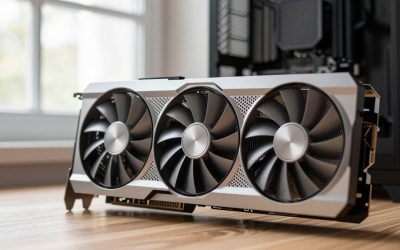
The Arc B570 is the better gaming card for anyone with a reasonably modern CPU: it is clearly faster than the RX 6600 at 1080p, much faster at 1440p, and brings 10 GB of VRAM, stronger ray tracing, and XeSS 2 frame generation. The RX 6600 only wins if you can get it used for well under the B570’s price, need the shortest and most frugal card possible, or are pairing it with an older CPU that would hold the Arc card back.
Quick answer: Our top pick in 2026 is the 1080p medium — our #1 rated choice. See the full ranked comparison, alternatives and buying advice below.
How Big Is the Performance Gap?
Unlike many budget matchups, this one isn’t close. In Tom’s Hardware’s Arc B570 review, the Intel card came out about 29 percent faster than the RX 6600 at 1080p ultra and about 14 percent faster at 1080p medium. The gap widened at higher resolutions: roughly 45 percent at 1440p ultra and 34 percent at 4K ultra. Tom’s noted that the RX 6600 wins a few individual games, but the B570 outclasses it overall. GamersNexus’s review also ranked the B570 above the RX 6600 in its charts.
The pattern makes sense. At low settings, games lean more on the CPU and the Radeon’s Infinity Cache, so the cards look closer. As settings and resolution rise, the RX 6600’s 128-bit bus and 8 GB buffer become bottlenecks, while the B570’s 160-bit bus and 380 GB/s of bandwidth keep it fed.
| Scenario (Tom’s Hardware review data) | Arc B570 lead over RX 6600 |
|---|---|
| 1080p medium | About 14% |
| 1080p ultra | About 29% |
| 1440p ultra | About 45% |
| 4K ultra | About 34% |
In practical terms, the RX 6600 is a solid 1080p medium-to-high card, typically in the 50 to 90 FPS range in demanding modern games, while the B570 can push toward higher settings or nudge into 1440p. Exact frame rates vary with settings, CPU, and game version.
Specifications
| Specification | Radeon RX 6600 | Intel Arc B570 |
|---|---|---|
| Architecture | RDNA 2.0 | Xe2-HPG |
| Release date | 13 October 2021 | 16 January 2025 |
| Launch MSRP | $329 | $219 |
| Shader units | 1792 | 2304 |
| Boost clock | 2491 MHz | 2500 MHz |
| Process | 7 nm | 5 nm |
| Board power (TDP) | 132 W | 150 W |
| VRAM | 8 GB GDDR6 | 10 GB GDDR6 |
| Memory bus / bandwidth | 128-bit / 224.0 GB/s | 160-bit / 380.0 GB/s |
| Cache | 2 MB L2, 32 MB L3 Infinity Cache | 9 MB L2 |
| Interface | PCIe 4.0 x8 | PCIe 4.0 x8 |
| Power connector | 1x 8-pin | 1x 8-pin |
| Length / width | 190 mm / 2-slot | 272 mm / 2-slot |
| Outputs | 1x HDMI, 3x DisplayPort | 1x HDMI 2.1a, 3x DisplayPort 2.1 |
The bandwidth line is the headline: the B570 has about 70 percent more memory bandwidth (380 versus 224 GB/s), which is why its lead grows with resolution.
Ray Tracing, Upscaling, and Frame Generation
Ray tracing on the RX 6600 is technically supported but rarely practical. RDNA 2’s first-generation RT hardware struggles even with light effects at 1080p, so most owners leave RT off. The B570’s Xe2 ray-tracing units are substantially more capable, allowing light-to-moderate RT at 1080p, especially combined with upscaling.
On the upscaling side:
- Arc B570 supports XeSS 2 Super Resolution, which uses the card’s XMX AI engines for a sharper, more stable image than older non-ML methods, plus XeSS Frame Generation and Xe Low Latency. It can also use FSR where a game only offers AMD’s upscaler.
- RX 6600 uses FSR 3.1-class upscaling and frame generation, and AMD’s driver-level Fluid Motion Frames. AMD’s machine-learning FSR 4 launched as an RDNA 4 feature for the RX 9000 series, so the 6600 doesn’t get the newest image quality improvements.
Neither card can run DLSS. If image quality at upscaled 1080p or 1440p matters to you, XeSS on Arc hardware is a meaningful advantage.
VRAM Headroom
The B570’s 10 GB is not a luxury; it is the difference between comfortable and compromised in a growing number of titles. At 1080p, several recent releases go past 8 GB at high texture settings, and when that happens the symptom is stutter and poor 1% lows rather than a tidy drop in average FPS. Frame generation also consumes additional memory, which further squeezes an 8 GB card.
- 1080p: 8 GB works with sensible texture settings; 10 GB gives breathing room.
- 1440p: 8 GB is often limiting; 10 GB is workable with medium-to-high textures.
- 4K: neither card is meant for it in modern games.
Cost per Frame Calculation
Using launch MSRPs and Tom’s 1080p ultra figure (RX 6600 = 100, B570 = 129):
- RX 6600: $329 / 100 = $3.29 per performance point.
- Arc B570: $219 / 129 = about $1.70 per performance point.
That makes the B570 almost twice the value at launch pricing. The RX 6600 has long since fallen below its MSRP, though, and used cards usually sell for roughly $120 to $170. For the RX 6600 to match the B570’s cost per frame at 1080p ultra, it would need to cost about $170 new, or $219 divided by 1.29. Any used RX 6600 noticeably below that figure is a fair deal; anything above it is overpriced compared with a new B570.
Power Draw, PSU, and Physical Size
The RX 6600 is one of the most efficient cards of its era, rated at 132 W, while the B570 is rated at 150 W. Both use one 8-pin connector. Sizing a PSU as GPU power plus CPU power plus about 150 W of headroom:
- RX 6600 with a 65 W CPU: 132 + 65 + 150 = 347 W. A quality 450 W unit is plenty.
- Arc B570 with a 65 W CPU: 150 + 65 + 150 = 365 W. A quality 450 to 500 W unit is plenty.
Physical size is where the RX 6600 has a real advantage. The reference length is 190 mm, and many partner models are short single- or dual-fan designs that fit compact cases easily. The B570’s listed length is 272 mm, so mini-ITX builders should check clearance carefully.
CPU Pairing Matters More Than Usual
Intel’s Arc drivers carry more CPU overhead than AMD’s, and reviewers such as Hardware Unboxed showed the B570 losing a significant share of performance with older CPUs. Arc also expects Resizable BAR to be enabled. In a modern system (Ryzen 5000/7000/9000 or Intel 12th gen and newer), the B570’s advantage holds. On an older quad-core or a board without ReBAR, the gap can shrink a lot, and the RX 6600 becomes the safer upgrade.
Display Outputs and Monitor Pairing
Both cards offer three DisplayPort outputs and one HDMI port, so multi-monitor setups are easy on either. The B570’s outputs are newer, with DisplayPort 2.1 and HDMI 2.1a, which gives more headroom for high-refresh 1440p panels and future monitors. For a typical 1080p 144 Hz or 165 Hz display, either card connects without issue. The bigger question is whether the GPU can feed that refresh rate: the RX 6600 is best matched to 1080p at 60 to 144 Hz in lighter games, while the B570 is the better partner for a 1080p high-refresh or entry-level 1440p monitor.
Which Should You Buy?
| If you… | Buy |
|---|---|
| Have a modern CPU and want the best 1080p card around $200 to $250 | Arc B570 |
| Plan to try 1440p | Arc B570 |
| Want ray tracing or ML upscaling | Arc B570 |
| Are upgrading a pre-2019 PC without Resizable BAR | RX 6600 |
| Have a small case or a low-wattage PSU | RX 6600 |
| Can find a used RX 6600 well under $170 | RX 6600, for 1080p medium-high play |
| Mostly play older DirectX 11 or esports titles | Either; RX 6600 is the more predictable driver experience |
Frequently Asked Questions
How much faster is the Arc B570 than the RX 6600?
According to Tom’s Hardware’s review data, the B570 is around 14 percent faster at 1080p medium and about 29 percent faster at 1080p ultra. At 1440p ultra the lead grows to roughly 45 percent. A few individual games still favor the RX 6600.
Is the RX 6600 still good for 1080p gaming?
Yes, it remains a capable 1080p card at medium to high settings. Its 8 GB of VRAM means some newer games need lower texture settings. It is best value when bought used at a clear discount.
Can I run an Arc B570 on a 450 W power supply?
With a typical 65 W desktop CPU, a good-quality 450 W unit with an 8-pin PCIe connector should handle the B570. With a higher-power CPU, step up to 550 W. Unit quality matters more than the label.
Does the Arc B570 need Resizable BAR?
Intel strongly recommends it, and performance drops noticeably without it. Most AMD Ryzen 3000 and newer and Intel 10th-gen and newer platforms support it after a BIOS update. Enable it in the BIOS before judging the card’s performance.
Will the RX 6600 get FSR 4?
AMD introduced FSR 4’s machine-learning upscaling for RDNA 4 graphics cards. The RX 6600 is RDNA 2 and relies on FSR 3.1-class upscaling and frame generation. Those features still raise frame rates but don’t match ML upscalers for image stability.
Ready to decide? Our #1 pick for 2026 is the 1080p medium.
Live price & availability on Amazon.