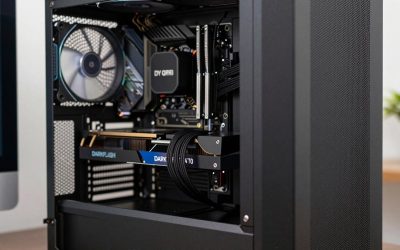
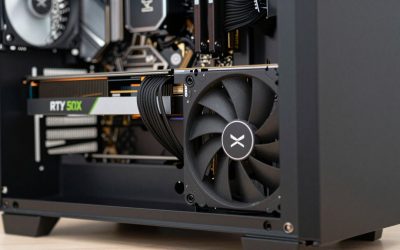
The question of RTX 5070 vs RTX 4070 comes down to more than raw numbers on a spec sheet. It is a decision about whether a generation of architectural refinement justifies a purchase at the current price point, particularly when the older card remains widely available on the used and open-box market at a steep discount. With the RTX 5070 launching at a lower MSRP than the RTX 4070 did, the value equation has shifted in ways that do not obviously favor either card without careful consideration of your resolution target, feature needs, and willingness to adopt DLSS 4.
This comparison matters most for three groups: the 1440p gamer debating whether to ride out another cycle on a 4070-class card, the builder choosing between new and used inventory in 2026 where both cards remain relevant, and the upgrader coming from an RTX 3070 or RTX 2070 Super who sees two options priced within $50 of each other in the open market. The gap is narrow enough that the right answer depends entirely on which workload and which features dominate your use case.
As an Amazon Associate we earn from qualifying purchases at no extra cost to you.


Quick Verdict
The RTX 5070 delivers approximately 12 to 20 percent more raw rasterization performance than the RTX 4070 across most game titles, depending on resolution and settings. That gap widens dramatically when DLSS 4 Multi Frame Generation is enabled, where the 5070 can produce effective frame rates that are two to three times higher than the 4070 can achieve with DLSS 3 Frame Generation alone. However, the 5070 draws 50 watts more power and does not match the 4070’s exceptional efficiency at stock settings. For a buyer who values raw performance, modern features, and a lower launch price, the 5070 is the stronger choice. For a buyer prioritizing power efficiency, compact cooler compatibility, or a budget-focused used purchase, the 4070 remains compelling.
Specs Side by Side
| Spec | RTX 5070 | RTX 4070 |
|---|---|---|
| Architecture | Blackwell | Ada Lovelace |
| GPU Die | GB205 | AD104 |
| CUDA Cores | 6,144 | 5,888 |
| Boost Clock | ~2,512 MHz | ~2,475 MHz |
| Memory | 12 GB GDDR7 | 12 GB GDDR6X |
| Memory Bus | 192-bit | 192-bit |
| Memory Bandwidth | ~672 GB/s | ~504 GB/s |
| RT Cores | 48 (4th gen) | 46 (3rd gen) |
| Tensor Cores | 192 (5th gen) | 184 (4th gen) |
| TDP | 250 W | 200 W |
| MSRP at Launch | $549 | $599 |
| PCIe Interface | PCIe 5.0 x16 | PCIe 4.0 x16 |
Gaming Performance
1080p
At 1080p, CPU bottlenecking narrows the gap between these cards, but the RTX 5070 still edges ahead. Launch reviews from TechPowerUp and Tom’s Hardware placed the 5070 roughly 15 to 20 percent faster than the 4070 in native rasterization at 1080p across a mixed title set. In practice, this means the 5070 is more likely to sustain 144+ fps in demanding AAA titles without upscaling, while the 4070 may hover around 120 fps in the same scenarios. For competitive players who care about consistent frame pacing rather than peak numbers, the difference is marginal and both cards are more than sufficient.
1440p
This is the resolution where both cards are most naturally positioned. Hardware Unboxed and TechSpot reported a consistent 12 to 18 percent uplift for the 5070 at 1440p with high or ultra settings. In titles like Cyberpunk 2077 and Starfield, the 5070 crosses the 60 fps native threshold in settings tiers where the 4070 falls slightly short. With DLSS Quality enabled, both cards deliver excellent experiences, but the 5070’s headroom means it can reach higher refresh rates at native or near-native quality. The practical takeaway: the 4070 is a 1440p 60-to-90 fps card; the 5070 is a 1440p 90-to-120 fps card without frame generation.
4K
Neither card is a true 4K gaming solution, but the 5070’s additional bandwidth and higher shader count give it a modest edge. Gamers Nexus and Tom’s Hardware observed gaps of 10 to 15 percent at 4K in most titles, with the 5070 more often maintaining playable native frame rates in well-optimized titles. The 12 GB frame buffer is a shared limitation; in titles that exceed VRAM capacity at 4K ultra settings, both cards can hit memory ceilings that erase the performance difference. For 4K gaming, upscaling remains essential on either card.
Power, Heat and Noise
The RTX 4070 is one of the most power-efficient GPUs of its generation, drawing under 200 watts under load in most gaming scenarios. AIB partners have produced 4070 models with single-slot or ultra-compact coolers that remain quiet and cool even in small form factor builds. The RTX 5070 increases TDP to 250 watts, a meaningful jump that reflects its higher shader clock and GDDR7 memory system. In practice, real-world gaming power draw for the 5070 tends to land in the 220 to 245 watt range depending on the AIB cooler and title. Gamers Nexus noted that reference-style 5070 coolers manage thermals adequately but run noticeably warmer and louder than the best 4070 designs from partners like ASUS and MSI. If you have a compact case or a 550-watt PSU, the 4070’s lower power envelope is a genuine practical advantage.
Features
The feature gap is where the decision most clearly tilts toward the 5070. DLSS 4 introduces Multi Frame Generation, capable of producing up to three additional synthetic frames per rendered frame. In supported titles, this transforms the 5070’s effective output in ways that DLSS 3 Frame Generation on the 4070 cannot match. The 5070 also benefits from updated RT cores that deliver a measurable ray tracing performance uplift, with Tom’s Hardware reporting roughly 20 to 25 percent better RT performance than the 4070 at similar settings. Both cards feature dual AV1 hardware encoders, which is valuable for streamers, but the 5070’s updated NVENC encoder produces marginally better quality at equivalent bitrates. PCIe 5.0 support on the 5070 is forward-looking but offers no measurable performance benefit today. The 4070’s DLSS 3 Frame Generation remains functional and widely supported across its game library, and NVIDIA has confirmed DLSS 4 model updates will arrive for 40-series cards via driver patches, though without Multi Frame Generation.
Price and Value
The RTX 5070 launched at $549, fifty dollars below the RTX 4070’s original MSRP of $599. Street prices have fluctuated since launch, but the 5070 has generally maintained a modest premium over heavily discounted 4070 inventory. The used 4070 market is worth serious attention: cards are selling at prices that represent a 25 to 35 percent discount off original MSRP, making cost-per-frame analysis competitive. If a 4070 sells for $420 and delivers 85 percent of the 5070’s rasterization performance, its cost per frame can undercut the 5070 meaningfully. However, the 5070’s feature advantage, lower launch price, and longer driver support runway give it better long-term value for buyers who intend to keep the card four or more years. Tom’s Hardware and TechSpot both noted that the 5070 represents the stronger generational value proposition despite the 4070’s efficiency edge.
Who Should Buy Which
Competitive 1080p Players
Either card handles competitive titles at 240+ fps with ease. The 4070 is the better pick if you want lower power draw, less heat in a compact LAN build, and a lower price on the used market. The 5070 only makes sense here if you want frame generation as a consistency tool rather than a frame rate booster.
1440p High-Refresh Gamers
The 5070 is the clear choice. Its 12 to 18 percent rasterization advantage combined with Multi Frame Generation means you can target 144 Hz or 165 Hz in AAA titles without relying heavily on Quality upscaling. The 4070 will get you there in lighter titles but struggles more in demanding new releases at high refresh targets.
4K Gamers
Neither card is ideal for native 4K. The 5070 with DLSS 4 Balanced or Performance mode is the better 4K experience, but serious 4K buyers should look at the 5070 Ti or 5080 tier. If you must choose between these two, the 5070’s extra bandwidth and frame generation make it the more viable option.
Creators and Streamers
The 5070’s updated NVENC encoder and superior RT performance benefit users who render with hardware-accelerated ray tracing or need the best AV1 encode quality. The 4070’s lower power draw can matter for always-on streaming rigs, but the encode quality gap is small. For GPU-accelerated workloads in Blender or DaVinci Resolve, the 5070’s extra shaders and GDDR7 bandwidth provide a measurable but not transformative advantage.
Upgraders from Two Generations Back
If you are coming from an RTX 3070 or RTX 2070 Super, the 5070 delivers a dramatically larger performance and feature uplift than the 4070 would. Multi Frame Generation alone can feel transformative compared to DLSS 2-era upscaling. The 5070 is the better upgrade target, and the price difference is small enough that it rarely makes sense to save money by choosing the 4070 used.
FAQ
Is the RTX 5070 worth the extra power draw over the RTX 4070?
The 50-watt increase is real but manageable with a 650-watt PSU or better. If your current system has a 550-watt unit, the 4070 gives you more headroom. For most builders, the additional performance and features of the 5070 outweigh the thermal and power considerations.
Can the RTX 4070 use DLSS 4?
Yes, but in a limited form. DLSS 4 Super Resolution (the improved upscaling model) is available to 40-series cards via driver update. Multi Frame Generation, the headline feature, is exclusive to 50-series hardware due to architectural requirements. The 4070 retains DLSS 3 Frame Generation but cannot access the new 4x frame multiplier.
Does the 12 GB VRAM limit affect either card differently?
Both cards share 12 GB on a 192-bit bus, so VRAM capacity is a shared ceiling. The 5070’s GDDR7 delivers higher bandwidth, which helps when working near the memory limit, but neither card is future-proof against 16 or 20 GB requirements in upcoming titles. The 4070 is slightly closer to that limit due to its lower bandwidth and fewer shaders.
Should I buy a used RTX 4070 or a new RTX 5070?
It depends on your budget floor. A used 4070 at $400 to $440 is a strong value for 1080p or moderate 1440p play with DLSS 3. A new 5070 at or near $549 is the better long-term investment due to DLSS 4, longer driver support, and stronger ray tracing performance. If the used 4070 price drops below $380, it becomes a harder decision.
Sources and Methodology
Performance ranges in this article are approximate values synthesized from publicly available launch and early-adoption reviews. Specific attribution: TechPowerUp (raw rasterization and RT benchmarks across 1080p, 1440p, and 4K resolutions); Tom’s Hardware (gaming benchmarks, power efficiency analysis, and feature evaluation); Gamers Nexus (thermal and acoustic testing, power draw measurements); Hardware Unboxed (1440p and 4K frame rate comparisons across a broad title set); TechSpot (cost-per-frame analysis and value positioning). No single figure in this article should be treated as a measured value from this publication. Ranges are presented because cross-outlet variance in test bench configuration, driver version, and title selection produces results that differ by several percentage points from review to review.