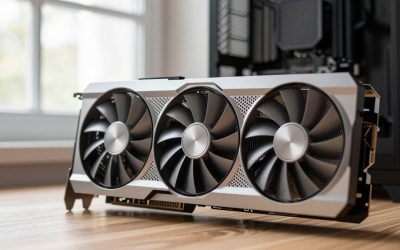
Upgrading from an RTX 2080 Ti to an RTX 5070 Ti roughly doubles gaming performance in GPU-bound scenarios, adds 5 GB of VRAM for a total of 16 GB, and unlocks DLSS 4 Multi Frame Generation, making it one of the most worthwhile upgrades for 1440p high-refresh and 4K gaming. The trade-offs are a 300 W rating, a 16-pin power connector and a longer 304 mm reference card, so check the power supply and case before buying. Owners who game only at 1080p will see smaller gains and may be better served by the cheaper RTX 5070.
Quick answer: Our top pick in 2026 is the Architecture — our #1 rated choice. See the full ranked comparison, alternatives and buying advice below.
From Turing Flagship to Blackwell Upper Mid-Range
The RTX 2080 Ti launched on 20 September 2018 at $999 with 4,352 CUDA cores, 11 GB of GDDR6 on a 352-bit bus and a 250 W TDP. The RTX 5070 Ti launched on 20 February 2025 at $749 with 8,960 CUDA cores, 16 GB of GDDR7 on a 256-bit bus, 896 GB/s of bandwidth and a 48 MB L2 cache, rated at 300 W.
That is two full architectural generations of improvement. Beyond the higher core count and clocks (2,452 MHz versus 1,545 MHz boost), Blackwell brings fourth-generation RT cores and fifth-generation Tensor cores, which matter as much as raster speed in modern games.
Specification Table
| Spec | RTX 2080 Ti | RTX 5070 Ti |
|---|---|---|
| Architecture | Turing | Blackwell 2.0 |
| Release date | 20 September 2018 | 20 February 2025 |
| Launch MSRP | $999 | $749 |
| CUDA cores | 4,352 | 8,960 |
| Boost clock | 1,545 MHz | 2,452 MHz |
| Process | 12 nm | 5 nm |
| TDP | 250 W | 300 W |
| Memory | 11 GB GDDR6 | 16 GB GDDR7 |
| Bus / bandwidth | 352-bit / 616.0 GB/s | 256-bit / 896.0 GB/s |
| L2 cache | 5.5 MB | 48 MB |
| Interface | PCIe 3.0 x16 | PCIe 5.0 x16 |
| Power connectors | 2x 8-pin | 1x 16-pin |
| Length / width | 267 mm / 2-slot | 304 mm / 2-slot |
| Outputs | 1x HDMI 2.0, 3x DP 1.4a, 1x USB-C | 1x HDMI 2.1b, 3x DP 2.1b |
The Performance Leap in Numbers
Launch reviews widely placed the RTX 5070 Ti close to the RTX 4080 in raster performance; one review headline summed it up as an RTX 4080 for $749, at least in theory. The 2080 Ti, by comparison, sits around RTX 3070 level. Aggregated game data from comparison sites puts the 5070 Ti roughly 90% ahead of the 2080 Ti on average, and 3DMark Time Spy and Time Spy Extreme scores show a similar gap of about 90-95%. Taking published sources together, a fair range is roughly 80-100% faster at 1440p and 4K, with smaller gains at 1080p where the processor becomes the limit. PassMark’s synthetic score shows a lower gap of around 50%, but it understates real-game differences for modern architectures.
Ray tracing widens the gap further. In 3DMark Speed Way, a ray tracing-focused test, the 5070 Ti scores around 2.5 times what the 2080 Ti manages. In heavy RT or path-traced games, the 2080 Ti is often unplayable at 1440p while the 5070 Ti remains usable with DLSS.
Approximate frame rates
As a rough guide that varies with settings, CPU and patches: in demanding current games at 1440p high settings without upscaling, the 2080 Ti often lands around 50-75 fps while the 5070 Ti reaches roughly 100-140 fps. At 4K, the 5070 Ti typically holds 60 fps or more in most titles with DLSS Quality, which the 2080 Ti struggles to do.
DLSS 4 and Frame Generation
Both cards support DLSS Super Resolution, including NVIDIA’s DLSS 4 transformer model, so 2080 Ti owners already have access to the improved upscaler. The new features that come with the 5070 Ti are DLSS Frame Generation and Multi Frame Generation, which can generate up to three additional frames for every rendered frame in supported games. On a 240 Hz monitor, that can turn a base 70-80 fps into very smooth motion.
Frame generation adds smoothness, not responsiveness, and works best when the base frame rate is already around 60 fps. Treat it as a bonus for high-refresh displays rather than a substitute for raw performance.
VRAM: 11 GB to 16 GB
The jump to 16 GB is one of the strongest reasons to choose the 5070 Ti over the 12 GB RTX 5070:
- 1440p: 12 GB covers most games today, but 16 GB leaves headroom for ultra textures, ray tracing and frame generation together.
- 4K: 16 GB is the practical target for high settings in new releases. The 2080 Ti’s 11 GB is increasingly tight at 4K.
- Longevity: buyers who keep a GPU for five years or more benefit most from the extra memory.
Power Supply, Connector and Case Clearance
The 5070 Ti draws 50 W more than the 2080 Ti. A PSU sizing calculation with a typical 125 W gaming CPU and about 150 W of headroom: 300 + 125 + 150 = 575 W. A quality 750 W unit is the comfortable choice, while 650 W is workable with a mid-range CPU. Owners who ran a 2080 Ti on a quality 650 W PSU can often keep it, but an older or lower-tier unit is worth replacing.
The connector changes from two 8-pin plugs to a single 16-pin. Most cards include an adapter that uses multiple 8-pin PCIe cables; check how many the adapter needs and use separate PSU cables rather than daisy-chained ones. A native 12V-2×6 cable from a newer PSU is the tidiest option. Make sure the plug is fully seated.
Size is the other check. The reference length is 304 mm versus 267 mm for the 2080 Ti, and many partner 5070 Ti cards are longer and thicker than two slots. Measure the space between the rear of the case and the front fans or radiator before ordering.
The card runs at PCIe 5.0 x16 but works in PCIe 3.0 slots. With a full x16 link the penalty on PCIe 3.0 is small, though an older CPU from the 2080 Ti era may limit frame rates at 1080p and 1440p.
Value Calculation
Taking the 2080 Ti as 100 points and the 5070 Ti as about 190 points:
- RTX 2080 Ti: $999 / 100 = about $10.00 per point at launch.
- RTX 5070 Ti: $749 / 190 = about $3.95 per point at launch.
A used 2080 Ti usually sells for around $250-$350, which offsets a sizeable part of the upgrade. Compared with the RTX 5070 at $549, the 5070 Ti costs $200 more at MSRP for roughly 20% more performance and 4 GB more memory, which is worth it mainly at 4K or for long ownership.
Is It the Right Upgrade for You?
| Use case | Recommendation |
|---|---|
| 1080p, esports focus | Keep the 2080 Ti or consider the RTX 5070 |
| 1440p at 144-240 Hz | RTX 5070 Ti: roughly double the performance plus MFG |
| 4K gaming | RTX 5070 Ti: 16 GB and DLSS make 4K practical |
| Ray tracing and path tracing | RTX 5070 Ti |
| Older CPU, PSU under 650 W | Plan a PSU and possibly CPU upgrade first |
Display Outputs and Extras
The 5070 Ti’s HDMI 2.1b and DisplayPort 2.1b outputs support high refresh rates at 4K and beyond, including 4K at 240 Hz on capable monitors, which the 2080 Ti’s HDMI 2.0 and DisplayPort 1.4a cannot drive without heavy compromise. Buyers planning a new high-refresh 4K or ultrawide display get much more from the newer card. The 2080 Ti’s USB-C port, originally intended for VR headsets, is not present on the 5070 Ti.
The newer card also brings a more capable NVENC encoder with AV1 support, useful for streaming and recording at higher quality per bitrate, and NVIDIA Reflex in compatible games cuts input latency, which pairs well with frame generation.
Frequently Asked Questions
How much faster is the RTX 5070 Ti than the RTX 2080 Ti?
Published comparisons put it roughly 80-100% faster in GPU-bound games at 1440p and 4K, and the lead is larger with ray tracing. At 1080p the gain is smaller because the CPU often limits performance.
Can my 2080 Ti power supply run an RTX 5070 Ti?
A quality 650-750 W unit generally can, since the card is rated at 300 W. Older or low-quality units should be replaced, and the 16-pin adapter will need multiple separate 8-pin PCIe cables.
Will the RTX 5070 Ti fit in my case?
The reference length is 304 mm, about 37 mm longer than the 2080 Ti, and many partner cards are larger. Measure available clearance, including any front radiator or fans.
Does the RTX 2080 Ti support DLSS 4?
It supports DLSS 4 Super Resolution with the transformer model. It does not support DLSS Frame Generation or Multi Frame Generation, which are among the main reasons to upgrade.
Should I get the RTX 5070 or RTX 5070 Ti as a 2080 Ti upgrade?
The RTX 5070 is the better value for 1440p if budget is tight. The RTX 5070 Ti is the better choice for 4K, heavy ray tracing or long-term ownership thanks to its 16 GB of VRAM and higher performance.
Ready to decide? Our #1 pick for 2026 is the Architecture.
Live price & availability on Amazon.