RTX VSR stands for RTX Video Super Resolution, Nvidia’s driver-level feature that upscales and cleans up low-resolution video played in a browser. It’s not a game feature, it’s not DLSS, and it doesn’t need a specific game to support it. If you’ve seen people mention “AI video upscaling” for Nvidia cards, this is what they mean.
What RTX VSR actually does
RTX VSR runs on top of Chrome, Edge, or other Chromium-based browsers and upscales streaming video in real time, using the GPU’s tensor cores to sharpen edges, reduce compression blocking, and fill in detail that isn’t really there. It works on video playing from YouTube, Netflix, Twitch, or basically any site using standard HTML5 video. It does not work on local video files played in VLC or Windows Media Player, and it does not touch game footage.
The practical effect: a blurry 480p or 720p video looks noticeably cleaner, with less of the muddy, blocky look you get from heavy compression. It’s most useful on old YouTube videos, low-bitrate streams, or content that was never encoded well in the first place. On already-good 1080p or 4K streams from well-funded platforms, the difference is much smaller because there’s less compression noise to clean up.
What you need to run it
RTX VSR is restricted to RTX 30-series and 40-series cards. It will not run on GTX cards or older RTX 20-series cards, because Nvidia leans on the tensor cores introduced with Ampere for the real-time processing. You also need a recent Game Ready or Studio driver and a Chromium-based browser, since Firefox support has historically lagged or been absent depending on driver version.
There’s a real GPU load cost. Running VSR at higher upscale settings while also gaming, streaming, or running other GPU tasks will eat into your headroom. On a lower-end 30-series card like a 3050 or 3060, cranking VSR to its highest quality setting while doing anything else demanding can cause stutter in the browser itself, not just in your game. On a 4070 or above, you generally won’t notice the cost unless you’re already pushing the card hard.
| GPU tier | RTX VSR support | Real-world experience |
|---|---|---|
| GTX 16-series and older | Not supported | No tensor cores, feature is simply unavailable |
| RTX 20-series | Not supported | Has tensor cores but Nvidia excluded this generation |
| RTX 3050 / 3060 | Supported | Works, but higher quality settings can cause stutter under load |
| RTX 3070 / 3080 / 3090 | Supported | Smooth at all quality levels for normal browsing |
| RTX 40-series (any) | Supported | No noticeable overhead for typical use |
Is it worth buying a GPU for this
No. RTX VSR is a nice bonus on a card you’re buying for gaming or content creation, not a reason to buy a GPU on its own. If your main complaint is that YouTube videos look soft, there are cheaper fixes, like just picking a higher quality stream when one’s available, or using a browser extension that does basic sharpening without needing dedicated AI hardware.
Where it genuinely adds value is for people who already watch a lot of lower-bitrate video content, like older tutorial videos, archived streams, or regional content that never gets re-encoded in high quality. If that’s a real daily annoyance for you and you’re already shopping for a GPU upgrade, it’s a legitimate tie-breaker in favor of a card that supports it over one that doesn’t, all else being equal.
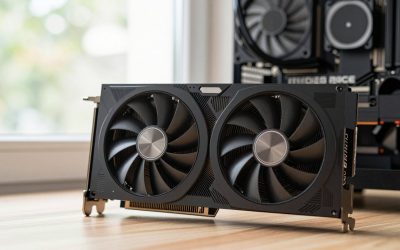
If you’re currently running a GTX card and are due for an upgrade anyway, something like an RTX 4060 graphics card gets you VSR support plus a solid jump in gaming performance over anything from the GTX generation. If you want more headroom for VSR plus heavier gaming or creative work, an RTX 4070 graphics card handles both without the stutter issues you might see on a 3050 or 3060.
Where it falls apart
VSR has some rough edges worth knowing before you rely on it. It can introduce visible artifacts on fast motion, especially sports or action scenes, where the upscaling algorithm sometimes smears or ghosts detail it’s trying to invent. It also doesn’t play well with every site: some video players use custom controls that don’t expose a standard HTML5 video element, and VSR simply won’t trigger on those, even though the setting is on.
Driver updates have occasionally broken VSR outright, where it silently stops activating until a later driver fixes it. If you’ve enabled it in the Nvidia Control Panel and it doesn’t seem to be doing anything, check the GeForce Experience overlay (Alt+Z) for a confirmation it’s active, since there’s no persistent on-screen indicator otherwise.
Battery life takes a hit on laptops. If you’re on an RTX-equipped gaming laptop and watching video unplugged, VSR’s tensor core usage will drain the battery noticeably faster than standard playback. Worth turning off manually if you’re trying to stretch a charge.
Alternatives if you’re not buying Nvidia
AMD doesn’t have a direct equivalent built into its drivers the same way, though some browsers and streaming apps have their own software upscaling that works regardless of GPU brand. Intel’s Arc cards also lack a dedicated feature like this as of now. If VSR is a selling point for you specifically, Nvidia is currently the only option, which is a fair reason to lean toward an RTX 40-series graphics card if you’re cross-shopping between brands and this feature actually matters to your daily use.
FAQ
Does RTX VSR work with Netflix and other DRM-protected streaming?
It can, but results vary by platform and browser version, since some DRM-protected video streams don’t expose themselves in a way VSR can process. YouTube and Twitch are the most reliably supported.
Will RTX VSR improve my own game footage or recordings?
No. It only applies to video played back through a supported browser’s video element. It has nothing to do with in-game rendering, screen recordings, or video editing software.
Does using RTX VSR hurt my GPU over time?
No more than any other sustained GPU workload. It raises power draw and temperature somewhat while active, similar to light gaming, but it isn’t uniquely stressful on hardware.
Can I use RTX VSR and DLSS at the same time?
Yes, they don’t conflict since one works on browser video and the other works inside supported games. You can have both enabled with no interaction between them.