Nvidia Reflex is a latency-reduction feature that shows up in two places: a driver-level setting and an in-game toggle. Turn it on and your GPU stops queuing up rendered frames ahead of time, which cuts the delay between your mouse click and the resulting action on screen. It’s free, it’s been around since 2020, and it works on any RTX 20-series card or newer. If you play competitive shooters, it’s one of the few settings that actually matters more than raw frame rate.
What Reflex actually does
Normally your CPU renders several frames ahead and hands them to the GPU in a queue. That queue smooths out frame pacing but adds latency, sometimes 20-40ms worth, because the frame you’re seeing was computed a few frames ago relative to your input. Reflex tells the CPU to hold off submitting new frames until the GPU is actually ready for them, which collapses that queue down to near zero. The tradeoff is almost nothing: you lose a sliver of frame-time consistency in exchange for your inputs showing up faster.
This is different from G-Sync or high refresh rate monitors, which reduce latency and smooth motion through the display side. Reflex works on the render pipeline itself, so the two stack. A 240Hz monitor with Reflex on will feel noticeably sharper than either one alone.
Reflex vs Reflex + Boost
Most games that support Reflex also offer a “Boost” variant in the dropdown. Boost forces your GPU clocks higher during CPU-bound moments (menus, low-load scenes) specifically to keep render queue times down. It’s a small extra latency win, but it also means your GPU runs hotter and louder even when it doesn’t need to for frame rate. On a card with a weak cooler, that’s a real tradeoff.
| Mode | Latency benefit | Power/heat cost | Best for |
|---|---|---|---|
| Off | None (baseline) | Lowest | Single-player, non-competitive games |
| On | Moderate, consistent | Negligible | Default for anything competitive |
| On + Boost | Small additional gain | Noticeably higher at low loads | CPU-bound esports titles (CS2, Valorant) on cards with good cooling |
In practice, plain “On” gets you 90% of the benefit. Boost is for people chasing the last few milliseconds in CS2 or Valorant, where frame rates are already in the hundreds and the GPU is sitting half-idle anyway.
What hardware you actually need
Reflex itself works on any RTX card, including budget ones. You don’t need a flagship GPU to get the latency benefit, that part is basically free. What you do need a stronger card for is keeping frame rates high enough that Reflex has something to work with, since the latency reduction is proportional to how much of a render queue existed in the first place. At low frame rates (under 60fps), the queue is already large, so Reflex has more room to help, but you’re still playing at 60fps input feel, just less laggy than it would otherwise be.
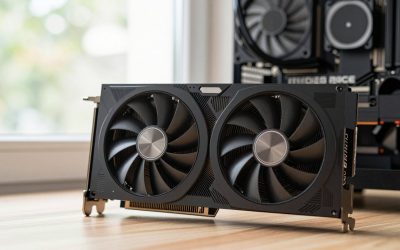
If you’re buying a card specifically for competitive shooters, prioritize frame rate first and treat Reflex as a free bonus on top. A card that holds 240fps+ in your game will feel better than a slower card with Reflex on, every time. For most people shopping in this range, a current-gen RTX 4070 graphics card is the sweet spot for 1440p esports titles at high refresh. If you’re on a tighter budget, an RTX 4060 graphics card still gets full Reflex support and plenty of frame rate in lighter esports titles like Valorant or CS2.
Reflex Analyzer: the part most people skip
If you own a Reflex-compatible G-Sync monitor (look for “Reflex Latency Analyzer” in the spec sheet) and a compatible mouse, GeForce Experience’s overlay can show you actual click-to-pixel latency numbers in milliseconds. It’s genuinely useful for tuning settings, you can see exactly what toggling Boost or changing your frame cap does instead of guessing. Most people never touch this because it requires specific hardware, but if you’re buying a new monitor anyway, checking for that certification is a nice-to-have, not a must-have.
Frame caps and V-Sync: don’t skip this part
Reflex works best paired with a frame rate cap, either an in-game limiter or Nvidia’s own, set a few frames below your max refresh rate. Uncapped frame rates with V-Sync on reintroduce the exact queuing delay Reflex is trying to remove, so leaving V-Sync on without a cap defeats a lot of the point. If your monitor doesn’t have G-Sync/VRR, capping below your refresh rate and leaving V-Sync off entirely is usually the lowest-latency combo. If you do have a VRR monitor, G-Sync plus a frame cap plus Reflex is the standard competitive setup Nvidia itself recommends.
Who should actually care about this
Competitive shooter players: turn it on, it’s free performance in the way that matters most for aim. Casual and single-player gamers: it won’t hurt to enable it, but you won’t notice much difference in something like a story-driven RPG where a frame or two of input lag isn’t the bottleneck to your enjoyment. Streamers and content creators running CPU-heavy encoding alongside their game may notice a bigger benefit than usual, since Reflex also helps when the CPU is the bottleneck, which is exactly when input lag tends to get worse.
FAQ
Does Reflex lower my frame rate?
No, in most cases it has no measurable impact, and in CPU-bound scenarios it can even help frame pacing slightly. The “Boost” variant can occasionally shift power usage in ways that affect sustained clocks on cards with weak cooling, but this is a minor effect.
Do I need an Nvidia Reflex-branded mouse or monitor to use it?
No. Basic Reflex latency reduction works with any mouse and monitor on an RTX card. The special hardware (Reflex Latency Analyzer monitors and compatible mice) is only needed to measure your latency in milliseconds, not to get the latency benefit itself.
Does AMD have an equivalent?
Yes, AMD Anti-Lag and Anti-Lag+ do a similar job on Radeon cards. They’re not identical in implementation but solve the same render-queue problem. If you’re comparing cards between brands, don’t treat Reflex as an Nvidia-exclusive dealbreaker, just know it’s one less thing to configure since so many competitive titles support it natively.
Should I enable Reflex in every game?
It’s safe to leave on by default in any game that supports it. There’s essentially no downside outside of extremely rare edge cases with specific driver versions, which Nvidia patches quickly when reported.