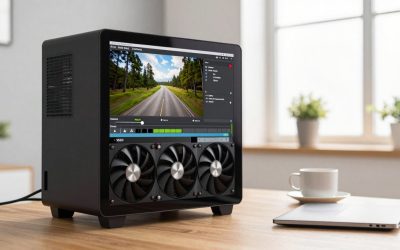
“Professional PC” means different things depending on what pays your bills. A video editor, a CAD engineer, and a software developer all need different balances of CPU cores, GPU power, and memory bandwidth. What they share is a low tolerance for crashes, thermal throttling, and slow storage. This guide covers how to spec a machine that actually holds up under daily production work, not just benchmarks.
What actually matters for professional work
Gaming PCs and workstations overlap more than they used to, but the priorities differ. Gamers chase peak GPU frame rates. Professionals need sustained performance across long render queues, multitasking with a dozen apps open, and storage that won’t choke on large files. The three components worth spending real money on are the CPU, RAM, and storage. The GPU matters a lot if you do 3D, video, or AI work, and matters less if your day is spreadsheets, code compilation, and virtual machines.
A common mistake is overspending on a flagship GPU while running 16GB of RAM. If you have Chrome with 40 tabs, a Slack client, a Docker setup, and a video editor open at once, RAM capacity will bottleneck you long before the GPU does. For most professional workloads in 2024, 32GB is the realistic floor and 64GB is where you stop thinking about memory at all.
CPU: cores vs. clock speed
If your work is single-threaded (a lot of CAD, some older engineering software, general office use), a CPU with high clock speed and strong single-core performance matters more than core count. If you render video, compile large codebases, or run multiple VMs, more cores win. The current high-core-count desktop chips from AMD’s Ryzen 9 and Threadripper lines, and Intel’s Core i9 and Xeon W lines, are the realistic choices. You can browse current options through a desktop processor for video editing search to compare current generation pricing, which moves fast enough that naming specific models here would go stale within months.
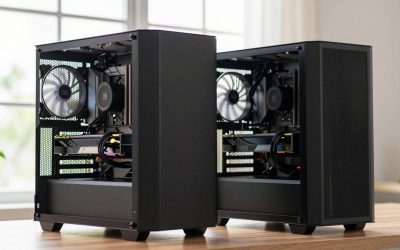
One failure mode worth knowing: cramming a high-core-count CPU into a case with mediocre airflow leads to thermal throttling under sustained load. A CPU that benchmarks well for ten minutes can quietly drop clock speed during a two-hour render. If you’re buying a prebuilt, check that it ships with a tower cooler or AIO rated for the CPU’s actual TDP, not the minimum spec.
GPU: when it matters and when it doesn’t
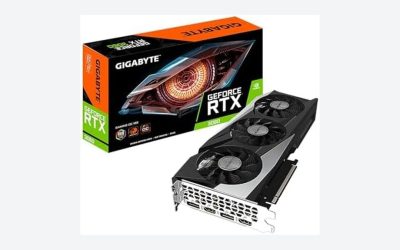
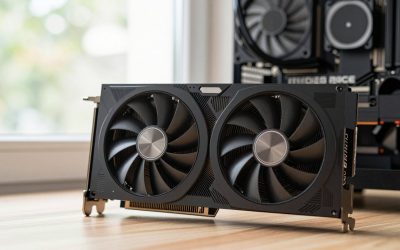
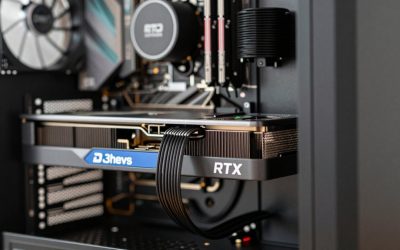
For 3D rendering, video editing with GPU-accelerated effects, CAD with heavy viewport work, or local AI model work, GPU VRAM capacity is often the real constraint, not raw speed. Running out of VRAM causes stuttering or outright crashes mid-project, which is worse than a slower render. For software development, data analysis, or office work, an entry-level or mid-range card is enough, and the money is better spent on RAM or an NVMe drive. A good way to compare current cards for your specific workload is a workstation graphics card search, since VRAM tiers and pricing shift every few months.
Storage: the part people underspend on
Storage is where professional builds most often go wrong. A single small NVMe drive for the OS plus a slow HDD for everything else was fine a decade ago. Now, large project files, scratch disks for video editing, and virtual machine images all want fast, low-latency storage. The practical setup is a fast NVMe SSD for the OS and active projects, plus either a second NVMe or a large SATA SSD for archives, with spinning disks reserved for cold backups only.
Watch for drives with small DRAM-less controllers advertised at bargain prices. They work fine for boot drives and casual use, but under sustained writes (large video exports, VM snapshots) they slow down noticeably once their cache fills. If your work involves sustained large writes, it’s worth checking a drive’s sustained write speed, not just its peak burst number, before buying. A NVMe SSD 2TB search is a reasonable starting point for a primary drive at a size that won’t fill up within a year.
| Workload | CPU priority | GPU priority | RAM | Storage |
|---|---|---|---|---|
| Video editing / motion graphics | High core count | High VRAM | 32-64GB | Fast NVMe, 2TB+ |
| CAD / engineering | High single-core clock | Mid-range, driver-certified | 32GB | 1TB NVMe |
| Software development | High core count | Entry-level | 32-64GB | 1TB NVMe |
| Data science / local AI | High core count | Very high VRAM | 64GB+ | 2TB NVMe |
| General office / admin | Mid-range | Entry-level or integrated | 16-32GB | 512GB-1TB SSD |
Prebuilt vs. custom build
A prebuilt workstation from an established vendor is the safer choice if you need a warranty, support line, and a machine that works on day one without troubleshooting. It’s also usually the better choice if this PC is a business expense and you need a clean invoice and predictable replacement timeline. Custom builds save money and let you choose exactly where to spend, but you own the troubleshooting if something doesn’t play nice. If your income depends on this machine being up and running, the time saved by a supported prebuilt often outweighs the savings from building it yourself.
Either way, don’t skip the power supply. A workstation with a high-end GPU and CPU under sustained full load needs real continuous wattage, not a unit’s peak rating. Undersized or low-quality PSUs are a common cause of random reboots under load that get misdiagnosed as software problems.
FAQ
Do I need ECC memory for professional work?
Only if your software specifically requires it or you’re running workloads where a single bit error could corrupt long-running calculations, such as some scientific computing or financial modeling. For video editing, CAD, and development, standard high-quality RAM is fine.
Is 32GB of RAM really enough, or should I go to 64GB?
32GB handles most single-application professional workloads comfortably. Go to 64GB if you regularly run multiple heavy applications simultaneously, work with 4K/8K video, or run virtual machines alongside your main software.
Should I buy a workstation-certified GPU instead of a gaming card?
Only if your software (certain CAD or medical imaging applications) specifically certifies against those drivers. For video editing, most development work, and general 3D work, a mainstream gaming GPU with sufficient VRAM performs the same for a lower price.
How long should a professional PC last before needing an upgrade?
A well-specced machine with adequate RAM and storage headroom typically stays useful for four to five years of professional work before a CPU or GPU upgrade becomes worthwhile. Storage is the easiest and cheapest component to upgrade along the way if you fill up your drive sooner than expected.