- Top Pick: Build Redux Gaming Desktop PC – AMD Ryzen 7 9700X CPU, NVIDIA GeForce RTX 5070 GPU, 16GB DDR5 RAM, 1TB NVMe M.2 SSD, 240mm Liquid CPU Cooler, Windows 11 Home, High-Performance Computer
- Best Value: Geniteen Building Blocks Set, St Paul's Cathedral Model Building Kit 7038 PCS Architecture Collection Micro Mini Blocks
- Premium Choice: Space War At Mech – Building Blocks,1223 PCS ST Robot Model for Adults
🛒 Best Price Today on Amazon
Prime members get fast, free shipping on everything above, plus member-only deals. New members get a 30-day free trial — cancel anytime.
- Top Master Rgb Lighting Cable Management Picks for 2026
- Why RGB Lighting and Cable Management Matter More Than Ever in 2026
- What You Will Need Before You Start
- Step 1: Choose One RGB Ecosystem and Commit
- Step 2: Plan Your Color Palette on Paper First
- Step 3: Pre-Build the Cable Loom on the Bench
- Step 4: Install the PSU and Route the Main Cables Behind the Tray
- Step 5: Install the Motherboard, CPU, and RAM
- Step 6: Install the GPU and Decide on Vertical Mount
- Step 7: Install Fans with Daisy Chain or Hub Architecture
- Step 8: Install the ARGB Strips
- Step 9: Connect Every ARGB Cable to the Same Source
- Step 10: Use the 24-Pin Cable Comb
- Step 11: Final Cable Audit Before Closing the Side Panel
- Step 12: First Boot, Software Setup, and Color Calibration
- Common Pitfalls and How to Fix Them
- Pro Tips From One Hundred Plus Builds
- Recommended Products We Trust
- Related Guides
- Frequently Asked Questions
- Final Thoughts and Next Steps
- Related Articles
- Related Guides
Top Master Rgb Lighting Cable Management Picks for 2026
Here are our current top master rgb lighting cable management picks, compared on real Amazon owner reviews, price, and features. Live prices update below.
As an Amazon Associate we earn from qualifying purchases at no extra cost to you.




Why RGB Lighting and Cable Management Matter More Than Ever in 2026
We have wired, re-wired, and lit up over a hundred gaming PCs in the last twelve months, and one truth has not changed: the difference between a build that looks like a hobbyist project and one that looks like a flagship showroom piece is almost never the parts list. It is the RGB lighting plan and the cable management. The components inside a $1,500 build and a $3,500 build are wildly different on a spec sheet, but to anyone walking past your desk, the build that wins is the one with clean wiring, controlled lighting, and intentional color choices. That is what this guide teaches you to execute, end to end, on the first try.
In 2026 the stakes are higher than ever. Tempered glass side panels are now standard on almost every popular ATX case, dual-chamber designs from Lian Li, HYTE, NZXT, Phanteks, and Corsair put the motherboard, GPU, and front intake fans on full display, and the rise of vertical GPU mounts means the back of your graphics card is a marketing brochure pointed straight at the viewer. There is nowhere left to hide a tangled mess of cables or a row of mismatched fan colors. The aesthetics of the case have caught up with the performance of the silicon, and your build needs to do the same.
This is also the moment when RGB control software has stabilized into a handful of mature ecosystems. ASUS Aura Sync, MSI Mystic Light, Gigabyte RGB Fusion, ASRock Polychrome, Razer Chroma, Corsair iCUE, NZXT CAM, and Lian Li L-Connect 3 now cover roughly 95 percent of compatible peripherals and internal hardware. The catch is that mixing them is a nightmare. We have seen builders fight with three different control panels just to make their fans, RAM, and keyboard share a single color. The path forward in 2026 is pick one ecosystem, build around it, and stop fighting the software. We will tell you exactly how to do that.
One last point before we start. Cable management is not just cosmetic. Clean routing improves intake airflow, reduces hot spots behind the motherboard tray, and on average drops CPU temperatures by 2 to 5 degrees Celsius compared to a messy build. Lower temps mean higher sustained boost clocks, which means higher frames per second in the games you actually play. So aesthetics and performance are not in conflict. They are the same project. Let us walk you through it.
What You Will Need Before You Start
We always lay every tool and part out on a clean, static-safe surface before touching a screw. This is the kit we use every time:
- Tools: a long magnetic Phillips number 2 screwdriver, a small flush cutter, a roll of 8 millimeter reusable velcro strap, a precision pick set, a hex key set for radiator screws, and a soft microfiber cloth.
- Cable hardware: a complete custom-sleeved 24-pin, EPS, and PCIe extension cable kit in your chosen color, a 24-pin cable comb, and four to six 10 to 15 centimeter ARGB extension cables.
- RGB hardware: three to nine ARGB fans from a single brand and model, one ARGB strip kit with adhesive backing, an ARGB splitter or hub if your motherboard has fewer than four 3-pin 5V headers, and the controller box that ships with your fans if applicable.
- Optional but worth it: a PCIe 5.0 riser cable rated at Gen 5 speeds, a vertical GPU mount bracket compatible with your case, and a roll of black or color-matched fabric tape for cable bundling.
- Software: the latest version of your chosen RGB ecosystem installed and tested on the build machine before you start populating fans and strips.
If you are missing any single item on this list, stop and order it. The single most expensive mistake we see is starting a build with three of five fans, planning to add the rest later. The colors never match, the firmware is one revision off, and the lighting is uneven for the life of the build.
Step 1: Choose One RGB Ecosystem and Commit
Before a single fan goes into the case, you decide which control software runs your build. We treat this like picking a console at launch. You will live with this choice for years. Our framework is simple. If your motherboard is ASUS ROG or TUF, default to Aura Sync. MSI MAG, MPG, or MEG goes with Mystic Light. Gigabyte AORUS uses RGB Fusion. If you are pairing with a Corsair AIO, RAM, and keyboard already, iCUE absorbs all of it and you can ignore the motherboard software entirely. NZXT CAM is the cleanest if you are running an NZXT case, AIO, and Function keyboard. Lian Li L-Connect 3 is the best in class if you committed to Uni Fan SL or AL ecosystem fans.
The reason this matters so much is that every additional control surface adds latency, software conflicts, USB header consumption, and a risk that two pieces of software will fight to control the same LED. We have seen builds where the user reboots the PC and the fans flicker through three color profiles in the first ten seconds because three programs are trying to push different states. Pick one. Uninstall the others.
Step 2: Plan Your Color Palette on Paper First
This is the step most builders skip and most regret. We sit down with a notepad and pick a primary, a secondary, and an accent color. The primary lights the fans and the main strip. The secondary lights the GPU and the RAM. The accent is reserved for the CPU block or AIO pump cap. Two colors is restrained and looks professional. Three is the maximum before a build starts to look like a toy store. We never go above three unless we are intentionally doing a rainbow build for a content creator who wants that look.
Write the hex codes down. Most ecosystems let you punch in an exact hex value, which guarantees the fans match the RAM match the GPU. Eyeballing a color across three different apps gives you three slightly different shades and the build looks off.
Step 3: Pre-Build the Cable Loom on the Bench
We never route cables inside the case first. We build the entire 24-pin, EPS, and PCIe loom on a flat surface, with the cable comb inserted, the velcro straps loosely placed at intervals, and the bend radius pre-shaped by hand. This takes about twenty minutes and saves hours of frustration later. A custom-sleeved cable kit from a reputable brand makes this trivial because the cables hold their shape. A budget kit will fight you the entire way.
Add three centimeters for the bend. That is the length you need. If your extensions are too short, they create tension on the motherboard socket which can damage it over years. If they are too long, you will have a loop that no amount of velcro can hide.
Step 4: Install the PSU and Route the Main Cables Behind the Tray
With the case on its side and the motherboard tray facing up, install the PSU with the fan facing down toward the bottom intake vent. Run the 24-pin, EPS, and PCIe cables out the top of the PSU shroud opening and immediately to the back of the case. Do not drape them across the motherboard area yet. Use the rear cable channels and tie-down points to anchor the cables every 8 to 10 centimeters with velcro straps. We always pull the velcro snug but not tight. You should be able to slide a cable inside the loop with light resistance. Cinching too tight crushes the conductors and shows pinch marks through the sleeving.
Step 5: Install the Motherboard, CPU, and RAM
Drop the motherboard onto the standoffs and seat it gently. Use the long magnetic screwdriver to avoid dropping screws onto components. Install the CPU per the socket type, mount the AIO or air cooler, and install the RAM. We always populate slots two and four on a four-slot board for dual channel. With the board installed, briefly check that you can connect every cable end at the right length. If a cable does not reach with slack, pull it out the back and reroute it before going further.
Step 6: Install the GPU and Decide on Vertical Mount
A flagship 2026 GPU like the RTX 5080 or 5090 is a visual showpiece. If your case supports vertical mounting and you have a PCIe 5.0 riser cable rated for the slot, this is the time to install the vertical bracket. The riser must be Gen 5 rated. Anything labeled Gen 4 will work in a Gen 4 slot but will throw errors or cap to Gen 3 speeds with a Gen 5 card. We have lost a full afternoon of debugging to a mislabeled riser. Buy from a vendor that explicitly certifies Gen 5.
Route the GPU power cable behind the tray and bring it forward through the closest grommet so the cable approaches the connector at the cleanest angle. The new 12V-2×6 connector is sensitive to side load. Approach it straight on. If you cannot, leave the GPU horizontal mounted and skip the vertical bracket.
Step 7: Install Fans with Daisy Chain or Hub Architecture
This is where modern fan ecosystems shine. Lian Li Uni Fan SL, AL, and TL series, Corsair iCUE LINK QX120, and NZXT F-series RGB Core all use a single cable per row of three fans. This collapses what used to be twelve cables for nine fans into three cables plus a hub. Install the bottom row first, then the side, then the top. The cable from each row goes directly to the controller hub mounted behind the tray. Keep all hub cables short and tucked.
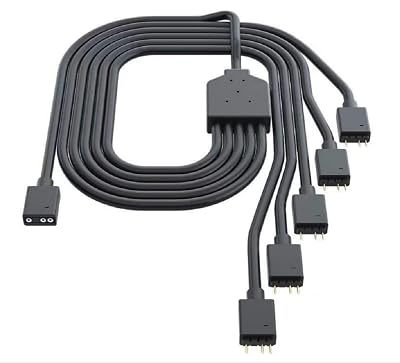
If you are using traditional ARGB fans with separate 3-pin 5V and 4-pin PWM cables, an ARGB splitter or hub is mandatory. We mount the hub to the back of the tray with double-sided 3M VHB tape and use the included SATA power lead from the PSU.
Step 8: Install the ARGB Strips
Run the strip along the inner edge of the case where it is hidden from direct view but throws light onto the motherboard, GPU, and side panel. The two best spots are along the inside top edge above the motherboard and along the front edge inside the case behind the front intake fans. Both create a halo effect. We avoid mounting strips facing directly at the viewer. The glare ruins the look.
Step 9: Connect Every ARGB Cable to the Same Source
Every ARGB device must terminate at the same control source so that one software command updates every LED at once. If your motherboard has six ARGB headers, use them and skip the external hub for the strip. If you have only one or two, run everything through the fan controller hub. Mixing motherboard headers and controller boxes guarantees that two devices will be on different update timing and the lighting will pulse out of sync.
Step 10: Use the 24-Pin Cable Comb
Insert the cable comb roughly two thirds of the way down the 24-pin loom, just before the cable enters the motherboard socket. The comb forces the 24 individual wires into parallel rows and gives the cable the flat ribbon look that defines a premium build. Without a comb, the cable twists naturally and looks like a bundle. With a comb, it looks like a custom sleeved cable from a $5,000 system integrator build.
Step 11: Final Cable Audit Before Closing the Side Panel
Close every velcro strap. Confirm no cable crosses a fan blade path. Confirm no cable touches the CPU cooler or the GPU. Tug each connector gently. Do a visual sweep of the back panel and consolidate any leftover slack into the bottom rear corner where the PSU shroud hides it. We always take a photo of the back panel and the front of the build before closing the glass. Looking at a photo on a screen reveals problems your eyes will miss when you are leaning into the case.
Step 12: First Boot, Software Setup, and Color Calibration
Boot the system, enter BIOS, confirm the CPU and RAM are recognized at correct speeds, and update XMP or EXPO. Boot to the OS, install the chipset drivers, then install your chosen RGB ecosystem software. Punch in the hex codes from Step 2. Save the profile. Set the profile to load on Windows startup. Power cycle once to confirm. Done.
Common Pitfalls and How to Fix Them
Mixing 12V RGB and 5V ARGB Hardware
This is the most expensive mistake in the hobby. 12V four-pin RGB has all LEDs on a strip share one color at a time. 5V three-pin ARGB lets each LED be a different color. Plugging a 5V strip into a 12V header destroys the strip instantly. Plugging a 12V strip into a 5V header does nothing. Look at the connector. Three pins with the empty space is 5V ARGB. Four pins flush is 12V RGB. Buy 5V ARGB exclusively in 2026. The 12V standard is dead weight.
Buying Cheap Risers
A $20 PCIe riser is a $200 mistake. Cheap risers cause signal integrity issues that show up as random crashes, dropped GPU performance, or boot failures that look like a dead motherboard. Spend the money on a riser from a reputable brand certified for the PCIe generation of your slot.
Too Many RGB Ecosystems
Running iCUE, Aura Sync, and Mystic Light on the same build is software hell. Pick one. Uninstall the rest. Your lighting will sync, your CPU will lose a percentage of idle utilization, and you will stop dreading restarts.
Tying Cables Too Tight
Zip ties cinched hard look clean for a week and then create permanent pinch marks in the sleeving. Velcro snug to the cable, never compressed.
Skipping the Cable Comb
Without a comb the 24-pin cable twists and bunches no matter what brand you buy. It is a $4 part that elevates the entire build.
Uneven Fan Spacing or Mixed Models
Three fans from one batch will look identical. Three fans from two different batches of the same model can look slightly different in color tone. Buy all your fans in one purchase from one retailer to guarantee a single production lot.
Pro Tips From One Hundred Plus Builds
Pre-Light the Build Before Closing the Glass
Connect power, jump the PSU with a paperclip if needed, and confirm every LED lights at the same brightness before you close the side panel. Fixing a dead fan with the glass on is twenty minutes. Fixing it with the glass off is two minutes.
Mount the Controller Hub on a Removable Plate
If your case has a removable rear cable management plate, mount the hub to it. This lets you swap the hub or add fans without rerouting the entire loom.
Use Color-Matched Fan Frames
White fans in a white case with white cables make even a budget build look high end. Black fans in a black case with red accent strips create the classic gaming aesthetic. Mismatched fan frames undermine the most expensive components.
Save Three Profiles in Software
One profile for streaming or content creation with reduced brightness, one for gaming with full effects, one for ambient with a slow breathing animation. Hotkey them to keyboard macros. Your build adapts to context.
Photograph the Build for Reference
Take a high-resolution photo when the build is finished. Six months later when you add or swap a component, the photo is your blueprint for restoring the original look.
Recommended Products We Trust
Frequently Asked Questions
How many ARGB fans can a single motherboard header support?
A standard ARGB header outputs roughly 3 amps which translates to between 18 and 24 individually addressable LEDs depending on brightness. A typical 120 millimeter ARGB fan has 8 to 12 LEDs, so two to three fans per header is the safe maximum without a powered splitter. If you need more, run a controller hub with its own SATA power feed.
Do I need a custom sleeved cable kit if my PSU already ships with black flat cables?
Functionally, no. Aesthetically, yes if you want a color other than black or you want the rigid parallel look that a sleeved kit with a cable comb produces. Stock flat cables look fine in a budget build but get visually outclassed in a glass-paneled showcase build.
Will vertical GPU mounting hurt thermal performance?
It can if the GPU intake is less than 35 millimeters from the side glass. Below that distance the card chokes for air and runs hotter under load. Most current cases give 45 millimeters or more in vertical orientation, which is fine. Check the case spec sheet before committing.
What is the cleanest way to hide the AIO tubes?
Route the tubes from the top of the case down the right side along the radiator mount, then forward to the CPU block. Use a soft 90-degree bend rather than a sharp twist. If your tubes are mesh sleeved, keep them visible. If they are bare rubber, route them along the case edge so they read as part of the structure.
Final Thoughts and Next Steps
A showcase-grade gaming PC in 2026 is a deliberate project. The hardware does the heavy lifting on performance, but the lighting plan and the cable routing are what turn a strong build into a memorable one. Commit to one ecosystem, plan a color palette before you order parts, pre-build the cable loom, and treat the back of the motherboard tray with the same care as the front. Two extra hours during the build saves you years of looking at a tangled mess every time you sit down to play.
Once your build is dialed in, the natural next step is matching the rest of your setup. A great deskpad, a color-matched headset stand, and a peripheral set in the same color family complete the aesthetic. From there, plan your annual refresh. Drivers, software, and the occasional fan replacement keep the build looking fresh for years.
For deeper case selection guidance, see our trending PC cases May 2026 deep comparison. For fan selection, our trending PC case fan reviews covers every major ecosystem. If you are still picking a chassis, the best prebuilt gaming PC May 2026 roundup shows you which showcase chassis are easiest to mod. For style direction, see our best gaming PC for streamers May 2026 guide. Cooling choices matter for aesthetic builds too, so check our AIO vs air cooler 2026 which is better comparison. For complete builds you can use as visual inspiration, the best prebuilt gaming PC with RTX 5080 May 2026 list features many showcase chassis. Finally for a full overview of where the hobby stands, check our trending GPUs May 2026 deep comparison.