

- Top Pick: Nvidia GeForce GTX 1080 8GB FE Founders Edition GDDR5X Video Graphics Card (Renewed)
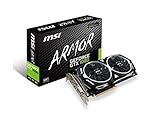
- Best Value: MSI Gaming GeForce GTX 1080 8GB GDDR5X SLI DirectX 12 VR Ready Graphics Card (GTX 1080 ARMOR 8G OC) (Renewed)
- Premium Choice: XFX SPEEDSTER SWFT309 RADEON RX 6700 Gaming Graphics Card with 10GB GDDR6 HDMI 3xDP, AMD RDNA 2 RX-67XLKWFDV (Renewed)
The RX 6700 is the clear choice over the GTX 1080: it is roughly 35-55% faster in modern games, has 10 GB of VRAM instead of 8 GB, supports ray tracing and current AMD upscaling and frame generation, and draws slightly less power. The GTX 1080 only makes sense as a very cheap stopgap for 1080p gaming in older titles, especially now that NVIDIA has moved Pascal cards off its regular Game Ready driver schedule.
The GTX 1080 was NVIDIA’s flagship-class card in 2016 and remains legendary for its longevity. The RX 6700 arrived five years later as a midrange RDNA 2 card. Because both now sell for budget prices on the used market, buyers upgrading an older PC or building on a tight budget often weigh them against each other.
As an Amazon Associate we earn from qualifying purchases at no extra cost to you.


Key Differences in the Specs
| Specification | GTX 1080 | RX 6700 |
|---|---|---|
| Architecture | Pascal | RDNA 2.0 |
| Release date | 27 May 2016 | 9 June 2021 |
| Launch MSRP | $599 | No official AMD MSRP listed |
| Shader units | 2560 CUDA cores | 2304 stream processors |
| Boost clock | 1733 MHz | 2450 MHz |
| Process | 16 nm | 7 nm |
| Board power (TDP) | 180 W | 175 W |
| Memory | 8 GB GDDR5X | 10 GB GDDR6 |
| Bus width | 256-bit | 160-bit |
| Bandwidth | 320 GB/s | 320.0 GB/s |
| Cache | 2 MB L2 | 3 MB L2 + 80 MB Infinity Cache |
| Interface | PCIe 3.0 x16 | PCIe 4.0 x16 |
| Power connectors | 1x 8-pin | 1x 8-pin |
| Length / width | 267 mm / 2-slot | 267 mm / 2-slot |
| Display outputs | DisplayPort 1.4, HDMI 2.0b, DL-DVI | 1x HDMI 2.1, 2x DisplayPort 1.4a, 1x USB Type-C |
Raw memory bandwidth is identical at 320 GB/s, but the RX 6700 backs its narrower bus with 80 MB of Infinity Cache, which greatly raises effective bandwidth at 1080p and 1440p. Add a 41% higher boost clock and a far newer architecture, and the RX 6700’s lead in games is no surprise. The two cards also have nearly identical power draw, length and connector needs, which makes the swap physically simple.
Gaming Performance: A Full Tier Apart
Direct professional head-to-head testing of these two cards is rare, so the gap is best estimated from where each card sits in published review data. Tom’s Hardware’s test of the Sapphire RX 6700 10GB placed it about 30% ahead of the RX 6600 and about 9% ahead of the RX 6650 XT, and TechPowerUp’s data places the RX 6600 at or slightly above the GTX 1080 in modern titles. Chaining those positions puts the RX 6700 roughly 35-55% ahead of the GTX 1080, with the larger gaps in recent DirectX 12 and Vulkan games, which Pascal handles less efficiently than newer architectures.
Approximate expectations, which vary with settings, CPU and game patches:
- 1080p high settings: the RX 6700 commonly delivers around 70-110 FPS in demanding modern games, while the GTX 1080 often lands around 45-75 FPS and may need medium settings in the newest titles.
- 1440p: the RX 6700 is a workable 1440p card at high settings, often around 50-80 FPS. The GTX 1080 typically needs medium settings and upscaling to stay near 60 FPS in newer games.
- Older and esports titles: both run games like Counter-Strike 2, Valorant and older DirectX 11 releases at high frame rates, and the gap matters less.
Games the GTX 1080 cannot run
A growing number of recent releases require hardware ray tracing or mesh shaders as a baseline. The GTX 1080 lacks hardware ray tracing and does not support DirectX 12 Ultimate, so those games will not launch or will run poorly on it. The RX 6700 supports DirectX 12 Ultimate and hardware ray tracing, so it remains compatible with these titles. This compatibility issue is arguably more important than the average frame rate gap.
Ray Tracing, Upscaling and Frame Generation
The RX 6700 supports hardware ray tracing through RDNA 2’s ray accelerators. Its ray tracing performance is modest, so light effects at 1080p are realistic while heavy settings are not. The GTX 1080 has no ray tracing hardware at all.
For upscaling, the GTX 1080 does not support DLSS, which requires RTX tensor cores. It can use AMD FSR (including FSR 3.1 upscaling and, in supported games, FSR frame generation) and Intel XeSS through its DP4a path. The RX 6700 supports the same FSR 3.1 features plus AMD Fluid Motion Frames 2 at the driver level, which adds frame generation to many games without native support. FSR 4 is officially limited to RDNA 4 Radeon RX 9000 cards, so neither card gets AMD’s newest upscaler.
Driver Support in 2026
NVIDIA announced that its 580 driver branch would be the last to bring Game Ready support to Maxwell, Pascal and Volta GPUs, with security updates continuing for a period afterward. That means the GTX 1080 will not receive new game-specific optimizations for future releases. The RX 6700 remains part of AMD’s actively supported RDNA 2 lineup. For a card intended to run new games over the next few years, this is a significant point in the RX 6700’s favor.
Power and Fit: An Easy Swap
Board power is nearly identical: 180 W for the GTX 1080 and 175 W for the RX 6700. Using GPU power plus CPU power plus about 150 W of headroom with a 95 W CPU:
- Either card: roughly 175-180 + 95 + 150 = about 420-425 W, so a quality 500-550 W unit is enough.
Both use a single 8-pin PCIe connector, though some partner GTX 1080 cards use 8-pin plus 6-pin, and both are listed at 267 mm long and two slots thick. Any system that runs a GTX 1080 reliably can run an RX 6700 with no PSU changes in almost all cases. Two caveats: the GTX 1080 includes a DVI port that the RX 6700 lacks, so an older DVI-only monitor will need an adapter, and if you are switching from NVIDIA to AMD, use Display Driver Uninstaller or a clean driver install to avoid conflicts.
The RX 6700 runs on PCIe 4.0 but works fully in a PCIe 3.0 slot, with a negligible impact because it uses all 16 lanes.
Pairing With an Older CPU
Many GTX 1080 owners run CPUs from the same era, such as quad-core Intel 6th or 7th generation chips or first-generation Ryzen. Those processors can limit the RX 6700 at 1080p, especially in CPU-heavy open-world and multiplayer games, so the full 35-55% gain may only appear at 1440p or in GPU-heavy titles. A six-core or better CPU from the last several years lets the RX 6700 stretch its legs. If your platform is very old, budgeting for a CPU upgrade alongside the GPU, or at least choosing 1440p to shift the load to the graphics card, gets more out of the switch.
Value Calculation
As a broad guide, GTX 1080 cards usually sell for about $80-$120 used and RX 6700 cards for roughly $170-$220. Taking the GTX 1080 as 100 performance points and the RX 6700 as about 145:
- GTX 1080 at $100: about $1.00 per point.
- RX 6700 at $195: about $1.34 per point.
The GTX 1080 wins on raw cost per frame, but that metric ignores missing features, limited driver support and games it cannot run. For anyone planning to play new releases, the RX 6700’s higher price buys a lot more longevity.
Choose by Use Case
| Scenario | Pick |
|---|---|
| Tight budget, older games and esports at 1080p | GTX 1080 |
| New AAA games at 1080p high | RX 6700 |
| 1440p gaming | RX 6700 |
| Games requiring ray tracing hardware | RX 6700 (GTX 1080 cannot run them) |
| Upgrading an existing GTX 1080 PC | RX 6700 is a meaningful jump; also consider RX 9060 XT new |
| DVI-only monitor | GTX 1080, or RX 6700 with an adapter |
Frequently Asked Questions
How much faster is the RX 6700 than the GTX 1080?
Based on where each card sits in published review data, the RX 6700 is roughly 35-55% faster in modern games. The gap is largest in recent DirectX 12 and Vulkan titles. In older DirectX 11 and esports games, the difference is smaller.
Is the GTX 1080 still good for gaming in 2026?
It can still handle many games at 1080p with medium settings and esports titles at high frame rates. However, it lacks ray tracing hardware, cannot run some recent games that require it, and no longer receives Game Ready driver optimizations. It is best as a cheap stopgap.
Can the GTX 1080 use DLSS?
No. DLSS requires the tensor cores found on RTX cards. The GTX 1080 can use AMD FSR and Intel XeSS in games that support them.
Do I need a new PSU to upgrade from a GTX 1080 to an RX 6700?
Usually not. The two cards have nearly identical power ratings, 180 W and 175 W, and both typically use one 8-pin connector. A quality 500-550 W unit that runs a GTX 1080 should handle an RX 6700.
Is 10 GB of VRAM a real advantage over 8 GB?
Yes, in newer games. Several recent releases exceed 8 GB at high textures even at 1080p, which causes stutter. The RX 6700’s 10 GB gives more room before texture settings need to drop.
Ready to decide? Our #1 pick for 2026 is the Architecture.
Live price & availability on Amazon.












