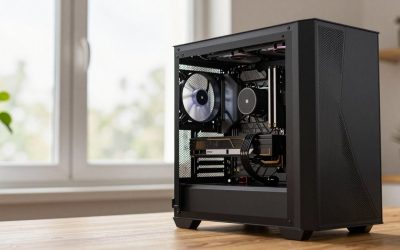
Direct Answer: Gorilla Tag is one of the lightest VR games on Steam. Its visuals are deliberately simple and low-poly, its maps are small and self-contained, and all of its movement comes from your hands rather than from a simulated world. The official minimum is a GeForce GTX 970 or Radeon R9 290 with just 4 GB of RAM and 140 MB of storage — hardware from the mid-2010s. Any dedicated VR-ready desktop built since then can run it, and a current entry-level gaming PC will exceed what the game can actually use. What matters is not 4K flat-screen performance but a stable framerate at your headset’s refresh rate, since the PC version is VR-only and there is no non-VR desktop mode.
As an Amazon Associate we earn from qualifying purchases at no extra cost to you.


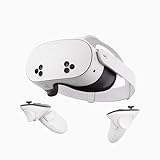

What Kind of PC Do You Need for Gorilla Tag?
Gorilla Tag, developed by Another Axiom, arrived on Steam on January 1, 2023 and is listed under Action and Casual. It is built around accessibility and high-framerate VR movement: the art style is intentionally basic, the physics are limited to arm-driven locomotion and simple collision, and matches are small. That means there is almost no CPU-heavy simulation, no large texture streaming, and no ray tracing or complex lighting to worry about. The developer also publishes no recommended spec, because the game does not need one.
On PC the game is VR-only, running through SteamVR or the Oculus PC runtime. You need a compatible headset — a Meta Quest 2, Quest 3 or Quest 3S over Link or Air Link, a Valve Index, an HTC Vive, or similar — plus a PC that satisfies the VR runtime. If your machine can already run SteamVR Home and other VR essentials without stutter, it can run Gorilla Tag. The real target is not 60 FPS on a monitor but a steady 72, 90 or 120 Hz inside the headset, because dropped frames in VR are far more noticeable than a flat-screen stutter. Gorilla Tag is light enough that even modest VR-ready hardware holds those refresh rates comfortably.
Gorilla Tag Official PC System Requirements
These are the requirements Another Axiom lists on the game’s Steam store page. The minimum is a mid-2010s mid-range CPU and GPU, and no recommended tier is published alongside it.
| Component | Minimum (official) | Recommended (official) |
|---|---|---|
| OS | Windows 10 | Not published |
| Processor | Intel Core i5-4590 / AMD FX 8350 | Not published |
| Memory | 4 GB RAM | Not published |
| Graphics | NVIDIA GTX 970 / AMD Radeon R9 290 | Not published |
| Storage | 140 MB available space | Not published |
Source: the official Gorilla Tag Steam store listing (app 1533390), checked October 2026. Publishers can update these specs after patches.
Because no recommended spec exists, the practical ceiling for Gorilla Tag is set by your headset and your VR runtime rather than by the game. The store page’s own additional notes make that point directly: “This runs on a Quest, so it should probably run on any reasonable computer that can run Oculus or SteamVR at all that isn’t literally a toaster.” Anything with a dedicated VR-capable GPU comfortably clears the listed minimum. Note also that PC support is listed as SteamVR or Oculus PC only — there is no flat-screen mode, so integrated graphics and non-VR laptops are not a route to playing it.
GPU Recommendations by Headset Resolution
For a VR game, “resolution” means the combined render resolution sent to the headset, which is higher than a 1080p monitor. The good news is that Gorilla Tag is light enough that no tier below is required just to run it — these groupings are about how much headroom you have for higher refresh rates, supersampling and other VR games.
For Quest 2 / Quest 3 / Quest 3S and Similar Headsets (72Hz – 120Hz)
This is the most common way to play Gorilla Tag on PC, over Link, Air Link or Steam Link. The headset handles the video encoding, but the PC still has to render two high-resolution views per frame.
- At or near the official minimum (GTX 970, R9 290, GTX 1060, RX 570, RX 580): These cards meet the published requirement and will run Gorilla Tag, though you may want to leave SteamVR’s render resolution at its default or slightly below on a Quest 3 to hold a steady refresh rate. They are the floor, not the sweet spot.
- Entry VR-ready cards (GTX 1660 Super, RTX 2060, RTX 3060, RX 6600): Comfortably above the minimum. A locked 90 Hz is easy, and there is enough headroom for 120 Hz on a Quest 3 at default render scale.
- Current mainstream cards (RTX 5060, RTX 5060 Ti, RX 9060 XT, Arc B580): Far more than Gorilla Tag alone can use, but the right pick if you also play heavier VR titles. They leave room for 120 Hz plus raised supersampling.
For Valve Index / Vive Pro 2 / High-Resolution PCVR (higher per-eye resolution, 120-144Hz)
- Mid-range current cards (RTX 5070, RX 9070, RTX 4060 Ti, RX 7700 XT): Easily handle Gorilla Tag at an Index’s 120 or 144 Hz, or at full resolution on a Vive Pro 2. You will hit the headset’s refresh limit or your CPU long before the GPU is the problem.
- High-end cards (RTX 5070 Ti, RTX 5080, RX 9070 XT): Unnecessary for this game specifically, but if you already own one you can push SteamVR supersampling well above 100% and stay locked to the headset’s maximum refresh rate.
There is no meaningful 4K flat-screen discussion for Gorilla Tag, because there is no traditional desktop mode to render. If you mirror the headset view to a monitor, any of the cards above will have no trouble filling the mirror window. Choose your GPU around your headset’s refresh rate and your other VR games instead.
CPU, RAM and Storage Notes for Gorilla Tag
CPU
Gorilla Tag is not CPU-bound the way large simulation or open-world games are. There is no complex AI, no crowd simulation and no physics engine juggling hundreds of objects. The CPU’s main jobs are tracking your head and hands, running the VR runtime, and handling the network code for the lobby.
The listed Core i5-4590 / FX 8350 minimum dates from the first generation of consumer VR. Any modern desktop CPU clears it — even an entry-level chip such as a Core i3-12100F, Ryzen 5 5500 or Ryzen 5 5600 sits well above what this game needs, and there is no benefit to a Core i5-14400F or Ryzen 5 7600 specifically for Gorilla Tag. Single-core speed matters more than core count here, but even budget 4-core and 6-core CPUs are fine. You do not need an X3D or i7/i9-class processor for this title; those chips only pay off in heavier VR games.
RAM
The official minimum is 4 GB, and that is genuinely the figure the developer publishes. In practice, 8 GB is a more comfortable floor on a Windows 10 or Windows 11 VR system, because the operating system, the headset software and SteamVR all take their share before the game even starts. 16 GB is the standard amount for a modern gaming PC and leaves room for a browser, voice chat and the VR runtime at the same time. Gorilla Tag will not gain framerate from 32 GB, and memory speed has little effect on it.
Storage
Gorilla Tag needs just 140 MB of space, making it one of the smallest installs on Steam. Its maps are small and load quickly. An SSD is nice to have for general system responsiveness and for the VR runtime, but it is not a framerate factor here, and the game gains nothing from a high-end PCIe 4.0 or 5.0 NVMe drive. There is no heavy texture streaming or open-world asset loading that would stutter on an older drive.
Example PC Builds for Gorilla Tag
These are two reference builds rather than shopping lists, and both assume you already own a SteamVR- or Oculus-compatible headset. Gorilla Tag itself needs far less than either, so both are really aimed at a broader VR library.
Budget VR-Ready Build
Target: a locked 90 Hz in Gorilla Tag with headroom for 120 Hz on a Quest 3, plus other VR games at modest settings.
- CPU: Intel Core i3-12100F / Core i5-12400F or AMD Ryzen 5 5500 / Ryzen 5 5600
- GPU: NVIDIA GeForce RTX 3060 / RTX 4060 or AMD Radeon RX 6600 / RX 7600
- RAM: 16 GB DDR4 (2x8GB)
- Storage: 500 GB – 1 TB NVMe SSD
Every GPU in this list sits well past the official GTX 970 minimum, so Gorilla Tag has plenty of margin at 100% SteamVR render scale. This is the sensible class of machine if social VR games like Gorilla Tag are your main focus.
Balanced High-Refresh VR Build
Target: 120-144 Hz on a Valve Index or Quest 3 with raised supersampling, and strong performance across VR titles.
- CPU: Intel Core i5-14400F / Core i5-13400F or AMD Ryzen 5 7600
- GPU: NVIDIA GeForce RTX 5060 Ti / RTX 5070 or AMD Radeon RX 9060 XT / RX 9070
- RAM: 16 GB DDR5 (2x8GB) or 32 GB if you multitask heavily
- Storage: 1 TB NVMe SSD
For Gorilla Tag alone this is far more than necessary, but it keeps you locked to refresh rate at 120 Hz or above with supersampling raised, and it leaves room for heavier VR games such as Half-Life: Alyx or BONELAB.
Laptop and Handheld Suitability
Gaming Laptops
Gorilla Tag runs well on VR-ready gaming laptops, but not every gaming laptop is VR-ready. You need a dedicated NVIDIA or AMD GPU with VR support and a video output that connects directly to that GPU for the headset link. Most modern laptops with an RTX 4050 Laptop, RTX 4060 Laptop or RX 7600M XT and a capable CPU such as a Core i5-13450HX or Ryzen 7 7735HS will hold 90 Hz or higher in Gorilla Tag without trouble. Laptops with only integrated graphics, or with low-power GPUs that lack VR support, will not give a good experience and may fail the headset’s compatibility checks.
Steam Deck, ROG Ally and Other Handhelds
The PC version of Gorilla Tag is not a good fit for handhelds. Steam Deck, ROG Ally, Lenovo Legion Go and similar devices have no native VR support and cannot drive a PCVR headset the way a desktop can. The Steam build requires a headset and SteamVR, which these devices do not provide for gameplay — even though the game’s tiny 140 MB install would otherwise be trivial for them. If you want Gorilla Tag on the move, the standalone Meta Quest version is the intended portable option, and it is the version the PC requirements were written around in the first place.
Settings That Boost FPS the Most in Gorilla Tag
Gorilla Tag has very few graphics options, so the settings that matter most live in SteamVR and your headset software rather than in the game. If you see reprojection or stutter, change these first:
- Lower SteamVR Render Resolution / Supersampling: This is the biggest performance lever in VR. Because the game renders two high-resolution views per frame, raising supersampling multiplies the pixel count quickly for very little visible gain in Gorilla Tag’s simple art. Leave it at 100% or Auto unless you have obvious headroom.
- Drop the Headset Refresh Rate to 90Hz: If your system cannot hold 120 or 144 Hz, locking to 90 Hz feels smoother than fluctuating between refresh rates with reprojection kicking in. A stable, lower refresh rate is more comfortable than an unstable higher one.
- Turn Off Motion Smoothing if You Are Already Locked to Refresh Rate: Motion Smoothing is useful when you fall below refresh rate, but it can add slight artifacting. Gorilla Tag rarely needs that compensation, so native frames look cleaner.
- Use Wired Link or a Stable Wi-Fi 6/6E Connection on Quest: For Quest over Air Link, encode bitrate and network stability affect perceived smoothness more than raw GPU power does. If you see hitching that does not show up as a low framerate, lower the encode bitrate slightly or switch to wired Link.
Inside the game itself there are only a handful of quality toggles, and the low-poly art means there is no texture streaming pool, crowd density or shadow-quality setting that can meaningfully drag performance down. Default settings are effectively optimal.
FAQ
Do I need a VR headset for Gorilla Tag on PC?
Yes. The Steam version is VR-only and requires SteamVR or the Oculus PC runtime plus a compatible headset. There is no official non-VR desktop mode on PC.
Can Gorilla Tag run on integrated graphics?
Not for the PC VR version. Even though the game is visually simple, VR rendering requires a dedicated VR-capable GPU. Integrated graphics such as Intel UHD or older AMD Vega iGPUs do not meet the SteamVR requirements and will not give a playable VR experience.
How much storage and RAM do I really need?
The official figures are 140 MB of storage and 4 GB of RAM. In practice, 8 GB of RAM is a more comfortable floor on a modern Windows VR system, and 16 GB plus a 500 GB or larger SSD is the sensible baseline once you account for the operating system, the VR runtime and other apps.
Will a better GPU give me an advantage in Gorilla Tag?
Not competitively. A stronger GPU lets you run higher supersampling for a slightly clearer image and a more stable refresh rate, but movement and physics are not tied to framerate once you are locked to your headset’s refresh rate. A GPU that simply meets the official minimum already provides that lock.