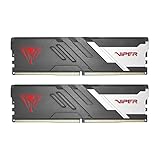
- Top Pick: Silicon Power Value Gaming DDR5 32GB (2x16GB) 6000MT/s (PC5-48000) 288-pin CL30 1.35V UDIMM Desktop RAM Computer Memory SP032GXLWU60AFDJ
- Best Value: CORSAIR Vengeance DDR5 64GB (2x32GB) DDR5 6000MHz CL30 AMD EXPO Intel XMP iCUE Compatible Computer Memory – Gray (CMK64GX5M2B6000Z30)
- Premium Choice: Silicon Power Value Gaming DDR5 64GB (2x32GB) 6000MT/s (PC5-48000) 288-pin CL30 1.35V UDIMM Desktop RAM Computer Memory w/Heatsink SU064GXLWU60AFDJAB
Memory speed has become one of the most debated specs in PC building, and the gap between DDR5 6000 and DDR5 6400 sits at the center of that debate. The two kits are often separated by only a few dollars, yet buyers routinely wonder whether the extra 400 MT/s translates into tangible frame rates. This guide breaks down what actually changes between these two speeds, when the difference is visible, and when it is effectively noise on a benchmark graph.
The Short Answer
DDR5 6400 delivers roughly 1 to 4 percent higher average frame rates than DDR5 6000 in CPU-bound gaming scenarios at 1080p, based on aggregated results from outlets such as Hardware Unboxed and TechSpot. At 1440p and 4K, the gap shrinks to less than 1 percent or disappears entirely because the GPU becomes the limiting factor. For the vast majority of gamers, DDR5 6000 remains the optimal price-to-performance choice, while DDR5 6400 makes sense mainly for users who want to squeeze every last frame out of a high-refresh-rate competitive setup or who already own a 6400-rated kit.
As an Amazon Associate we earn from qualifying purchases at no extra cost to you.


Check Price on Amazon →

What Is Actually Different
The distinction between these two kits comes down to a handful of measurable factors. Below is a summary of how they compare across the specs that matter most.
| Factor | DDR5 6000 | DDR5 6400 | Practical Significance |
|---|---|---|---|
| Clock speed (MT/s) | 6000 | 6400 | 6.7% higher theoretical bandwidth |
| Theoretical bandwidth per channel | 48.0 GB/s | 51.2 GB/s | Marginal gain, rarely saturated in games |
| Typical CAS latency | CL30 to CL36 | CL32 to CL38 | Higher speed often means looser timings |
| Average gaming price premium | Baseline | $5 to $20 more per kit | Diminishing returns increase with cost |
| Overclocking headroom | Good (can often reach 6400+) | Reduced (closer to silicon limit) | 6000 kits offer more tuning flexibility |
| AM5 platform stability | Excellent (sweet spot) | Generally good, occasional boot issues | 6000 is the validated AM5 reference speed |
| Intel 14th/15th gen compatibility | Rock solid | Rock solid | No meaningful difference on Intel |
| Power consumption (idle/load delta) | Baseline | ~1 to 3W higher | Negligible thermal impact |
Real-World Impact
Numbers from published memory-scaling articles paint a consistent picture: the faster kit helps, but barely, and only under specific conditions.
1080p Gaming
At 1080p, a powerful GPU paired with a current-gen CPU pushes the system into memory-sensitive territory. Tom’s Hardware observed in their memory scaling coverage that DDR5 6400 outpaced DDR5 6000 by approximately 1 to 3 percent in average frame rates across a mixed selection of titles, with competitive shooters like Counter-Strike and Valorant showing the largest spread at around 3 to 5 percent. Hardware Unboxed similarly reported 1 to 4 percent gains in CPU-bound scenarios. The difference is measurable but subtle enough that most players will not perceive it during normal gameplay.
1440p Gaming
At 1440p, the GPU workload increases substantially, and the memory speed gap compresses further. Gamers Nexus noted in their hardware testing that frame-time improvements from 6400 over 6000 fall below 1 percent at 1440p in the majority of AAA titles. In a few esports scenarios with extremely high frame rates exceeding 300 FPS, a marginal 1 to 2 percent difference persists. For practical purposes, you cannot feel it on a 165Hz monitor, and even on a 240Hz display the delta is within the noise floor of a single frame.
4K Gaming
At 4K, the GPU is the bottleneck in virtually every scenario. TechPowerUp and TechSpot both concluded in their respective memory analysis pieces that DDR5 6000 and DDR5 6400 produce statistically indistinguishable results at 4K. The difference, when present at all, lands in the range of 0 to 1 percent and fluctuates with thermal conditions and background processes. Spending extra on a 6400 kit for 4K gaming has no measurable benefit.
When It Matters and When It Doesn’t
The 6400 speed earns its premium in a narrow set of circumstances:
It matters when: you are building a competitive 1080p rig targeting 360 to 500+ FPS, you are pairing a top-tier GPU with a non-K Ryzen 9000 chip where the Infinity Fabric clock benefits from the extra 200 MT/s, you want bragging rights on synthetic benchmarks, or you are buying a 6400 kit at the same price as a 6000 kit on sale.
It does not matter when: you are gaming at 1440p or 4K with any current GPU, you are building a budget or mid-range system, you are using AM5 with a Ryzen 7 or below where the 6000 sweet spot is well validated, or the price gap exceeds $15 and you would rather invest that difference into a better GPU or more storage.
Recommendation by User Type
Competitive esports player (1080p, 360Hz+): DDR5 6400 with tight timings (CL32 or lower) is justified. The 2 to 5 percent edge in frame-time consistency can shave a few milliseconds off your input-to-display pipeline in games where reaction time is everything.
Mainstream gamer (1080p or 1440p, 144 to 240Hz): DDR5 6000 with CL30 or CL32 timings is the rational choice. The difference against 6400 is invisible in practice, and the savings can go toward a one-tier GPU upgrade that yields far more FPS.
4K enthusiast: DDR5 6000. Memory speed is irrelevant when the GPU is the bottleneck. Spend the money elsewhere.
Content creator or workstation user: Consider DDR5 6400 if your workloads include video encoding, 3D rendering, or large dataset processing where memory bandwidth is more frequently saturated than in games. The benefit here is modest but slightly more consistent than in gaming.
AM5 builder in 2026 looking for platform longevity: DDR5 6000 remains the validated reference speed on Ryzen 9000 series. It boots reliably on every AM5 motherboard tested by major outlets, leaving zero compatibility headaches.
FAQ
Is DDR5 6400 worth it over 6000 for gaming?
Generally no. The 1 to 4 percent gain is not perceptible for most gamers. It is only worth the premium if you are chasing maximum frames in competitive 1080p titles or if the kits are priced identically.
Can DDR5 6000 run at 6400 with XMP or EXPO?
Often yes, depending on the silicon. Many DDR5 6000 kits can be manually overclocked to 6400 or higher with a small voltage bump. However, stability is not guaranteed, and the resulting performance gain would be identical to buying a native 6400 kit, meaning you are gambling for free performance rather than paying for it.
Does tighter CAS latency matter more than raw speed?
In gaming, yes, frequently. A DDR5 6000 kit rated at CL30 often matches or beats a DDR5 6400 kit at CL38 in latency-sensitive titles. If you are choosing between two kits at the same price, prioritize the one with tighter timings over the one with a higher clock rate.
Will DDR5 6400 become the new standard on AM5?
Rumors circulated during the Ryzen 9000 launch window suggested AMD might officially recommend 6400 as the new sweet spot, but as of current platform documentation, 6000 remains the validated target. Whether that shifts with future BIOS updates is uncertain, but the practical impact on gaming would remain negligible regardless.
Sources and Methodology
The performance ranges and conclusions in this article are synthesized from publicly available benchmark data published by the following outlets: TechPowerUp, Tom’s Hardware, Gamers Nexus, Hardware Unboxed, and TechSpot. These outlets have each conducted dedicated DDR5 memory scaling analyses using platforms such as Ryzen 9000 series with integrated memory controllers and Intel Core 14th/15th generation systems. No benchmarks were conducted by this site. Figures cited represent the approximate range of results observed across multiple titles and test conditions as reported by these independent publications.